Blogs

Add the best talent on the market, an agile skilled management & seamless involvement.

Blog Main Image
ad906268-cada-11f0-b28a-0242ac120004
eCommerce

A Detailed Guide to Fashion App Development

branex-logo Team Branex
The average customer isn’t standing in a boutique picking their favorite clothes anymore.  They are continuously scrolling in bed, swiping at lunch and making purchases while having a sandwich on the subway. If your fashion brand doesn’t live on their phone, you’re already losing their attention.  Your smartphone isn’t just a mode of communication.  It has become another sales channel. Do you know more than 57% of global e-commerce sales now happen on mobile devices? In fashion specifically, this number has risen to 68%.  Your website alone won’t be enough. In a world where 90% of the people love to use apps, you need a fully personalized fashion app which isn’t just a nice-to-have but your runway to revenue.  Are you a fashion brand owner looking to create a digital impact?  In this blog, we will share how you can begin your fashion app development journey. (and NAIL IT!)  So without further ado, let’s begin. 

Fashion eCommerce Market Analysis 

According to Sellers Commerce, the 2025 estimate of mobile commerce shows that fashion is the dominant channel taking up to 59% of the global e-commerce sales going mobile.  Analysts further predict 2026 will mark the era of "Intelligent Commerce." The growth is no longer about getting people to shop on phones, but keeping them there with better experiences. This shift will take apps from “rapid adoption” into a phase of "intelligent maturity." Here is the 2026 comparison forecast. 
Metric 2025 Estimate (The Tipping Point) 2026 Forecast (The Intelligent Shift)
1. Global Mobile Share 59% of total e-commerce ~62% of total e-commerce
2. Global Revenue ~$2.51 Trillion ~$2.74 Trillion
3. Mobile Cart Abandonment ~85% (High friction) ~75% (Improved via AI/One-tap)
4. Fashion Return Rate ~30% (Due to poor sizing) ~20% (Reduced via AR/Virtual Try-On)
5. Social Commerce Rev. ~$1.2 Trillion ~$2.0 Trillion (Driven by TikTok/Reels)
6. Avg. Order Value (AOV) Lower on mobile than desktop Parity reached (Mobile AOV matches Desktop)
7. Digital Wallet Usage ~40% of mobile transactions >50% (Becomes the default standard)
8. Conversion Rate ~2.5% on mobile ~3.5% (Boosted by "Agentic" curation)
Yet, only a tiny fraction of e-commerce stores have their own apps leading to a major caveat.  Only 1% of the e-commerce web presence have their own stores with higher-revenue flowing to brands (like Adidas, Nike and others). This shows there’s a major gap & opportunity potential.  Brands who capitalize on apps see much higher revenue per user (up to 7x) and materially better conversion/retention compared to mobile web or website experiences. 

Why Adoption Rates of Shopping Fashion Apps Higher? 

Fashion apps load faster, keep users logged in, offer surface personalization and one-tap checkout.  Furthermore, these mobile apps offer other options such as push notifications, in-app messaging and exclusive drops drive repeat visits which altogether offers faster re-engagement.  Mobile apps tend to capture richer & persistent user signals (such as behavior insights, favorites, purchases) fueling better recommendations and much better merchandising.  There are several case studies available across the Internet showing the success rate of mobile apps, including brands like Lyst, The Yes, and other large retailers claiming its lifetime value. 

What Brands Actually Found After Adopting a Mobile App? 

Higher conversion and larger AOV: Brands with mobile apps saw a higher conversion rate and average order values because of easy checkout process and better product discovery. 

Stronger repeat purchase & LTV: Brands with mobile apps leveraged push notification, personalization & VIP perks to increase repeat purchase frequency & customer lifetime value.  Narrow user base but high value: Brands with mobile apps saw frequent buyers (drops, staples & subscriptions) showing more personalized buyers turning into loyal customers.  Tech + creative investment is nontrivial: Brands who invested in UX, data infrastructure and a proven marketing plan saw a gradual increase in customers compared to half-baked apps.  Why Should You Build Your Fashion App?  Building your fashion app isn’t just an additional investment or a tech upgrade!  You’re making a strategic move, opening better outlets and future-proofing your business.  Here are a few reasons why you should invest in a fashion app for your brand.  Increase Sales Your mobile app can have features like “wishlist,” “back-in-stock alerts,” and “buy now, pay later” options which reduce friction and encourage users to buy on the spot without haggling.  Then there’s abandoned carts campaigns which you can run to re-initiate customer lifecycle. These features lead to more spontaneous buying increasing your chance of selling.  Direct Customer Access  Websites often depend on browser searches. An app doesn’t. It opens a direct line with customers.  You can reach your customers through push-notifications in the form of product drops, discounts and reminders. Moreover, in-app personalization lets customers see products as per their taste & behavior.  Brand Loyalty & Customer Retention  Mobile apps lead to acquiring one-time purchases and turning them into lifelong customers. You can offer customers exclusive deals, early access to new collections and personalized loyalty programs which ultimately led to repeated purchases. You can further optimize in-app experiences such as personalized style feeds, membership perks, virtual try-ons and so on to establish emotional connections.  All these efforts lead to building more promising emotional connections giving users reason to return. Over time, this engagement strengthens trust & loyalty turning you into a valuable customer.  Better Insights & Analytics  With insights and analytics, you can gain a better understanding of what time your customers shop the most. Ultimately, it helps you drive promotion and get the highest overall conversions. When you are armed with data, you can make smarter decisions on planning inventory, pricing strategies & running marketing campaigns which leads to better operations and higher return-on-investments.  You Earn Competitive Advantage  Although many fashion brands depend on websites or social media for increasing sales, they still run a dedicated mobile app as a standalone entity from websites and traditional brick-and-mortar stores.  Because mobile apps offer better control over branding and user experience which is hard to achieve on third-party platforms. This small difference is what sets your brand apart in the competitive industry.  Essential Steps to Develop a Fashion App for Your Brand If you have reached here, there’s a significant chance you’ve already decided to go down the pathway of building your next-gen fashion mobile app.   Here’s a step-by-step process to develop a fashion app for your brand.  Plan  Your first step is to come up with a plan for your fashion app.  Think about what your end-users expect from your brand or fashion app… Do you want to sell clothes, jewelleries, ornaments, accessories or something that shows the latest trend…  Find what your audience desires the most and build your fashion app features around it. 

Research

Research is equally important.  Once you have found the feature set, your next step is to find ways to make your app better.  Check out your competitors and see what feature sets they are marketing to their end-users. See what’s trending in fashion and technology and gather plenty of ideas for your app’s desired features. 

Find an App Company

App development is not a freelancer's job.  Or you can’t simply hire a mobile app developer and expect them to give you a full-fledged mobile app experience. What you need is a dedicated mobile app development company such as Branex.  At Branex, our mobile app development company is well versed in turning ideas into working apps that are bound to get picked as a high-quality and user-friendly fashion app experience on App stores.  Find a company that resonates with your idea clearly. 

Design 

Your next phase is design which is a big part of the fashion app.  You want your app to appear good and become easy to use. To make it accordingly, you can work with an app development company to create a beautiful and simple app design.  Choose your favorite colors, font style and layouts. Make sure your app delivers the right user experience. After all, you do want your fashion app to be attractive and appealing. 

Develop

Sit with the coders from your app development company and brainstorm.  The real magic happens with the development team who write the code of your approved app designThey will make your mockups and wireframes come to life. You can share and discuss feature sets with them and see which of them will work perfectly. This step requires a bit of your time & patience. 

Testing

If you have had your app coded the right way, you may want to check for performance before sending it live. Most mobile app development services providers perform functional and performance testing before sending the finished product live. You can ask friends, family members, and stakeholders within your company to test the app & provide the necessary feedback. Another way is to launch your mobile app in beta phase as part of your fashion app development strategy and see if there are any bugs existing. Make sure the app is perfectly optimized before you send it live.

Deployment & Promotion

All set, now it’s time to launch your fashion app.  Put your app on a preferred app store such as Apple Store or Google Play Store.  Talk about your app online, share it in forums and discussions. Market it through running ad campaigns, or simply get it listed in conversations in Reddit & Quora.  This way, you will send more powerful social signals to Google and other search engines.  Activate email marketing campaigns and push social posts through social channels. Use every possible marketing tool at your expense to give your mobile app the maximum exposure.  Promotion is key to successful marketing. It’s 80% of the job, which is quite essential to take care of. 

The Essential Features of Successful Fashion Shopping App

If you want to make your fashion e-commerce app stand out…  You need a feature set that engages users and boosts conversions.  A fashion mobile app must have the following features: 
User App Admin Panel Seller Panel
Easy Onboarding & Social Login Dashboard Overview Store Profile Setup
Advanced Search & Filters User & Seller Management Product Upload & Management
High-Quality Product Media Product & Catalog Management Inventory Tracking
Wishlist & Favorites Inventory Management Order Management
Multiple Payment Options Order & Delivery Management Earnings Dashboard
Order Tracking Marketing & Promotions Order & Delivery Management
Ratings & Reviews Analytics & Reporting Customer Feedback Access
Chat with Admin Content Management (CMS) Ratings & Reviews
Push Notifications Payment Gateway & API Integration Marketing & Promotions
Loyalty Programs & Rewards Multi-language & Currency Support Product Visibility Control

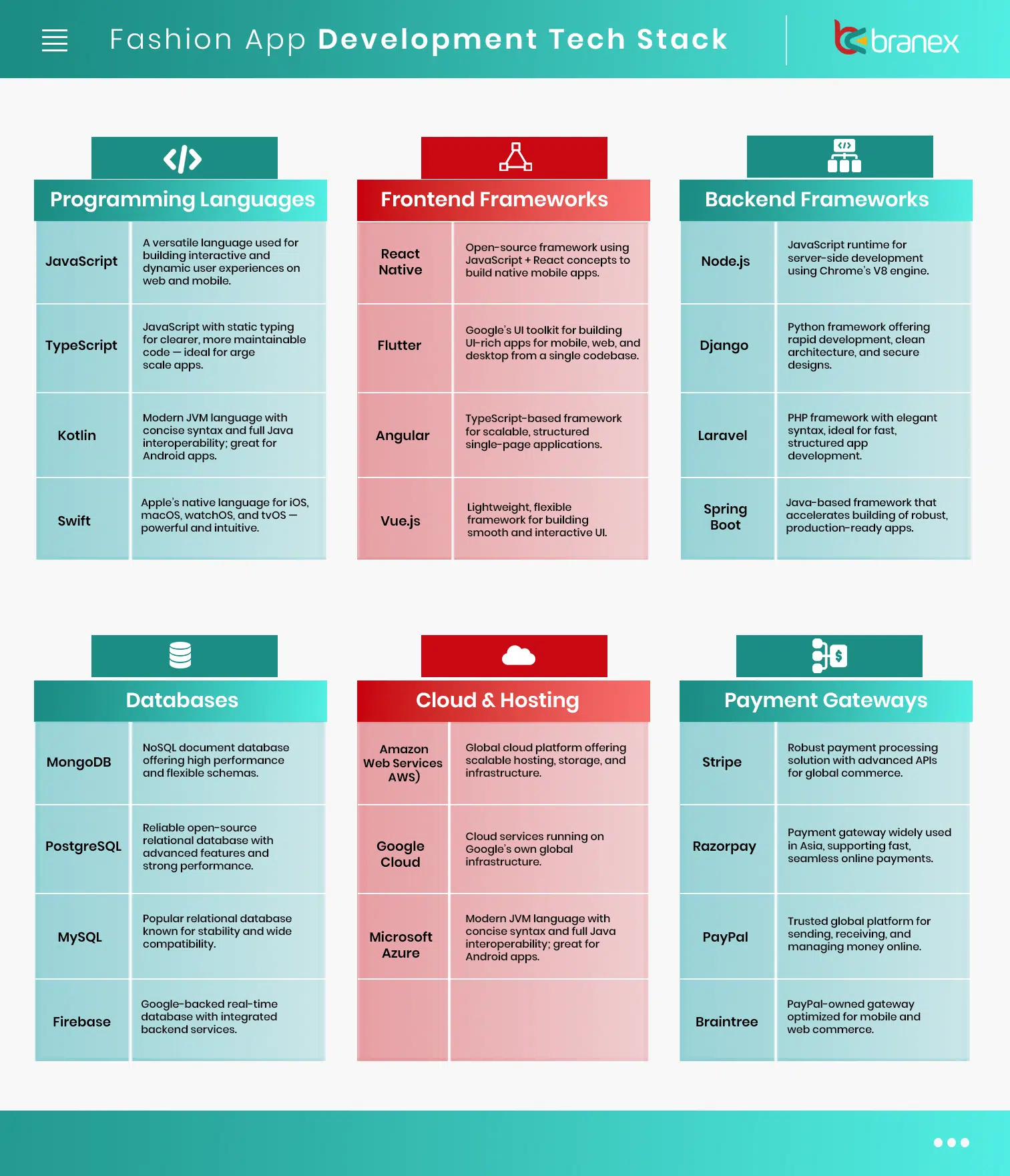
Desired Technology Stack 

To ensure your fashion eCommerce application becomes successful, you need the right combination of programming language, framework and relevant supporting technologies. 

Here’s the complete tech stack with multiple options for you to choose from: Based on your preference, you can set the tech stack as per choice.  How to Build a Shopping App for Your Fashion Brand?  To build your fashion shopping app, you need to take a well-planned approach.  It will keep your customers well engaged and provide a reasonable shopping experience.  Here’s a complete step-by-step guide on how to get started with your fashion shopping app today:  Define App Goal & Target Audience  Before you initiate the project, it’s highly important that you’re well aware of who your target audience is.  Ask yourself: 
  • Is your target market fashion enthusiasts looking for globally recognized brands? 
  • Or are you focusing on giving your end-customers a budget-friendly & fast-fashion shopping experience? 
Deciding who your target market will be will give you a better insight on UI design and feature priorities. You can also consider factors such as age, gender, location, shopping habit & device preferences.  It will also help you understand their spending behavior. When you define your audience early, it ties directly into your fashion brand and gives you a more profound positioning strategy.  It will harness you to set your brand identity much more clearly.  Plan Your App’s Core Features  Although we have discussed the feature set above, here’s a few essential features which we believe every fashion app must include in order to deliver a personalized shopping experience to end-users.  These key features are as follows: 
  • Product Catalog: Categories, filters, and sorting options to make browsing effortless.
  • Search Functionality: Smart search with auto-suggestions and voice search capabilities.
  • Wishlist & Favorites: Allow users to save items for later, encouraging repeat visits.
  • Shopping Cart & Checkout: Streamlined process with minimal steps to reduce cart abandonment.
  • Secure Payments: Multiple options like credit/debit cards, wallets, UPI, or cash-on-delivery.
  • Push Notifications: Personalized offers, sales alerts, and reminders to increase engagement.
  • User Accounts & Profiles: Track order history, manage addresses, and customize preferences.
When you prioritize the desired feature set for your app early on, you are more clear at envisioning what your app is going to appear to your end users.   Designing the App’s User Interface  Fashion is more of a bold statement. It highly depends on visual and aspirational identity.  So when you’re designing the app, you need to make sure it reflects your brand’s identity. Start by checking whether your app’s user interface is appealing for your end customers or not. 
  • Check for aesthetic appeal, and see if they reflect in the high-quality images and brand colors.
  • Users love app experiences which offer easy navigation which means they can checkout in a few taps. 
  • You can optimize your app to work on screen sizes and various orientations for responsiveness.
  • Check for interactive elements for smoother animations, swipe gestures & quick preview for engagement. 
Selecting the Best Technology Stack  Choosing the right tech stack can make or break your app’s performance. The desired tech stack will define the app’s scalability and maintainability.  For fashion shopping apps, you will have to consider: 
  • Frontend Framework - React Native or Flutter for cross-platform development
  • Backend Framework - Node.js , Django or Laravel. 
  • Database - MongoDB or PostgreSQL/MySQL for structured data management. 
  • Cloud Hosting - AWS, Google Cloud, or Azure for better reliability. 
Develop & Test the App for Performance  You can start with a Minimum Viable Product (MVP), a functional version of your app with its core features. It will give you plenty of options to: 
  • Test your app’s usability and find out pain points. 
  • Collect feedback from early users to refine features. 
  • Reduce development time & manage cost by iterating in phases. 
To choose the development path for your fashion app depends on what you’re most savvy with. You can choose for a customizable solution, and for that, you may require investing in custom development.  If you want to launch something quickly and you’re limited on budget, you can go for a ready-made solution (on-demand mobile application) which will relatively become a smarter choice. When it comes to custom mobile app development, you will have more room to design an app that fits your preferred style. You can add better features, customize every aspect that’s appealing.  How can Branex help you? It can offer you a winning app that is based on: 
  • Fashion focus design & themes. 
  • Flexible payment gateway integrations 
  • Customer retention tools & services 
  • Quick third-party integrations 
  • Cross platform mobile responsiveness
  • Powerful admin & vendor panels 
  • Scalable architecture 
Secure Payment Gateway Integration  The payment gateway you integrate will work as the solid backbone of your eCommerce store.  When you design your fashion app, make sure you integrate a payment gateway that supports: 
  • Multiple Payment Options - Cards, UPI, wallets, PayPal or other local gateways. 
  • Security & Compliance - PCI DSS compliance, SSL encryption and secure tokenization. 
Launch & Promote Your Ecommerce App  The perfect launch doesn’t stop when you’re done with uploading your app to the App Store or Google Play. You need to go the extra mile to create: 
  • The necessary buzz by sharing teasers on social media, through email lists and fashion blogs. 
  • By running app store optimization (ASO) to optimize title, description, keywords and visual for visibility. 
  • Through influencer partnerships to collaborate with fashion influencers to reach your target audience.
  • To encourage first-time downloads and make purchases with limited-time offers. 
How Much Does it Cost to Develop a Fashion App?  Developing a fashion eCommerce app is more than just an investment.  So before you review the cost structure, you need to understand that your budget for making the app is based on parameters like the depth of features, design expectations and operational needs.  Each component of the app contributes to the overall investment. Understanding where the major cost drivers sit helps you plan more accurately and avoid unexpected overhead.  
Cost Factor What It Includes Typical Cost Range Why It Varies
App Features & Complexity Product catalog, wishlist, search, cart, checkout, user accounts $8,000 – $25,000 (basic) Simpler modules = less backend work; advanced features = more engineering hours
AR try-ons, AI outfit recommendations, virtual wardrobe, live shopping $25,000 – $80,000+ (advanced) AR/AI engines, 3D modeling, ML training, video infra all raise complexity
Platform Choice iOS or Android $12,000 – $30,000 (single platform) Single codebase reduces effort
iOS + Android (native) $20,000 – $60,000+ Double development & double QA cycles
Design & User Experience Wireframes, UI screens, animations, micro-interactions, branding $5,000 – $20,000 Premium visuals & interactive flows take more designer hours
Development Team Type Freelancers / small offshore teams $10,000 – $35,000 Cost-effective but slower delivery & less specialization
Mid-size agency / expert product studio $35,000 – $120,000+ Higher skill, mature processes, better UX engineering
Third-Party Integrations Payments (Stripe, PayPal), analytics (GA, Mixpanel), AR SDKs, social login $3,000 – $25,000 Some APIs are plug-and-play; others require custom workflows
Backend & Infrastructure Admin panel, product management, inventory, order handling, CMS $10,000 – $50,000 Complexity depends on number of roles, automation, multi-warehouse setups
Maintenance & Updates Bug fixes, OS updates, new features, server scaling $1,500 – $8,000/month Depends on user base size, number of new features, security needs
Technology Stack Choice React Native / Flutter / Native Swift-Kotlin Included in dev cost Modern stacks reduce development time; native stacks cost more
The following breakdown offers a realistic starting point for estimating your fashion app’s budget.  Depending on what you want to achieve, the final investment can range from a minimal viable product to a fully featured app delivering the best fashion app experience to your end-customers. 
App Type What It Includes Estimated Cost
Basic Fashion App (MVP) Catalog, filters, cart, checkout, login, push notifications $25,000 – $45,000
Standard Fashion eCommerce App + advanced search, wishlist, tracking, loyalty, custom UI $45,000 – $90,000
High-End Fashion App + AR try-on, AI styling, editorial content, video shopping $90,000 – $180,000+
The best investment level depends on how differentiated and interactive you want your customer journey. The Future Trends in Fashion App  With the changing dynamic of the fashion industry, the fashion eCommerce landscape is transforming rapidly. And if you want to stay ahead, you need to embrace emerging technologies.  AI Powered Personalization - Because artificial intelligence is changing how shoppers shop stuff online, it analyzes customer behavior, preferences and purchase history to provide them with personalized product recommendations, predictive trends and optimized inventory management. It helps people better decide  Augmented & Virtual Reality - AR technology lets shoppers have virtual try-ons of clothing & accessories of their choice. This lets them bridge the gap between online browsing and in-store app experiences. Many fashion brands are incorporating AR features today to better visualize products before purchasing them. Social Commerce Integration - Social media has become the center stage for mapping the perfect shopping journey for customers. Fashion brands are using platforms such as Instagram and TikTok to showcase products, collaborate with influencers and allow users to purchase directly from social feeds. It gives end users a seamless shopping experience.  Sustainable & Ethical Fashion - Day after day, consumers are looking for sustainable and ethical practices. Whether it’s a fashion app they are engaging with or promoting an eco-friendly product, they are technically highlighting supply chains and offering better resale opportunities. Blockchain for Transparency - Brands are now using blockchain to bring full transparency to the fashion supply chain. Every step of a product’s journey gets logged on a secure, decentralized ledger, giving customers verified proof of where it came from and how it was made. Hyper-Personalized Marketing - With advanced analytics, fashion apps can now push marketing that feels tailor-made. From custom emails to targeted ads and unique promo drops, brands can reach users with content that actually matches their interests — boosting engagement and conversions. AI-Driven Inventory Management - AI is taking the guesswork out of stock management. By forecasting demand, automating replenishment, and balancing inventory levels, brands can avoid overstocking, prevent sell-outs, and keep operations running smoother than ever. Conclusion  Fashion isn’t just shifting, it’s being rebuilt from the ground up, one swipe, one tap, one personalized recommendation at a time.  Consumers no longer wait for trends to walk the runway… they expect trends to meet them where they already are: on their phones.  And the brands that understand this shift early are the ones rewriting the rules of retail. Building a fashion app isn’t about following the hype or adding another digital asset to your stack. It’s about owning your customer relationship, crafting an experience that reflects your brand’s identity, and creating a shopping journey that feels intuitive, curated, and instantly accessible. At Branex, our mobile app development company in USA can provide you with a similar experience. The runway is digital, and it's wide open. Let us help your brand take the front row.

FAQs

1. Why do fashion brands need a mobile app?

Fashion brands need mobile apps because most shoppers now browse and buy directly through smartphones. Apps offer personalization, faster checkout, push notifications, and better engagement than mobile websites.

2. How is mobile commerce changing the fashion eCommerce industry?

Mobile commerce now drives over half of global online sales, with fashion leading the chart. Consumers prefer browsing, comparing, and purchasing on mobile because it's quick and convenient.

3. What are the key benefits of having a fashion shopping app?

Better conversions, higher repeat purchases, stronger customer loyalty, direct communication through push notifications, detailed analytics, and a competitive advantage.

4. Do fashion apps convert better than websites?

Yes. Fashion apps typically deliver up to 7x higher conversion rates due to fast loading, one-tap checkout, saved preferences, and richer personalization.

5. What features should a fashion mobile app include?

Smart search, filters, high-quality product media, wishlist, multiple payments, order tracking, push notifications, loyalty programs, AR try-on, and user profiles.

6. What is the first step in building a fashion shopping app?

Define your app goals and target audience. Understanding user preferences, shopping patterns, and expectations sets the foundation for design and development.

7. How do I choose the right app development company?

Pick a company with proven mobile app experience, strong UI/UX skills, eCommerce expertise, and the ability to scale your app as your brand grows.

8. What is the best tech stack for a fashion app?

Frontend: React Native or Flutter
Backend: Node.js, Laravel, or Django
Database: MongoDB, MySQL, or PostgreSQL
Cloud: AWS, Azure, Google Cloud

9. Should I build a native app or cross-platform app?

Cross-platform (like Flutter/React Native) is ideal for most brands due to faster development, lower cost, and single-codebase maintenance.

Best WooCommerce Plugins For Your Store
Digital Marketing eCommerce

15 Best WooCommerce Plugins For Your Store

branex-logo Team Branex
If you’re planning to start an eCommerce business, WooCommerce is the perfect platform to get started. WooCommerce offers a range of features that ensure your store runs smoothly. Whether you're selling physical products, digital goods, or both, WooCommerce has you covered. Beyond product sales, it also serves as a content management system, enabling you to add blogs, product descriptions, landing pages, manage user reviews, and even launch email marketing campaigns—all within one platform. When was the last time you thought about customizing your eCommerce store? For those wondering how to create an eCommerce website, WooCommerce provides a seamless setup, and its versatility shines through its vast plugin ecosystem. WordPress for WooCommerce is incredibly versatile, and its diversity stems from the wide range of plugins available. Each plugin serves a unique purpose, whether it’s for dropshipping, product management, marketing, communication, or media/database optimization. With thousands of plugins available in the WooCommerce marketplace, store owners can easily feel overwhelmed by the options. But worry not—we’re here to cut through the noise. Today, we’ll guide you through selecting the best and most essential WooCommerce plugins for your store. So, without further ado, let’s dive in and explore everything you need to know.

We have categorized WooCommerce plugins according to their purpose. 

Let’s dive in and explore what you need to know!

1. WooCommerce Google Analytics Integration

WooCommerce Google Analytics The best way to increase your WooCommerce sales is by understanding user behavior. With WooCommerce Google Analytics Integration, store owners can easily learn about the best channels driving maximum traffic, including sources like search, social media, email, and ads. This way, you'll know where to focus your time and resources. Google Analytics is crucial for identifying areas where your website might be losing money, from product pages to carts, and checkouts.  It also helps pinpoint the products that attract genuine interest, aiding in comparison and revealing when customers are actively shopping versus casually browsing. The WooCommerce Google Analytics Integration is free to use, making it an accessible tool for all store owners.

2. ShopBuilder - Elementor WooCommerce Builder Addon

ShopBuilder - WooCommerce Builder ShopBuilder is an add-on for Elementor that simplifies designing the perfect online store. It comes fully equipped with over 100 flexible widgets to add products to your pages. ShopBuilder eliminates the burden of building a functional store from scratch, offering more than 40 templates and plenty of customization options for a smooth eCommerce experience. With 12+ specialized modules, including Wishlist, Compare, Quick View, Quick Checkout, Sales Notification, Variation Swatches, and Variation Gallery, you can easily choose what works best for your store. Additional features, such as product filters and enhanced pagination, make this WooCommerce plugin a favorite among digital users for its versatility and ease of use.

3. Customizer for WooCommerce

Customizer for WooCommerce WordPress for WooCommerce offers a variety of filters that allow you to customize multiple aspects of your store. You can change button text, add labels, and even write PHP code if necessary. This plugin comes with vital settings that allow store owners to deeply personalize their stores without the hassle of coding or modifying templates. It saves time by letting you customize features such as the “Add to Cart” button text for various product types, sales badge text for product pages, and options like checkout coupons or account creation checkboxes. However, note that this plugin doesn’t support WordPress multisite. This WooCommerce plugin is free to use, making it ideal for store owners who want to enhance their online shops without additional costs.

4. Booster for WooCommerce

Booster for WooCommerce If you're looking to avoid multiple plugins and want an all-in-one solution, Booster for WooCommerce is your go-to option. This powerful plugin packs 110+ features and is constantly updated with more. It’s perfect for non-tech-savvy individuals with zero coding experience who need a simple, setup-friendly tool.  Booster lets you easily add multi-currency pricing, generate PDF invoices, customize carts and checkout pages, and much more. You can choose between the free version or the paid one starting at $8.99/month if you're looking for more advanced features within a single website.

5. Checkout Manager for WooCommerce

Checkout Manager for WooCommerce If you want to customize the checkout process for your customers, Checkout Manager for WooCommerce is a great plugin to customize and edit the checkout page accordingly. The plugin brings more than 20 custom fields to play around with inside the billing or shipping checkout forms.  Optimizing the checkout process is incredibly important because if the checkout page is a mess, it will ruin the entire shopping experience. It eventually leads to a higher cart abandonment rate.  Not only does the Checkout Manager plugin for WooCommerce allow you to avoid these problems, but it also allows you to customize the entire checkout process.  You can add a message of your choice before the checkout to make it more personal. 

6. WP Mail SMTP

WP Mail SMTP The WP Mail SMTP is an email service API which helps your website email to land in your customer’s inbox without going into the spam folder. What’s really good about WP Mail SMTP is how you can integrate the following PHP mailer plugin with your favorite email platforms such as SendinBlue, Constant Contact, Sendlayer, MailChimp, GetResponse, Hubspot, ActiveCampaign and more.  If you’re running an online store, you might want to send and receive emails and also get notified when it happens. Basically, it uses the PHP mail () function where hosting providers are often responsible for setting it up. As a result, they often fail to use the function correctly which leads to email demise. With WP Mail SMTP, you don’t have to write even a single line of code.  WP Mail SMTP was built with email deliverability in mind. It allows businesses to send all sorts of emails like transactional emails, confirmation emails, shipping notifications & more.  To gain access, the pricing for WP Mail SMTP starts at a reasonable price of $49/month. 

7. WPForm 

wpforms With more than 5 million websites, WPForms is a contact form plugin that enables businesses to create & acquire valuable leads. So whenever a visitor comes to your website, WPForms opens appropriate communication lines, answers customer questions, and resolves their burdening issues.  WPForms doesn’t only offer a mode of communication, but if you purchase the Pro version of WPForms, it lets you accept Stripe, Square, and PayPal payments on every order form you fill out.  With WPForm, you can create almost any kind of form for your WooCommerce store. The different types of examples included are contact forms, online surveys, and order forms.  All it takes is just a few clicks, and you will create a form that converts. 

8. OptinMonster

optinmonster OptinMonster is the ultimate lead generation tool designed to help you grow your email list, increase conversions, and reduce cart abandonment. With its easy-to-use drag-and-drop builder, you can create stunning opt-in forms and pop-ups that capture your visitors' attention at the right moment.  Whether you're looking to offer a discount, promote a new product, or simply engage visitors before they leave your site, OptinMonster allows you to do it all without needing any coding skills. You can easily integrate OptinMonster with popular email marketing platforms like MailChimp, Constant Contact, and AWeber. With advanced targeting features, you can display the right message to the right people based on their behavior, device, or location, creating a personalized experience.  OptinMonster starts at $9/month and is billed on an annual basis.  If you want to learn more about which eCommerce platform is the best, here’s an article which we have covered on WooCommerce vs BigCommerce Read More: 

9. PushEngage

pushengage With PushEngage, you can easily reconnect with your WooCommerce customers, especially once they have left your website.  Imagine sending personalized push notifications to inform shoppers about new product launches, sales, or cart reminders—right to their devices.  PushEngage is a plugin that allows easy segmentation of the audience based on their individual behaviors. Let’s assume that your audience belongs to a certain demographic or they have a certain hobby, PushEngage ensures your messages are targeted and reach the relevant audience. When using this particular tool, you not only increase engagement but also decrease cart abandonment. Starting at just$9 per month, PushEngage is a smart investment for businesses who want to stay connected with all their customers, especially once they leave the store. 

10. RafflePress

rafflepress Looking to grow your WooCommerce store’s audience? RafflePress can offer you the best help.  The plugin’s specialty lies in creating viral giveaways and hosting contests. You can design them in any way of your choice to attract as many customers as you want to your website.  RafflePress brings a powerful drag-and-drop builder which enables WooCommerce shops to create visually appealing giveaways, one that encourages users so they can share them on social media.  The best thing about Rafflepress is how you can integrate actions such as 'follow us on Instagram' or 'share this on Facebook,' RafflePress which can contribute to the overall brand awareness.  Whether you're looking to grow your email list or increase site traffic, the plugin delivers results. Plus, with pricing starting at $39.50 per year, it’s an affordable solution to supercharge your marketing efforts.

11. Uncanny Automator

Uncanny Automator We all want to create a store experience that’s smooth and uncanny, and this is what the Uncanny Automator can achieve. With Uncanny Automator, you can automate repetitive tasks and streamline workflows. In fact, you can connect with hundreds of plugins and apps, to perform multiple store management actions. You can update inventory, send out order updates, or offer discounts to trusted customers and the best part is that you don’t even have to write a single line of code.  Whether it’s managing email campaigns or triggering a specified action after a purchase is performance, Uncanny Automater can take care of everything. Pricing starts at $149 per year, which is perfect for businesses ready to level up their efficiency and focus on growth rather than manual tasks.

12. Smash Balloon

Smash Balloon Smash Balloon is a robust social media content management tool that allows easy integration into your WooCommerce store. With customizable feeds for Instagram, Facebook, Twitter, and YouTube, you can display real-time social proof right on your website. This plugin is perfect for showcasing user-generated content, product photos, or customer reviews, that boosts trust and creates more engagement.  Setting up Smash Balloon is quick and requires no coding. It allows you to engineer posts that easily mimic the brand's appearance. Pricing starts at $49 per year, and that’s what makes it affordable.  If you want to integrate dynamic social content into your website, Smash Balloon is the answer. 

13. SearchWP 

SearchWP SearchWP offers built-in search functionality by delivers accurate and faster results.  Instead of relying on the standard search engine, this plugin indexes every bit of content from product descriptions to reviews, giving customers exactly what they're looking for in no time.  So what happens? You get improved user experience, reduced bounce rates, and higher conversion rates. Customizable and flexible, SearchWP ensures customers find products based on detailed queries.  The plugin starts at $99 per year, a worthwhile investment for businesses looking to improve site navigation and search performance.

14. LiveChat - WooCommerce Plugin 

LiveChat WooCommerce Plugin  The only way to make a customer feel fulfilled and happy is by giving them an interactive experience when they are at your online store. And the best way to engage them is by talking to them directly.  With LiveChat WooCommerce Plugin, you can achieve just that and in fact, do even more.  When you integrate LiveChat into your WooCommerce store, you can establish real-time conversations with your visitors. You can even educate them or guide them, especially when they are confused.  By performing this practice regularly, your customers can feel secure knowing that you have the answer to all their queries. With LiveChat WooCommerce, you can engage with customers in a sure-shot way.  There’s a Free Trial as well as a Premium Subscription starting at a price of $16 per agent. 

15. Genesis Connect for WooCommerce 

Genesis Connect for WooCommerce  Looking for a robust WooCommerce tool to preserve customization settings especially when your WooCommerce store goes on a module update? Well, in that case, Genesis Connect for WooCommerce is the right option for you. All you have to do is put copies of the templates in the child theme’s WooCommerce folder and customize individual copies as per your requirements.  With Genesis, you have plenty of other features available to take advantage of.  For instance, you can create your own template in the child theme’s WooCommerce folder. If there are any folders which are not required in Genesis Connect, you can also remove them.  The Genesis tool is absolutely FREE. 

Concluding Thoughts 

The ecosystem of WordPress WooCommerce is large-scale and brings hundreds and thousands of eCommerce plugins for your website. These plugins have a high adoption rate, and some of them are quite versatile and flexible. If you can’t decide which WordPress WooCommerce plugin can make your online store the best, why not try and test each of them and check for yourself?  While some are available for free, for the paid ones, you can always watch review videos on YouTube and other useful articles. Just make sure that your WooCommerce store is hosted on a proper hosting.  Partnering with a website design and development company can also help tailor the perfect solutions for your store’s unique needs.
Artificial Intelligence in eCommerce Industry
Artificial Intelligence eCommerce

How Artificial Intelligence is Reshaping the eCommerce Industry?

branex-logo Team Branex
It’s no secret how the eCommerce market keeps evolving.  From personalized approaches in showcasing products digitally to customized feedback received from customers, the eCommerce industry is set on a trajectory to achieve maximum growth.  Recent data indicates that global eCommerce growth is projected to reach 10.7%, with sales expected to hit around $6.5 trillion worldwide. In the United States, online shopping is anticipated to increase from $910 billion in 2022 to approximately $1.45 trillion by 2025. Today, artificial intelligence has permeated into our lives. From automating workflows to creating content faster, from implementing faster ways of marketing to offering more rich & unique user experiences to consumers, AI now takes center stage in almost every digital activity we perform.  In fact, research shows that half of the eCommerce organizations are now employing AI to offer their users a much more smooth and interactive user experience online.  If you want to learn more, keep reading as we will cover the different details on the role of artificial intelligence in the eCommerce industry, how AI is changing the future of eCommerce, and ways to how you can use augmented reality in eCommerce to gain success in the coming years.  So without further ado, let’s begin. 

The Role of Artificial Intelligence in the eCommerce Industry 

AI in Ecommerce Industry Artificial Intelligence (AI) is truly transforming the way we see the world. In the world of eCommerce, it’s significantly contributing to improving not just the customer’s experience but also the overall operational efficiency. There are many AI technologies such as machine learning, natural language processing & computer vision that help businesses to automate customer service, create personalized recommendations on products, and in fact, even optimize the overall supply chain management.  Today, there are AI-powered chatbots and virtual assistants as well which offer 24/7 customer support allowing customers to put up their queries and address concerns.  With AI-driven analytics, it becomes relatively easier for a web development company & other business owners to gain valuable insights into customer behavior, understand their buying patterns & address preferences. Such practices optimize the shopper’s online experience using a particular website or mobile app and improve the user experience ultimately increasing the chance of conversion.  There are other AI-powered implementations as well which are more useful in detecting and preventing fraudulent activities such as identity theft and even trace credit card scams and so on.  That’s not all because the use of AI in eCommerce goes beyond just tracking fraudulent activities; it also helps with automating routine tasks, managing inventories, performing order fulfillment, and freeing up resources so you can focus more on strategic and creative tasks.  A few benefits of AI implementation in eCommerce include the following: 
  • Personalized customer experiences
  • Improved operational efficiency
  • Enhanced security and integrity of transactions
  • Increased conversions and sales
  • Better customer insights and data-driven decision-making
  • Automation of routine tasks

How AI is Changing the Face of eCommerce? 

Different AI subfields have almost something valuable to offer; specifically in the changing world of eCommerce. AI technologies such as natural language processing, sentiment analysis, and predictive analytics are shaping the way online individuals shop, transforming the overall eCommerce industry.  Here are some of the AI technologies that are definitely changing the way eCommerce works: 

1. Machine Learning

Machine Learning in eCommerce Machine learning (ML) is capable of automating decision-making as well as performing product recommendations in real-time. It is a widely accepted concept in the artificial intelligence realm as one where complex algorithms are trained to learn from pre-existing data models and improve on the existing ones so they can generate better and more accurate results. Today, eCommerce businesses are employing machine learning to gain valuable customer insight and bring more conversions. 

2. Natural Language Processing (NLP) 

Natural Language Processing in eCommerce NLP, termed natural language processing, is one of the components which utilize voice search & speech recognition. With NLP, it becomes easier for complex search algorithms working behind the scenes to understand the concepts more effectively. At the same time, it helps computers to understand written & spoken words more effectively. Certain applications of NLP and how it helps businesses achieve better results are through spam detection and by leveraging the power of chatbots. 

3. Sentiment Analysis 

Sentiment Analysis in eCommerce Sentiment analysis is mostly used to monitor customer feedback and gain a better understanding of the audience’s needs and wants. In terms of business, it helps with making appropriate decisions and performing actions that do not leave the customers disgruntled. With sentiment analysis, marketers are more well-equipped to understand and respond to customers more effectively. It helps them to tailor their respective offerings to better suit their customer requirements. 

4. Predictive Analytics 

Predictive Analytics in eCommerce By leveraging big data and statistics to identify customer requirements, predictive analytics determine the best channels to understand the average shopper’s behavior. At the same time, predictive analytics also spot purchasing trends and optimize a shopper’s online purchasing experience. In this way, marketers better equip themselves to identify behavior and churn out results that prevent data loss. Predictive analytics determine what their average customer needs and when their interest piques while shopping. 

5. Deep Learning 

Deep Learning in eCommerce Deep learning leverages the use of large datasets and helps businesses make predictions to better understand trends, perform effective user actions, and understand user behavior at a deeper level compared to machine learning. These algorithms are very powerful in tracing a person’s buyer’s journey; they utilize this information to predict what type of purchases online shoppers will most likely make. Deep learning helps e-commerce businesses make more relevant recommendations & design personalized content that not only improves customer retention but also increases e-commerce conversions

How Do Businesses Use AI in eCommerce?

AI in eCommerce Business Artificial intelligence is not only about automating repetitive tasks. Its applications in eCommerce go a long way, and its benefits far outweigh the costs. Here’s how AI in eCommerce allows you to take your business to new heights. Check out these benefits of using AI in eCommerce and gaining success:

1. Increased Cybersecurity

Cybersecurity in eCommerce Using AI models enhances your business’s safety and security. For example, AI in eCommerce can automate the detection of inappropriate content using the right AI model and develop new rules that prevent fraudulent transactions. It can also help detect threats and prevent unwanted bots from creating problems on your website. With AI integrated into your eCommerce solutions, you don’t have to worry about external influences stealing credentials or creating fake profiles, ultimately resulting in the protection of customer data.

2. Better Customer Service

Better Customer Service Ask anyone who utilizes AI applications within their business operations, and they will tell you that the two most commonly used applications are chatbots and virtual assistants. They are not only accessible but also provide customers with well-rounded support by keeping them up-to-date regarding complex queries, helping them answer frequently asked questions, or directing them to relevant answers. Furthermore, with the continuous development of ML and NLP, chatbots are evolving tremendously, which helps them learn from previous conversations and better understand customer intent.

3. Fully Targeted Advertising

eCommerce Advertising Artificial intelligence uses data to enable intelligent product recommendations, which help better target potential customers, guide them through the buyer’s journey, and help them find the best products in their respective stores. AI helps customers base their decisions on multiple data points such as purchase history, browsing habits, and searched products. Besides product recommendations, you can also use AI to create content for different audience types. Altogether, this assists businesses in making much more accurate recommendations, reducing buying time, increasing conversion rates, and ultimately enhancing customer satisfaction.

4. Streamlined Business Processes

Business Process Since AI possesses the capability to work with large data sets and collect data from various sources, it is quite useful in streamlining business operations. A great application of AI in eCommerce is its capability to automate repetitive tasks and optimize workflow. As a result, AI allows eCommerce business owners to automate marketing processes, such as PPC advertising, SEO marketing, social media marketing, and content development. This not only increases employee efficiency but also considerably reduces the risk of human error.

5. Creating More Personalized Experiences

Great Personalized Experience Among the many benefits of AI, this technology can drive customer insights which can then be used to create unique, relevant, and personalized experiences for customers using multiple devices. Artificial intelligence is not only limited to offering you useful recommendations by intelligently understanding what you want from your past purchase decisions, but it also leverages AI to deliver better search results and understand you by including your sentiments, your needs, your interests & ultimately understanding your overall behavior. 

What Needs to Be Done Before Implementing AI into Your eCommerce Practices?

AI eCommerce Practices Introducing AI into your eCommerce business is a significant step that can enhance your strategy. Here are some actionable tips to guide you through this process:
  1. Identify AI’s Role in Your Business - First, determine what you want AI to achieve for your eCommerce platform. Are you aiming to enhance your offerings or gain deeper insights into your audience? Gather your team—marketers, business planners, designers, developers, and other stakeholders—to discuss their needs and identify how AI can meet these requirements.
  2. Engage Your Entire Team - When planning to implement AI, it's important to involve everyone in the organization. Keep the process simple to help your team select relevant solutions, customize them to fit their needs, and scale as necessary. If you decide to go for a comprehensive AI solution, consider forming a dedicated AI team to manage the implementation.
  3. Evaluate AI’s Effectiveness - Regularly review data to assess AI’s impact. Is it working? If so, review the complete data and find use cases supported by AI. Start by identifying revenue-generating opportunities and see how you can use the available data.

Use Cases with Real-Life Examples of AI Implementations in eCommerce

1. Personalized Product Recommendations

Product Recommendations Imagine walking into a store where every item on display seems tailor-made just for you. That's what AI can do for eCommerce. By analyzing a customer's past purchases, browsing habits, and preferences, AI crafts personalized product recommendations that feel like they were handpicked. This personalized touch not only boosts sales but also leaves customers feeling understood and satisfied. Take Amazon, for instance. Their "You May Also Like" section leverages machine learning to offer suggestions based on what you've previously bought or browsed. It's like having a personal shopper who knows your tastes perfectly.

2. Intelligent Search Functionality

Search Functionality Have you ever struggled to find the right words to describe what you're looking for online? AI-powered search engines come to the rescue by understanding natural language queries, even when they're incomplete or slightly off. This means you can search with an image, your voice, or just a casual description. eBay is a great example, with its AI-driven search that lets users find products effortlessly using images or voice commands. It's all about making the search process smoother and more intuitive, helping you find exactly what you need with minimal hassle.

3. Chatbots and Customer Support

Chatbot and Customer Support Nobody likes waiting on hold for customer service, and AI chatbots are here to change that. These intelligent assistants provide instant support, answer common questions, and enhance the overall shopping experience. Take Sephora's chatbot, Sephora Assistant, for example. It not only helps customers find the right products but also offers personalized recommendations and real-time assistance throughout the shopping journey. With AI chatbots, customer support becomes quick, efficient, and available 24/7, turning a potential pain point into a seamless experience.

4. Predictive Analytics and Forecasting

Forecasting Report What if you could predict future trends and make decisions today that set you up for success tomorrow? That's exactly what AI does with predictive analytics. By analyzing historical data, AI forecasts demand and optimizes inventory management. Walmart utilizes this technology to ensure that its shelves are stocked just right, reducing the risk of running out of popular items while avoiding excess inventory. It’s like having a crystal ball for your business, allowing you to be proactive rather than reactive.

5. Price Optimization

Price Optimization Finding the perfect price for a product can be tricky, but AI takes the guesswork out of the equation. By analyzing market data, customer behavior, and competitors' pricing, AI suggests optimal price points that maximize sales and profitability. Dynamic Yield, for instance, helped IKEA fine-tune its pricing strategy based on real-time customer behavior and market trends. This smart pricing approach not only boosts sales but also keeps customers happy by offering competitive prices that match their expectations.

6. Fraud Detection

Fraud Detection In the world of online transactions, security is paramount. AI plays a crucial role in detecting patterns and anomalies that indicate fraudulent activities, ensuring safe and secure shopping experiences for everyone. PayPal, for example, uses machine learning algorithms to identify and prevent fraud in real-time, protecting both buyers and sellers. With AI, eCommerce platforms can stay one step ahead of fraudsters, building trust and reliability with every transaction.

7. Visual Search

Visual Search Sometimes words fail to describe what you're looking for, and that's where AI-powered visual search steps in. By allowing users to search for products by uploading an image, AI makes it easier than ever to find similar items. ASOS, for example, uses this technology to let customers upload a picture of a product they love, and the system will find similar options available on their platform. It's like having a magic wand that turns a picture into a shopping list.

8. Automated Email Marketing

Automated Email Marketing AI revolutionizes email marketing by making it more personalized and efficient. Instead of generic blasts, AI crafts campaigns based on customer behavior and preferences, ensuring each message resonates with its recipient. Netflix, for instance, sends personalized email recommendations to its subscribers based on their viewing history and preferences, enticing them to explore new shows or continue watching their favorites. It’s about creating connections and encouraging engagement in a way that feels natural and relevant.

9. Smart Content Creation

Smart Content Creation Creating compelling product descriptions and marketing content can be time-consuming, but AI makes it a breeze. By generating personalized content, AI saves time and resources while maintaining a high level of quality and engagement. Alibaba, for instance, uses AI to craft unique product descriptions for its vast catalog, ensuring each item stands out with tailored content. It’s like having a team of creative writers working around the clock to bring your products to life.

10. AI-Powered Product Design

AI Product Design AI is even transforming product design by analyzing trends, customer feedback, and market data to inspire innovation. Nike, for instance, uses AI to design cutting-edge footwear that aligns with customer preferences and performance metrics. By combining data with creativity, AI helps brands like Nike stay ahead of the curve, delivering products that are not only functional but also highly desirable. It’s like having a design partner who never sleeps, constantly seeking the next big thing.

Concluding Thoughts

Artificial Intelligence (AI) is changing the way we shop online by making it smarter and more fun.  With AI, online stores can suggest products you might like, keep your information safe, and make shopping faster and easier. Businesses using AI can understand what customers want and give them a better experience. As AI keeps getting better, it will help online shopping become even more exciting.  To stay ahead, stores need to use AI wisely to keep growing and making customers happy. At Branex, we believe in building the best eCommerce solutions for our customers.  Whether you’re looking for an eCommerce platform with the latest AI features or you simply want to revamp your existing eCommerce presence, let Branex, a digital product development agency help you build the perfect eCommerce website solution powered by artificial intelligence. 

Contact us today and schedule a free consultation.

How to Start an Ecommerce Business
Business Tips eCommerce Guide

How To Start An Ecommerce Business In 2024?

branex-logo Team Branex
Are you interested in launching your very own eCommerce business this year? You're not alone—eCommerce sales in the United States are projected to surpass $1 trillion by the end of 2024, according to eMarketer.  We've all been there—dreaming of our own online store where we can sell our products.  Many have envisioned starting an eCommerce business, but only a few have turned that dream into reality. If you're looking to build your online store but aren't entirely sure where to begin, this article is your perfect guide. Hopefully, this step-by-step guide will help you to understand the best knowledge you require to start your eCommerce business. Ready to explore in depth and detail how to create one?  Here’s the perfect eCommerce website development guide to help you start an eCommerce business. 

What is an Ecommerce Business? 

Ecommerce Business Before we initiate on how to build an eCommerce store, you need to understand what an eCommerce business is. eCommerce refers to purchasing and selling products and services online.  According to the U.S. Census Bureau, online sales accounted for 15% of total retail sales in 2023, a figure that's steadily increasing. In the simplest of terms, an eCommerce website is your virtual storefront. It allows your customers to purchase what they want from the comfort of their desktop or mobile device.  Even though a store may have a brick-and-mortar presence, an eCommerce business operates solely through the Internet, making it the easiest and fastest way to make a quick purchase online.

What Are the Different Types of eCommerce Businesses? 

Types of eCommerce Business Generally, there are four different types of eCommerce businesses: 
  • B2B (Business to Business): A B2B model involves selling products or services to other businesses. This model is ideal for handling bulk orders or managing recurring transactions. 
  • B2C (Business to Consumer): In a B2C model, businesses sell directly to individual consumers. The best example of a B2C eCommerce store is one that also has a physical retail presence, like Target or Walmart.
  • C2B (Consumer to Business): In this model, individuals sell their products or services to businesses. An example is consumers offering feedback, content, or services to businesses in exchange for compensation. Websites like Fiverr are great examples of C2B transactions.
  • C2C (Consumer to Consumer): This model enables consumers to sell products to other consumers. Etsy and eBay are prime examples of C2C platforms where people sell handmade crafts, vintage items, and other goods directly to other consumers.

Things You Need to Know: Starting an eCommerce Business in 2024

1. Choose Your Niche

Niche for eCommerce Business This step is essential to follow if you’re going for a business-to-customer (B2C) website. If you already have a physical store or you're looking to create a marketplace, then you can skip the following step. In the case of a brick-and-mortar presence, your niche is already determined by the products you’re selling in your store. However, in an online marketplace, it’s the customers who drive the sales by listing their products. First things first, if you’re planning to launch your eCommerce store, it’s crucial to know what type of products you wish to sell online. Whether it’s home decor or apparel, your product selection will shape your brand. To ensure profitability, focus on products that are best-sellers in your chosen niche. Conduct competitor analysis to see what’s trending. For example, "athleisure" has been a booming niche, with sales increasing by 36% in 2023, according to Statista. Once you've identified the right niche, consider your audience. It’s important that your target market feels passionate about purchasing from you. A strong connection with your niche can significantly increase customer loyalty and repeat business.

2. Choose a Business Model

For every eCommerce presence, there are three different business models through which you can sell products online. Your choice will depend on how much control you want over the store. Dropshipping Model
  • Dropshipping: Dropshipping is a model where you sell products without holding inventory. When a customer places an order, you purchase the item from a third-party supplier who ships it directly to the customer. This model requires minimal upfront investment but can result in lower profit margins. According to a report by Grand View Research, the global dropshipping market is expected to reach $557.9 billion by 2025, driven by its ease of entry and low risk.
  • Wholesaling: Wholesaling involves purchasing products in bulk from manufacturers at lower prices and then selling them at retail prices. This model requires upfront capital for inventory and storage but allows for higher profit margins per sale. With wholesaling, you have greater control over product selection, pricing, and inventory management. However, it also carries the risk of unsold stock, which can impact profitability.
  • Manufacturing: In this model, you create your products and sell them directly to customers. Manufacturing offers complete control over product design, quality, and branding, giving your business a unique edge. However, it requires substantial investment in production facilities, materials, and research. The rewards can be significant, with higher profits and stronger brand loyalty, but the risks are also greater due to the complexities of managing the entire supply chain. 
Our eCommerce development services offer store solutions built on any of the above-mentioned business models.

3. Register Your Business

Register Your eCommerce Business According to Harvard Business Review, a strong, memorable business name can increase brand recall by up to 70%. Once you have decided on the type of product you’re going to sell and the business model you’ll use for your eCommerce store, your next task is to select the best business name. Your business name will reflect on your website’s domain and across other online platforms, including review sites and social media. Choose a name that’s unique, easy to remember, and available as a domain. Make sure to register your business legally and obtain the necessary licenses to operate. This step not only legitimizes your business but also protects your brand.

4. Picking the Right eCommerce Platform

Ecommerce Platform Choosing the right eCommerce platform is one of the most critical decisions you'll make for your online business.  While there are plenty of options available, it’s essential to choose a platform that satisfies your business needs. Here are some popular platforms:
  • Shopify: Known for its ease of use and extensive app ecosystem, Shopify is ideal for beginners and small to medium-sized businesses. It offers a range of customizable themes and integrates with various third-party tools, making it a versatile choice.
  • WooCommerce: If you prefer flexibility, WooCommerce is a great option. As a plugin for WordPress, it offers robust customization options and scalability, allowing you to grow your store as your business expands.
  • Magento: For larger enterprises with more complex needs, Magento offers unparalleled customization and scalability. However, it requires a higher level of technical expertise to manage effectively.
When choosing your platform, consider factors like ease of use, scalability, and customization options. If you anticipate rapid growth, ensure the platform can handle increased traffic and sales without compromising performance.  A study by Statista found that 29% of eCommerce businesses experienced significant platform-related challenges due to scalability issues, so make sure your choice can grow with you.

5. Designing Your Website

Designing Your Website for Ecommerce Business Your website is the digital face of your brand, and first impressions matter. A well-designed, user-friendly site can boost your conversion rates. Here’s how to create a compelling eCommerce website:
  • Choose a Theme or Hire a Designer: If you're using platforms like Shopify or WooCommerce, you can select a theme that suits your brand. Many of these themes are customizable, allowing you to tweak colors, fonts, and layouts. For a more unique look, consider hiring a professional web designer who can create a custom design that reflects your brand's personality.
  • Make It Responsive: With over 54% of web traffic coming from mobile devices, your website must be responsive. It means your website can deliver seamless results on smartphones, tablets, and desktops. A responsive design not only improves user experience but also boosts your site's search engine ranking.
  • Essential Pages: Your website should include key pages like Home, About Us, Shop, Contact Us, and Privacy Policy. These pages not only provide important information but also build trust with your customers. According to a Nielsen Norman Group study, clear and easy navigation can increase user retention by 40%, so ensure your site is easy to explore.

6. Setting Up Payment Gateways

Payment Process A smooth payment process is vital for customer satisfaction and can be a determining factor in whether a shopper completes a purchase. Here’s how to set up payment gateways: 
  • Integrate Popular Payment Options: Customers expect flexibility in payment methods. Integrate options like PayPal, Stripe, and credit card processors to cater to a wide audience. PayPal, for instance, is trusted by over 400 million active users worldwide, making it a reliable choice for your store.
  • Ensure Security: Payment security is non-negotiable. Implement SSL certificates to encrypt transactions and protect customer data. A study by the Baymard Institute found that 18% of customers abandon their carts due to concerns about payment security, so prioritize a secure checkout process.
  • Ease of Use: Simplify the payment process as much as possible. Allow guest checkouts and minimize the number of steps required to complete a purchase. The smoother the process, the less likely customers are to abandon their carts. According to a study by Barilliance, the average cart abandonment rate is nearly 70%, so a streamlined checkout can improve conversions.

7. Adding Products

Adding Products on Ecommerce Business Once your website is set up, it's time to populate it with products. How you present your products can make or break your online store's success. Follow these tips to ensure your products shine:
  • High-Quality Images: Invest in high-quality images for each product. Clear, detailed photos can increase sales by 30%, according to a Shopify report. Consider multiple angles, zoom options, and even 360-degree views to give customers a comprehensive look at your products.
  • Detailed Descriptions: A good product description does more than just list features; it tells a story. Describe the benefits, materials, and uses of the product. Incorporate keywords naturally to improve search engine visibility, but keep the tone conversational. 
  • Organize into Categories: Properly organizing your products into categories improves navigation and increases the shopping experience. Categories should be intuitive, allowing customers to easily find what they're looking for. A well-organized store not only improves user experience but also encourages more browsing, increasing the likelihood of multiple purchases.

8. Implementing SEO Strategies

SEO Strategies Search engine optimization (SEO) is the backbone of your online store's visibility. Without it, your beautifully designed website might as well be invisible. Here’s how to implement effective SEO strategies:
  • Optimize for Search Engines: Start by identifying relevant keywords that your target audience is searching for. Tools like Google Keyword Planner or Ahrefs can help you discover high-traffic keywords related to your products. Integrate these keywords naturally into your website's content, including product descriptions, titles, and meta tags.
  • Meta Tags and Descriptions: Meta tags are like a sneak peek of your webpage. Ensure each page on your website has a unique meta title and description. These not only help search engines understand the content but also entice users to click on your site from search results. According to Moz, well-crafted meta descriptions can increase click-through rates by up to 5.8%.
  • Quality Content: Content is still king. Regularly update your site with high-quality content, such as blog posts, product guides, and customer testimonials. Content marketing can drive organic traffic to your site, improving both your search rankings and customer engagement.
  • On-Page and Off-Page SEO: Don’t just focus on what’s happening on your website. On-page SEO involves optimizing individual pages, while off-page SEO focuses on activities outside your website that impact rankings, like backlinks from reputable sites. According to Backlinko, websites with high-quality backlinks are 3.8 times more likely to rank higher on Google.

9. Setting Up Shipping Options

Shipping for Ecommerce Business Shipping is a critical component of your eCommerce business, directly impacting customer satisfaction and your bottom line. Here’s how to set up effective shipping options:
  • Choose Shipping Methods: Decide which shipping methods you’ll offer. Will you provide flat-rate shipping, or will you offer free shipping to encourage more sales? A study by Invesp shows that 93% of online buyers are encouraged to purchase more products if free shipping is available.
  • Integrate with Shipping Carriers: Partner with reliable shipping carriers like FedEx, UPS, or USPS. Many eCommerce platforms offer easy integration with these carriers, allowing you to automate shipping calculations and print labels directly from your website. This can save you time and reduce errors in the shipping process.
  • Set Clear Shipping Policies: Transparency is key. Clearly outline your shipping policies on your website, including delivery times, costs, and return processes. Customers appreciate knowing what to expect, and clear policies can reduce cart abandonment. According to Statista, 56% of U.S. shoppers abandoned their carts due to unexpected shipping costs.

10. Testing and Launching Your Site

Launching Your Site for Ecommerce Business The moment of truth is here—your site is ready to go live. But before you hit that launch button, thorough testing is crucial. Here’s a step-by-step guide to ensure a smooth launch:
  • Perform a Full Site Audit: A comprehensive audit checks for any technical issues that could affect your site’s performance. Use tools like Google Search Console or SEMrush to identify broken links, missing meta tags, or slow page load times. A study by Kissmetrics found that 47% of consumers expect a web page to load in 2 seconds or less, so addressing these issues is vital.
  • Test User Experience: Navigate through your site as if you were a customer. Test the product search, navigation, and checkout process to ensure everything is intuitive and glitch-free. Don't forget to test the mobile version of your site—mobile shopping accounted for 72.9% of global eCommerce sales in 2021, so mobile responsiveness is a must.
  • Payment Process: Run multiple test transactions to ensure that the payment process works seamlessly. Check for any delays or errors, as these could frustrate customers and lead to lost sales.
  • Launch and Promote: Once you’re confident everything is working perfectly, it’s time to launch. Announce your site through social media channels, email marketing campaigns, and online ads. Create a buzz around your launch with promotions, discounts, or even a giveaway to attract initial traffic.

Concluding Thoughts

Starting an eCommerce business in 2024 offers incredible opportunities, but success requires careful planning and execution. When it comes to choosing the right platform, you want an eCommerce website which is user-friendly, follows the best SEO marketing strategy, and offers easy payment & shipping options. Always remember, the key is to stay adaptable, continuously optimize, and keep your customers happy and at the heart of every decision. Ready to turn your eCommerce dream into reality?  The time to start is now.  Branex is a premier custom website development company specializing in top-tier eCommerce solutions. We deliver high-end eCommerce websites tailored to your needs, utilizing platforms such as Shopify, Magento, and other bespoke software platform solutions.
Augmented Reality in eCommerce
AR/VR eCommerce

How Augmented Reality (AR) in eCommerce Boosts Online Shopping Experience? 

branex-logo Team Branex
Augmented Reality (AR) in e-commerce has emerged as one of the most effective tools for enhancing sales and user experience. Recently, I've been particularly fascinated by the expansion of eCommerce within the traditional retail space.  According to the U.S. Census Bureau, online retail sales in the United States have seen significant growth, increasing by 15% in the past year alone and reaching a total of $136 billion in Q2 of 2024.  This surge reflects a substantial shift in consumer behavior, with more people turning to online shopping for its convenience, price comparison, and access to a wider range of products. Customer Interest and Usage Insights:
  • 61% of consumers prefer shopping at stores that offer AR experiences.
  • 35% of consumers would shop online more if they could virtually try on products.
  • By 2022, 83.1 million people in the US were using AR monthly, a number projected to continue growing.
  • AR experiences lead to a 94% higher conversion rate compared to products without AR features.
  • 70% of shoppers stated they would be more loyal to brands incorporating AR into their shopping experience.
These statistics clearly demonstrate the transformative impact of Augmented Reality on the retail industry. Let’s go a bit deeper into how AR in eCommerce can optimize your online shopping experience and revolutionize the way you engage with online product purchases and eCommerce brands accordingly.

Core Benefits of Augmented Reality in eCommerce

Benefits of Augmented Reality in eCommerce Let’s discuss Augmented Reality and how it benefits online shoppers & e-commerce business owners.

1. How Does it Benefit Online Shoppers? 

  • Virtual Try-Ons

One of the leading benefits of augmented reality in eCommerce is that it allows customers to virtually try on clothing, accessories, or makeup before making a purchasing decision. It ultimately increases their overall confidence within an industry where setting an appearance is everything. This feature is quite beneficial within the fashion industry.
  • Product Visualization

Another astounding benefit of having augmented reality in eCommerce is that you can visualize furniture, home decor, and other products before deciding to purchase. With AR’s product visualization feature, you apparently reduce the likelihood of returns and eventually increase customer satisfaction.
  • Increase Engagement

Beyond just advertising and virtual try-ons, augmented reality allows businesses to create entertaining shopping experiences for customers. It offers informative and engaging brand interactions, giving customers a chance to have a more enjoyable and memorable experience. Increased engagement leads to higher customer retention and word-of-mouth marketing.  For example, IKEA’s AR app allows users to see furniture in real-time in their homes just before they decide to purchase it, helping customers to make more informed decisions. Speaking of IKEA’s AR app, want to learn how much an AR app is going to cost you? 

2. How Does It Benefit eCommerce Businesses? 

  • Reduce Product Returns

Since AR allows customers to check a product in real-time, testing it virtually in a real-world scenario reduces its chance for returns. It also offers customers a chance to check and feel the product in real-time.
  • Helps You Stand Out From Competitors

Augmented reality automatically portrays your enterprise as one of the rare one percentiles in the market.  Imagine how many projects are out there overselling themselves as brands with better class and quality. Only a few of them truly stand out from competitors, making them a worthwhile option for purchase.  As a business, it’s your innate desire to beat the competition, and this can only be achieved if you’re giving your customer an experience that no other brand is offering.  Augmented reality checks for your brand, offering you a chance to become among the 1%.

What Are the Technical Challenges Associated with Augmented Reality (AR)?

Challenges with Augmented Reality Although implementing Augmented Reality in eCommerce comes with its fair share of technical challenges, here are a few key considerations that you need to address when we talk about online shopping.

1. Device Compatibility:

When it comes to AR technology, a primary concern with AR experience is whether the AR design is compatible with a wide range of devices such as smartphones, tablets, and computers. Based on the different hardware capabilities and pre-designed operating systems, it often becomes a roadblock to build solutions on augmented reality unless it's completely responsive or not. This often requires extensive testing and optimization to deliver a consistent experience for all users.

2. Internet Speed and Stability:

AR technologies often rely on stable and fast internet connections to function smoothly. It can become a challenge for users with slower internet speeds or those in remote areas with limited connectivity. Businesses need to consider ways to optimize their AR experiences to minimize data usage and make sure they can still be accessed and enjoyed by a broad audience.

3. Performance Optimization:

AR applications, especially those with complex 3D models and animations, can be demanding on device resources. It eventually creates performance issues such as lag, slow loading times, or even crashes. Optimizing AR content to run across different devices is significant for providing a positive user experience.

4. Hardware Limitations:

Creating immersive AR experiences requires processing power, advanced cameras, and sometimes additional sensors. While high-end devices may have these capabilities, older or more basic models might struggle. This can limit the availability and accessibility of AR features for users with less sophisticated hardware.

5. Software Development:

Developing AR applications demands specialized software development services with skills and resources. Businesses may face challenges in acquiring or developing in-house expertise to create and maintain AR content. It includes all the know-how and basic knowledge of 3D modeling, animation & Augmented Reality programming frameworks.

Success Stories - How Augmented Reality (AR) Propelled Brands Forward?

1. Disney’s AR Character Meet and Greets

Disney Augmented Reality Character Disney Park introduced an augmented reality experience allowing visitors to interact with their favorite Disney characters remarkably. The Disneyland app allows users to point their devices at unique markers around the park. As a result, the park brings characters like Mickey Mouse and Elsa to life, so you and your children can have a more entertaining and interactive experience. This digital interaction is especially appealing to young visitors and adds an extra layer of magic to the Disney experience. The AR meet and greet creates an unforgettable moment for people visiting Disneyland. This perfect blend of physical and digital creates an impressive immersive experience.

2. Gatorade’s Bolt Breaker

Gatorade Bolt Breaker Gatorade introduced the “Bolt Breaker” game, offering an immersive AR experience where users had the chance to experience record-breaking sprints of Usain Bolt. Not only did Gatorade’s Bolt Breaker game become an engaging digital experience for users, but it also became a powerful marketing tool allowing individuals to step into their favorite shoes. As a result, athletes were able to test their abilities on a virtual track. However, the Bolt Breaker Game unexpectedly met its demise when the State of California filed a suit against the firm. They went under the bus for publishing misleading statements within the game. For instance, in the game, users would see Bolt drinking Gatorade instead of water to increase his performance, whereas they showed that drinking normal water slowed him down.  Although the complaint was settled later on, the game was no longer available to the public.

3. Burger King’s "Burn That Ad" Campaign

Burger King Ad Campaign Burger King Brazil deployed an AR feature that encouraged users to “burn” competitors’ ads in exchange for a free Whopper. All that an individual had to do was point their smartphone camera at any fast-food advertisement, and the app would automatically allow people to virtually set the ad on fire. By completing the task, the user would eventually get a coupon for a free burger. This innovative campaign took Burger King to a whole new level, maximizing app downloads and acquiring more engaged customers by giving them a memorable experience. The “Burn That Ad” campaign leveraged AR to create the necessary buzz and engagement which Burger King was missing out on. They turned their entire traditional advertising on its head and used experiential marketing to win more customers in Brazil.

4. Coca Cola Zero Sugar #TakeATasteNow

Coca Cola Ad Campaign Coca Cola’s Zero Sugar campaign rolled out across 13 major locations in the UK, including London, Glasgow, Manchester, Cardiff, Bristol, Lakeside, and Bluewater Shopping Centres. The first digital-out-of-home (DOOH) campaign by Coca Cola offered an average smartphone user the chance to scan a QR code, which awarded them a digital bottle of Coke Zero on their phone and a voucher. This voucher allowed app users to claim the real thing from a nearby Tesco. The AR campaign made a memorable experience; a free product sample on the street was all it took! Coca Cola further promoted the campaign through Instagram.

5. Christian Dior Parfums’ AR Beauty Try-On

Christian Dior Parfums During the Eid of 2023, Christian Dior Parfums launched an interactive campaign to advertise its Dior Addict Lipstick. It was during this season that Google’s data revealed that searches for beauty products increased by 35%. Christian Dior Parfums took advantage of the situation and introduced AR technology to its Video Action Campaign ads on YouTube and Google’s partner websites. The ad allowed users to try different shades of lipstick on different models with different skin tones. In fact, ladies were able to experience the “Beauty Try-On” campaign using their selfie cameras. The campaign gained popularity in some of the major Muslim countries like Saudi Arabia, the United Arab Emirates, Kuwait, and Qatar, reaching more than 4 million people over 21 days. 41% of consumers interacted with the Beauty Try-On panel before making a purchase decision.

6. Warner Bros & SnapChat’s Barbie AR Activation

Warner Bros and SnapChat Barbie AR Character During the summer of 2023, the Barbie movie was released and appeared in international cinemas. However, before it was launched, it was backed by a very well-executed marketing campaign.  This campaign was carried out in collaboration with Snapchat.  Back in June, a few days ahead of Barbie's official release, Warner Bros. Pictures launched a Wardrobe AR lens which allowed Snapchat users to visualize themselves as the famous Barbie character. They tried on different outfits to experience how they would appear as Barbie.  In fact, Snapchat went a step ahead, allowing users to scan global landmarks such as the Eiffel Tower, the Sydney Harbour Bridge, Berlin’s Brandenburg Gate, the Statue of Liberty, and London’s Tower Bridge to create bright pink and other pastel-colored versions.

The Future of AR Technology in eCommerce

Future of Augmented Reality in eCommerce As we look at the latest advancements in augmented reality and virtual reality, it’s clear that augmented reality (AR) is here to stay and is poised to grow exponentially. But what does the future hold for eCommerce? Let’s have a look at how augmented reality services are going to transform the future of eCommerce for the better.

1. Spatial Computing in eCommerce

Spatial computing in AR represents a revolutionary shift in how we interact with digital content.  Imagine browsing through an online store not by scrolling on a screen but by interacting with 3D visual objects in real-time, much like Tony Stark from Iron Man working on his spatial screens.  This technology is transforming eCommerce by offering immersive shopping experiences where customers can virtually try on clothes, visualize furniture in their homes, or even walk through virtual showrooms. Leading platforms like Magic Leap, HoloLens, Google ARCore, and others are pioneering these innovations. For instance, IKEA’s AR app allows users to place true-to-scale 3D models of furniture in their own homes using their smartphones. This not only increases the shopping experience but also reduces the likelihood of returns.

2. The Merge of AI and AR in eCommerce

The past decade has seen significant advancements in both AI and AR technologies, and their integration is set to revolutionize eCommerce.  AI, with its capabilities in algorithms and data processing, enables machines to simulate human intelligence and perform routine tasks. When combined with AR, this results in more interactive and personalized shopping experiences. One compelling example is the use of AI-powered AR for facial and spatial recognition, which enables better face and gesture mapping. This technology can be used in virtual try-on solutions for makeup or eyewear, allowing customers to see how products will look on them before making a purchase.  Moreover, AI can analyze customer preferences and behaviors to provide personalized product recommendations in AR environments, making the shopping experience more intuitive and engaging.

3. Adoption of AR and 3D Imagery in eCommerce 

Did you know that businesses have seen a massive growth of up to 94% in conversion rates when integrating 3D imagery and AR-led content on their websites? It’s a testament to how powerful augmented reality (AR) and 3D imagery can be in enhancing the overall online shopping experience. One prominent advantage of combining AR with 3D imagery is the ability to showcase products from every angle, allowing users to thoroughly examine them. It’s an immersive approach that helps convey the full experience of a product to customers, beyond what traditional images & descriptions can achieve. With AR and 3D imagery, customers view products from multiple angles and zoom in to see intricate details. They can also place virtual models of products within the real-world environment, all thanks to AR.  This feature is beneficial for items like furniture, home decor, and fashion.  For example, IKEA lets buyers virtually integrate items of furniture into images uploaded by the users. It gives people a chance to see how the furniture appears in their home before they purchase it.

Bottomline 

Augmented Reality (AR) is revolutionizing eCommerce by introducing how consumers shop online.  With virtual try-ons, immersive product visualizations, and carrying out engaging interactions, AR leads to higher customer satisfaction and brings more loyalty to the customers.  Today, businesses benefit from reduced product returns and increased engagement. It’s the only way they stand out in the ever-growing competitive eCommerce landscape.  Now, there are challenges with AR as well such as device compatibility issues and performance optimization problems; however, overcoming these hurdles is not much of a problem. With the integration of AR with AI and 3D imagery, there’s much to promise, even more personalized & interactive shopping experiences as shown by innovative campaigns from brands such as Disney and Coca-Cola.  If there’s one thing for sure, AR is here to stay! Branex is a mobile app development company and AR development service where we believe the future is now. We build powerful AR solutions, that are bound to deliver remarkable results. 
Ecommerce Website Development Guide
eCommerce Guide Web Design & Development

Ecommerce Website Development: A Detailed Guide in 2024

branex-logo Team Branex
Imagine walking into a crowded mall with over 24 million stores (that's online stores!).  Standing out in this online heavily crowded space can be tough. But your secret weapon? An amazing eCommerce website experience that keeps customers coming back. While online stores handle payments and stuff, they're about much more than just selling.  Think sleek design, easy navigation, and security that makes grandma comfortable. Sounds complicated? Don't worry! 

Do you build an Ecommerce store? Essentials tips to keep in mind

This guide will explain custom eCommerce development, helping you understand and find the best place to build your dream online store.  Get ready to ditch the confusion and unlock your ecommerce success!

Define the Objective of Your Ecommerce Website’s Purpose 

Forget crowded malls and waiting in line! E-commerce businesses offer a convenient way to shop for anything you need, right from your computer or phone.  ecommerce shop Think of it as your virtual mall, packed with a vast selection of products like clothing, electronics, groceries, and even pet supplies.  From household essentials to hobbies and crafts, you'll find it all in one place. The internet is booming with new businesses every day, making it easier than ever, to find what you want, when you want it. That's the beauty of online shopping! But before you dive in, let's get you started on the right foot. The first step is figuring out what your online store is all about. Ask yourself:
  • What's your vision? Where do you see your business in 3-5 years? Are you aiming for explosive growth, niche domination, or building a loyal community around your unique products?
  • What problem are you solving for your customers? Are you simplifying their lives with convenient access to essential items, or offering something truly special and worthwhile?
By defining your goals and understanding your customer's needs, you'll lay the foundation for a successful online venture.

Power of Keyword Research 

With your vision and mission defined, it's time to unlock the power of keywords! keyword research for ecommerce website The ultimate dream - dominating search results and driving customers to your online store. To make that dream a reality, keyword research is highly important.  Remember, it's not just about chasing "top products". The secret lies in low-volume, long-tail keywords that deliver targeted traffic and boost sales. While Google Keyword Planner is a valuable tool, don't neglect other gems like Ahrefs, SEMrush, and UberSuggest. These tools help you uncover hidden keywords that can propel your ranking faster than you think. But hold on! Remember Google's ever-evolving algorithm? It now prioritizes content semantics, search intent, and topical relevance. Keyword research has adapted to this shift. Here's the key:

1. Go Beyond Just Keywords

Understand the search intent behind them. Are users looking to buy, learn, or compare? Targeting the right intent is key to attracting the right customers.

2. Think Semantically

Don't just stuff keywords in - create content that naturally flows and uses relevant synonyms and related terms. This signals relevance to search engines and users alike.

3. Embrace Long-Tail Keywords

While less competitive, they attract highly targeted customers ready to convert. Think "best vegan leather hiking boots for women" instead of just "boots". By mastering this new approach to keyword research, you'll unlock the true potential of your online store and outrun the competition.

What is Semantic SEO Marketing? 

Semantic SEO is a user-focused marketing strategy that boosts website visits by using clear metadata and content that directly reaches what people are searching for.  It goes beyond individual keywords and instead organizes content based on topics and related concepts, making it easier for search engines to understand the context and recommend relevant pages to users.  Think of it like a well-organized library where information is grouped by themes, making it easier for visitors to find exactly what they need quickly. For example, an eCommerce site employing Semantic SEO might have a pillar page on 'running shoes' with cluster content pages focusing on different types of running shoes for specific user needs (marathon, trail, casual).  This topical organization not only helps users visit the site easily but also signals to search engines the depth and expertise of the content, leading to higher rankings and increased organic traffic.

The Secret to Successful Keyword Research on Ecommerce Website

The secret to successful keyword research is Semantic SEO. Modern keyword research is all about searching terms based on user intent. So first things first, if you’re planning to start an e-commerce website, begin with identifying and meeting searcher’s intent for a given keyword. Your content will more likely rank higher in the SERPs (Search Engine Result Pages) if it engages potential customers. Our four-step process will show you how to make it happen: 
  • Step # 1: Avoid common keyword research mistakes that have been rooted in past techniques; avoid the ones that no longer work for you. 
  • Step # 2: Make use of intent marketing to drive better rankings so you can bring more organic traffic. 
  • Step # 3: Select the best keywords for your eCommerce website content. 
In the past, relying solely on keyword volume for keyword research was common, but today, a more nuanced approach considering user intent and search engine algorithms is necessary. 

Why Google’s Algorithm Started Prioritizing Search Intent? 

keyword variation for ecommerce website Back in the day, keyword placement and placing backlinks would be the primary focus of Google’s algorithm. They are still an important aspect of SEO but there’s more to it than before…  People started realizing how keywords and backlinks are being abused and so did the machine learning algorithm behind Google. Such spammy practices like keyword stuffing & bulk buying of low-quality backlinks for websites offered little to no real value.  As a result, unhelpful and useless content took center stage and low-quality content started appearing more on the SERPs. It became quite contradictory to Google’s universal goal of bringing useful content to searchers.  Therefore, Google released several updates to improve its algorithm; 

1. Panda Update (2011):

Aiming to combat manipulative SEO tactics, particularly the mass production of low-quality content by "content farms", the Panda update launched in 2011. It shifted the ranking algorithm to favor unique, high-quality content that offered genuine value to users. Panda penalized websites with:
  • Thin content: pages lacking substantial information or depth.
  • Duplicate content: content copied from other sources without adding value.
  • Low user engagement: websites with high bounce rates, limited time spent on page, and minimal user interaction.
By rewarding user-friendly content, Panda ushered in a new era of SEO emphasizing quality over quantity.

2. Penguin Update (2012):

Targeting manipulative "link building" practices, the Penguin update launched in 2012 analyzed website backlink profiles. It aimed to identify and devalue spammy backlinks from low-quality or irrelevant websites while recognizing and rewarding backlinks from authoritative sources. Penguin encouraged a natural approach to link building, focusing on acquiring links from credible and relevant websites in the same niche or with a clear connection to your content. Moreover, Google introduced the "disavow tool" allowing website owners to report bad backlinks they cannot directly remove. This tool helped websites recover from negative impacts stemming from manipulative link-building strategies.

3. Hummingbird Update (2013):

Marking a more significant shift in search understanding, the Hummingbird update launched in 2013 focused on interpreting user intent. Moving beyond keyword matching, Hummingbird aimed to grasp the context and purpose behind a search query. This update enabled Google to:
  • Analyze and rank content based on topics, including subtopics and synonyms, rather than just exact-match keywords.
  • Understand the connection between entities within a search query, identifying relevant results even if keywords used directly don't appear on the page.
By prioritizing search intent, Hummingbird revolutionized SEO, urging websites to create content aligned with what users truly seek and answer their questions directly, not just match specific keywords. The Hummingbird update (2013) was a pivotal moment in keyword research, marking a shift from exact-match keywords to understanding user intent and context.  However, several other significant updates further transformed the keyword research landscape:

4. RankBrain (2015): 

Introduced machine learning to interpret complex and long-tail searches, understanding nuance and relationships between words and entities. This emphasized creating content that aligns with natural user queries, going beyond just individual keywords.

5. BERT (2019): 

Further advanced natural language processing capabilities, allow Google to understand even more complex and conversational search queries. This pushed keyword research toward identifying user pain points, interests, and motivations, rather than focusing solely on specific keywords.

6. Passage Ranking (2020): 

Prioritized ranking of individual passages within web pages relevant to specific search queries, even if the keyword might not be present on the entire page. This encouraged creating content with specific answers and information distributed throughout the text.

7. MUM (Multimodal Unification Model) (2021): 

Announced, but not fully implemented yet, MUM promises to understand different information formats like text, images, and videos together. This implies the need for comprehensive content strategies that encompass various media formats to cater to diverse user needs and search intentions.

8. Core Web Vitals Update (2023): 

While not directly related to keyword research, this update emphasizes page experience factors like loading speed, mobile-friendliness, and visual stability. It moved the direction from creating content that was well optimized for both, user experience as well as satisfying the user search intent.  Eventually, it summed up to;  “Today, Google encourages "covering every topic in depth and detail" not just for keywords, but to truly address user needs, provide comprehensive information, and deliver an excellent user experience. This involves understanding searcher intent, creating high-quality content, and optimizing for various content formats. It's about meeting users where they are, with the information they truly seek, not just matching specific keywords.”

Branex Strategy for Implementing Best Keyword Research Practices

1. Find a Domain Name and Relevant Hosting Service 

domain for ecommerce website The next step is to find a fitting eCommerce website domain name. Finding the best domain name can often feel like searching for a needle in the haystack. However, with the right keyword research & resources, you can easily find an eye-catching choice that meets the current business trends. A few tips to find the perfect domain name and relevant hosting are: 

2. Check Domain Trends:

Search up what other businesses within the industry are doing. See if there are any emerging keywords or themes that you could try incorporating within your domain name. 

3. Use a Domain Generator Tool:

If you can’t come up with ideas yourself, you can always make use of a domain generator tool. Such tools are great for quickly generating ideas & eliminating associated stresses.   Once you have come up with a suitable domain name that suits your preference, the next step is to set up web hosting for your eCommerce website. The Internet is full of many web hosting service providers; it’s important to thoroughly evaluate options & find one that meets your business needs. A few things that you need to pay attention to are:
  • The level of customer support offered
  • Security features
  • Pricing
  • Platform compatibility
Finding the right domain name and web hosting for your eCommerce website can be a time-consuming process. But, once you've found the right one, your digital store can go live. 

Choosing the Right Platform for Your Ecommerce Website 

eCommerce has come a long way and using an eCommerce platform can be daunting. Making the wrong decision can often leave you with a website that’s broken and full of errors.  After all, you don’t want to go to and fro your website.  When you make the wrong decision, it can be catastrophic for your overall business.  E-commerce website development platform selection can be a complex process as there are a lot of technologies out there. Selecting the right one should be at the top of your list!  Here are a few things you need to consider when deciding the platform for your eCommerce website: 
  • Ease of User & Functionality - The first factor to consider is the ease of use and functionality of the chosen platform. Does it have all of the features that you need to build a successful website? Such as integrated payment gateways and mobile responsive design. Does it have a user-friendly online store that is intuitive for your customers to use? And is your eCommerce website easy to manage once it's up? 
  • Support & Community - The second is to consider how to access support documentation, user groups, & training support. The support can come in many forms, including but not limited to online user groups, detailed support documents, social media groups, business forums, and more. Organizations take time to provide quality support which is often rewarded in the later stages of your business. 
  • Scalability & Flexibility - Nowadays, customer experience is dependent on customization and expansion capabilities which are far-reaching. Understanding what your store offers is critical when choosing a platform that supports long-term growth. With careful consideration, you can create digital experiences that are enjoyable and worthwhile for shoppers, online visitors, and more.  

Deciding Whether to Go For Custom Website Design vs Template 

If you want more control over your eCommerce website design, you might want to go for a custom website design option instead of a template. If you’re low on budget and can’t afford to hire a designer, you may consider using a template or pre-built theme.  While choosing a website design, you should check on factors like website responsiveness, user interface design, SEO optimization, eCommerce functionality, advanced analytic tools & customizable templates. The choice of whether to use a custom design or template depends on these factors, regardless of whichever approach you choose for your next web design. 

How Do You Know Custom Web Design is Right For You? 

You may consider the following factors
  • Website responsiveness: Will your website be responsive on all devices, from desktops to smartphones?
  • User interface design: Does your website offer an engaging experience that guides users towards desired actions? 
  • SEO optimization: Is your website built with search engines in mind, for maximum visibility?
  • E-commerce functionality: Does your website include shopping features like product listings, checkout processes, and secure payment gateways?
  • Advanced analytics tools: Can you track and analyze user behavior to understand what's working and what’s not? 
  • Customizable templates: Do you need a unique design that reflects your brand identity and sets you apart from the competition?
If you answered "yes" to most of these questions, a custom website design might be the best investment for your e-commerce business. However, even if you're on a tight budget, there are ways to achieve a high-quality eCommerce website look and feel.  Consider partnering with a UI/UX design agency that specializes in crafting user-centric e-commerce experiences. They can help you create a website that not only looks beautiful but also takes your business up a notch giving it a significant upscale. 

Planning What Features You May Want in Your eCommerce Website? 

There are several important features that your eCommerce website must have at all costs. If these features are not present, there’s a high chance your website might not perform as effectively as you think it may. Listed below are a few necessary options that you must include: 
  • User-Friendly Navigation - One of the most important features of an eCommerce website is to be able to find products that you’re looking for. When the products are organized in proper categories, intuitive menus, and a powerful search function, it becomes easier for customers to navigate through different parts of the website. 
  • High-Quality Product Pages - Another important feature that will make an eCommerce website standout is to find high-quality product images. Alongside images, it is also highly important to have detailed descriptions, zoom functionality, and customer reviews on their website. 
  • Mobile Responsiveness - Just as much as high-quality website images are concerned, so are website looks and functionality. If your website doesn’t work effectively across all devices such as smartphones and tablets, you can experience roadblocks and your website or app may not perform as effectively across different devices as you expect it to. 
  • Fast Loading Time - When it comes to the online shopping experience, nobody wants to spend time waiting for a website to load. Therefore, it is important to optimize your website, so it has a fast loading time and you do not avoid losing customers. 
  • Security & Trust - Last but not least, securing a website is of the utmost importance. These may include practices such as implementing SSL certificates, applying for strong password protection, and clear privacy policies to build trust among customers. 

Make Sure to Collect & Track Payments on Your eCommerce Website 

payment option for ecommerce website For any eCommerce business to handle payments efficiently, it should support different merchant accounts and payment gateways.  While PayPal and Apple Pay are commonly considered quick payment processing services, there are many other renowned payment options that one can choose to easily handle small and large transactions not just locally but also internationally.  If you’re planning to launch your own eCommerce website, here are a few options that you should consider while setting up your eCommerce web. 
  • Stripe: A popular option for its ease of use and wide range of features, including recurring payments and subscription billing.
  • PayPal: A well-known and trusted brand with a large user base. Less suitable for high-risk businesses.
  • Amazon Pay: A good option if you sell on Amazon or want to reach Amazon's customer base.
  • Square: A good option for smaller businesses with simple payment needs.
  • Authorize.Net: A popular option for larger businesses with more complex needs.
Many merchant accounts are already integrated with different CRM (customer relationship management) platforms which offer additional benefits like automatic tracking of billing data, keeping customer records up-to-date, and simplifying the acquisition of payment details.  Having the right payment gateway well-integrated with your eCommerce online presence will offer secured payments all the while keeping the transaction process simple & easy. 

Picking the Right Type of eCommerce Shipping & Delivery 

More than 50% of the people in the United States receive Amazon packages almost every week. With the rise of eCommerce, there are many third-party logistics providers which offer shipping and delivery. Services such as Amazon FBA, FedEx, and DHL are a few popular third-party providers worthy of consideration for businesses that are looking to optimize shipping & delivery platforms. To ensure your customers have a smooth customer experience, choosing the right type of eCommerce shipping & delivery becomes more than eminent.  No matter what third-party eCommerce shipping provider you select for your next eCommerce store, make sure to have an impactful strategy in place for efficient delivery. 

Integrate the Correct Ecommerce Customer Support 

Every successful e-commerce store needs robust customer support in place.  This includes a combination of best practices, such as a knowledge base, live chat support, phone support, FAQs, and AI-powered tools. Here's how you can ensure perfect customer service across different channels:
  • Live chat apps: Make use of platforms like Facebook Messenger and WhatsApp to offer personalized and convenient experiences. Customers appreciate the real-time interaction, minimizing the need to wait on hold or for email replies.
  • Phone support: Don't underestimate the value of offering a phone line. This direct communication channel remains important for some customers, allowing them to address complex issues or simply prefer voice interaction. Make sure your representatives are equipped to handle concerns most effectively. 
  • Knowledge base: Create a comprehensive FAQ section or knowledge base. This lets customers find answers to common questions independently, reducing support load and saving everyone time. 
  • AI-powered tools: Consider implementing AI-powered chatbots to handle basic inquiries, freeing up human agents for more complex situations. Moreover, AI-powered shopping assistants can personalize product recommendations & answer product-related questions, improving the overall shopping experience.
To deliver exceptional customer support in your e-commerce business, blend creativity with best practices. This winning combination keeps your customers engaged & meet efficiently.  Traversing the crowded online marketplace can be daunting, but a user-friendly, secure, and well-optimized website is your secret weapon. This guide explores the process, equipping you with the knowledge and strategies to build a successful e-commerce store. Here are the key takeaways to remember:
  • Define your vision and target audience. What are you selling, and who are you selling it to? Understanding their needs and search intent is significant.
  • Embrace "Semantic SEO" for effective keyword research. Focus on content that answers user questions and provides value, not just ranking for specific keywords.
  • Choose the right platform based on your needs. Consider ease of use, functionality, scalability, and support before making a decision.
  • Prioritize user experience with features like:
    • Intuitive navigation and search
    • High-quality product pages with detailed descriptions and images
    • Mobile responsiveness for seamless browsing on any device
    • Fast loading times to keep customers engaged
    • Secure payment gateways and clear privacy policies
  • Offer multiple payment options and integrate a reliable shipping & delivery service.
  • Implement a robust customer support system including FAQs, live chat, phone support, and AI-powered tools to assist customers & answer their questions effectively.
Don't forget! Creativity and best practices go hand-in-hand.  By implementing these strategies and adding your unique touch, you can build an e-commerce website that attracts customers, drives sales, and thrives in the online market.

Ready to Launch Your ECommerce Journey?

Branex, a custom website development company is here to help!  We offer comprehensive e-commerce development services and strategic SEO solutions to create a winning online store for your business.  Contact us today for a free consultation and let's discuss how we can help you achieve your e-commerce goals.
Best Dropshipping Products to Sell Online
eCommerce Entrepreneurship

21 Best Dropshipping Products To Sell Online in 2021

branex-logo Team Branex

Planning to start an eCommerce business in 2021? Yes, sir! Then dropshipping is one of the best options.

Do you know why?

Not only is it extremely easy to start, but it is also free.

Wait, what? Free?

All you have to do is choose your e-commerce platform, set up your online store, import products from a supplier, and start promoting them on social media and search engines and you are good to go.

That does not mean that you might not face any challenges along your dropshipping journey. You will and how you cope with these challenges will determine how successful your dropshipping business becomes. Let's look at some of the dropshipping business challenges

Dropshipping Challenges

Selecting the right supplier and finding dropshipping products that customers will love are two of the biggest challenges most dropshipping business owners face during the early stages.

Lower profit margins and increasing competition have made it tough for new dropshipping businesses to survive. Offering customer support and finding the best dropshipping niches to target and the worst dropshipping niches to avoid are other hurdles you might encounter when starting a dropshipping business.

Current State of Drop Shipping Industry

According to dropshipping statistics,

  • The dropshipping industry is expected to grow to $557.9 billion by 2025. That's a whopping 28.8% annual growth rate.
  • Dropshippers can make 50% more profit as compared to those who maintain their own inventory.
  • Best dropshipping suppliers can earn 18.33% more profit if they sell to top dropshipping stores instead of selling products through their own online stores.
  • 34% of Amazon sales are fulfilled through dropshipping.
  • More than 27% of online retailers have already adopted drop shipping.
  • 23% of all online sales globally were fulfilled through the dropshipping model.

Which Products Sell Most?

There are three different types of products that sell well.

  • Products that cost less than $10
  • Products that are hard to find
  • Products that are useful for your target customer

Since dropshipping businesses are usually driven by impulse buying behaviors of online shoppers, businesses can capitalize on it by promoting products through social media ads. Besides making the ad eye-catching, you should also quote an irresistible price, so users are encouraged to buy a product.

In this article, you will learn about 21 dropshipping products you can sell online in 2021.

21 Top Dropshipping Products To Sell Online In 2021

Are you thinking about the best products to dropship? Here are the 21 best dropshipping products 2021 you can sell online.

1. Face Masks

The demand for facemasks has surged due to coronavirus. These face masks were one of the most sought-after items in 2020 and we will see that trend continue in 2021. Fashion-conscious consumers jumped on the peel-off face mask to make a style statement.

2. Hand Sanitizers

Another item that stayed in demand throughout 2020 and will continue to stay in demand until this pandemic goes away was hand sanitizers. You can stock up on hand sanitizers and sell them through your dropshipping business to make a profit.

3. Infrared Thermometer

With social distancing becoming a necessity and people fearing getting infected with this deadly virus, businesses are using contactless infrared thermometers to check the temperature of both employees and customers before letting them in. As a result, demand for infrared thermometers, especially non-contact ones, has spiked.

4. Nail Paint

Despite the pandemic, the fashion industry continues to move on and so do the fashion-forward women amongst us. In addition to nail paints, there has been a surge in demand for spider nail gel. Dropshipping business owners can purchase it at a low price from different suppliers such as AliExpress and sell it for double the price.

Nail Paint Dropshipping

5. Juicer and Blender

Lockdowns and work-from-home trends have made us lazy and fitness enthusiasts are trying their best to stay fit. To do so, they are extracting fresh juices from fresh fruits by using a portable blender instead of relying on bottled juices, which are available in the market. This has increased the demand for portable blenders.

6. Winter Coats

The winter season is in full swing. Winter coats made up of fur and wool help you keep warm during the chilly season. Apart from giving people a stylish look, it also protects them from the harmful effects of cold weather. Dropshipping businesses can purchase it off-season and sell it at a premium during the winter season.

7. Scarves and Mufflers

If your dropshipping business has a fashion and style-conscious target market, you should surely stock up on scarves and mufflers. In addition to making them stand out from the crowd, those zipped pockets allow them an option to carry their belongings such as their smartphones, sunglasses, or more.

8. Plush Blankets

Cold, dark, and gloomy winters can take their toll on you. People want to protect themselves from the unpleasantness each winter. That's why there's a steady demand for blankets every year. If you sell plush blankets through your dropshipping business, you will see your sales graph go up throughout the winter as they will be one of the best-selling products during the winter months.

9. Waterproof Shoe Cover

Are you a person who loves his shoes and sneakers? If yes, then this waterproof shoe cover is for you. It not only protects your shoes from water damage but also keeps them safe, clean, and dry. These covers are made up of special silicone material, making them a perfect choice for outdoor use during a rainy day.

10. Adventure Gear

Are you fed up with sitting at home during lockdowns? If yes, then you are not alone. Most people share the same feelings and want to get out of the house. If your target customers consist of adventure lovers, then they will be more than happy to see you selling adventure gear through your dropshipping business.

11. Solar Panels

There is a lot of hype surrounding clean, green, and renewable sources of energy and solar energy is one of them. As global warming grows, the environment continues to push for increasing public awareness about the use of renewable energy sources. Before these items go mainstream, it is an ideal time for online businesses to sell portable solar panels as the demand for these things will only grow over time.

12. Exercise Resistance Bands

Exercise bands in general and resistance bands, in particular, are some of the best selling products online. It might not be a surprise when you consider the worldwide lockdowns, gym closures, and businesses forcing employees to work from home. All these factors led to the growth of the home exercise culture and people started creating gyms at home with basic exercising equipment. No matter how basic your home gym might be, resistance bands were a regular feature along with other machines.

13. Yoga Mats

Staying at home and doing nothing can quickly add more pounds to your weight and fitness buffs are aware of that. They want to keep their bodies and minds in shape even during lockdowns and work-from-home periods. Yoga and meditation are two of the best ways to do that. That is why we witnessing an exponential increase in the demand for yoga mats so much so that it has become one of the most trending products to sell online.

14. Water Bottles

Did you know that the global market for reusable water bottles is worth more than $8.72 billion? Yes, you read that right. According to statistics, the compound annual growth rate of the reusable water bottle market will be 3.9% from 2019-2025, which means that this market will be worth more than $10.64 billion in 2025.

Healthy lifestyles and the increasing threat to the environment caused due to non-reusable bottles can make it one of the best things to sell online for online businesses. The best way to sell these products is to show them in action. You can do that by asking your customers to post pictures and videos of the water bottles while using them.

15. Raincoats

Irrespective of which country you live in, chances are it might receive rainfall. Yes, some countries get more rainfall than others and raincoats are a must-have accessory for people living in regions that receive moderate to high rainfall throughout the year. If your target audience belongs to any such country, you can sell them raincoats or, even better, hooded raincoats to keep them protected from downpours. You can buy a raincoat for a fraction of the cost and still sell it for many times more, especially during the rainy season.

16. Bluetooth Speakers

Want to make music listening a social experience? Want to listen to music on your next camping trip? If yes, then Bluetooth speakers might be your best bet. They are not only portable but can deliver great sound. With more and more people planning their next road trip, it could become one of your top-selling products.

What's more, these portable speakers come in all shapes and sizes, giving consumers a lot of options to choose from according to their needs. You do not have to carry bulky speaker sets to enjoy your favorite tunes on the go, thanks to these Bluetooth speakers.

17. Wireless Headphones and Earbuds

With most smartphone manufacturers ditching the headphone jack in their latest smartphones, more and more consumers have no choice but to adopt wireless headphones to listen to the audio. This has led to an increase in sales of wireless earphones, so much so that it has become one of the trending products to sell online. Apart from traditional players, many new players are also jumping into this market by looking at its potential. So, you can expect to see wireless earbuds and wireless headphones from different manufacturers in the future.

18. Posture Corrector

When you are working from home, you are more likely to work long hours. What's even more dangerous is the wrong posture you adopt while working through a long and tiring workday. You will find very few people who have the right posture, which increases the risk of back problems. Since it is a common problem with most people, more people will order it from your dropshipping business. That is where posture corrector comes into play. Whether you are working from home or office, a posture corrector is an important accessory to have.

19. Laptops

With the remote work trend in top gear, one of the items that are selling like crazy is laptops. Even though most businesses provide their employees with laptops, those who don't are rushing to buy laptops. Some remote workers are also purchasing a laptop because they don't want to work on their personal laptops due to security risks. They don't want to put their personal data at risk.

20. Monitors

Just like other tech accessories, there has been a steady increase in the demand for monitors as people continue to set up their workstations at home. They come in all sizes from different brands. Provide users with a variety of monitors to choose from so they can easily choose one according to their work needs.

Some people might even be looking to purchase a second monitor for added screen real estate so they can get more done in less time. With the holiday season about to begin, we might see many people opening their wallets to buy monitors as they are waiting for discounts and deals. If you can offer them that through your dropshipping business, you can make a quick buck.

21. Phone cases

Just like laptops, phone cases are a great way to not only keep your phone from getting damaged but also a brilliant way to make your phone look different. Most people tend to apply cases on their smartphones for added protection and durability. Even though the competition is stiff in this market, you can gain a competitive advantage by offering phone cases from different manufacturers at an affordable price.

Summary

To sum up, the top 21 dropshipping products to sell online offer a diverse range of opportunities for entrepreneurs to tap into trending markets and meet consumer demands. From innovative tech gadgets to eco-friendly essentials, these products are carefully curated to align with market trends, customer preferences, and profit potential.

BigCommerce vs WooCommerce
eCommerce Web Design & Development

BigCommerce vs WooCommerce: Which is the Best For eCommerce Website?

branex-logo Team Branex
Planning to start an eCommerce website? And you can’t decide which platform to choose? Do you easily get overburdened with the number of options? To help you make a decision, we have compared the two giants, WooCommerce & BigCommerce.  If you are looking for the best platform to streamline your online selling process, there are plenty of options across the Internet. The only way you can sell predominantly in the online market is when you can sell fast. You can achieve this by simply having a platform that offers both automation & flexibility. In this article, we are going to do a quick review based on different metrics. It’s not a complete ecommerce website development guide, but it does help you decide the better option. We will check both on ease of use, associated costs, payment options, integrations and add-ons, and more.  Hopefully, this article will help you reach a decision.  If you’re interested in learning about BigCommerce or WooCommerce, then buckle up and let us help you choose the right one for your next online store. 

What is WooCommerce? 

WooCommerce for eCommerce Platform WooCommerce is an open-source eCommerce extension for WordPress (a popular content management system) that powers millions of online stores. It’s best for building complex eCommerce sites where you add deep-level customization to your website so it fulfills your unique business requirements. According to Statista, WooCommerce is among the most popular eCommerce platforms. As of 2024, WooCommerce holds 37.7% of the global eCommerce platform market share, making it the leading platform. BigCommerce, on the other hand, remains much smaller with only a 1% market share. However, this certainly does not mean that BigCommerce is an unpopular option.  When it comes to customization, WooCommerce offers plenty of customization options. This free-to-use platform is absolutely free, and you only have to pay a yearly subscription based on your needs.  Due to its high-end customizability, WooCommerce gives you the opportunity to add multiple extensions at the backend making this particular online store highly versatile for online use. 

What is BigCommerce? 

BigCommerce BigCommerce, on the other hand, is a standalone eCommerce solution where you can build online stores of your choice to create and manage all your online selling activities.  With BigCommerce, you don’t have to be an expert-level developer to manage an online store. You need very little to no expertise in dealing with custom eCommerce development services & solutions. The best thing about BigCommerce is that it’s fully hosted. You don’t have to search for a separate host or think about coming up with a domain name and checking its availability.  BigCommerce includes different service packages such as hosting, design, content, SEO, payment processing & other alternative marketing features.  Anyone with a piece of limited technical knowledge can operate BigCommerce and use it to set up their online store. If you want to focus more on selling products, BigCommerce is perfect for you. 

Comparing the Giants - WooCommerce vs BigCommerce 

Do you find yourself stuck between making a choice? Can’t decide whether you want to go for WooCommerce or BigCommerce for your next digital product?  Let’s do a quick comparison to best understand the major differences between the two. Hopefully, it will help you decide which platform is the most suitable option for you. 

Ease of Use

Being a business owner, what’s the first thing that comes to your mind? 
  • Meeting customer satisfaction. 
  • And quick order delivery. 
This will only be achieved if you have an online store which you can easily manage.  BigCommerce offers an easy store launch. Besides, you don’t have to worry about site maintenance much, especially the way you would when you are running a website on WordPress WooCommerce.  As mentioned above, BigCommerce doesn’t require setting up hosting or choosing a domain name which further adds to the ease of its usage for customers. Another benefit of hosting a website on BigCommerce is that you don’t have to worry about things such as security, backup, or website performance issues.  The team at BigCommerce takes care of it all for you.  To get started with BigCommerce, just sign up. You get a 15-day trial period.  BigCommerce Sign up As soon as you’re done signing up on the BigCommerce page, you are directed to a BigCommerce dashboard where you have plenty of options to customize your store, the way you desire.  BigCommerce Dashboard Don’t like your store’s current design? Want to change how it appears online? You can do it by changing the theme of your store. There are plenty of design options for you to choose from.  Once you've confirmed what store design works best for you, your next option is to customize your theme. Add the different design elements of your choice and add products as many as you want.  There are many other settings and options which you can access from the admin panel. With BigCommerce, you can find it on the right-hand side in the form of a menu. You can choose from plenty of options such as managing products, orders, marketing, customers, analytics & integrations.  Starting as a completely new business? BigCommerce will offer you a sub-domain that’s free to use.  Here’s what a subdomain for BigCommerce appears like: 

https://mystore.mybigcommerce.com

In case, you want to give your BigCommerce store a custom subdomain, then you can buy it from BigCommerce or any other domain name registrar of your choice & integrate it to your BigCommerce store. If your website is already on WordPress, then you can use the BigCommerce WordPress plugin. This plugin will help you enjoy all the benefits and features of BigCommerce on your WordPress website.   On the contrary, WooCommerce works as a standalone WordPress website plugin.  It is not a self-hosted platform such as BigCommerce. It’s a WordPress plugin that you need to install at the back end of your existing website so it can function as an eCommerce online store.  If you’re starting a new store with WooCommerce, you will have to purchase a separate hosting & a domain name for your WordPress website. Once you're done with the initial purchase & launch, the next step is to install the free-to-use WooCommerce plugin at the back end of your website.  A good hosting platform such as HostNoc offers cheap dedicated servers & separate eCommerce hosting. As soon as you’re done with the WordPress setup and purchase, your next step is to start with WooCommerce. When you install the plugin, it will take you to a setup wizard.  You can start with the basics through this wizard such as page setup, setting store location, configuring shipping and taxes, setting up payment options, and getting the store to launch.  You can do it all in under a few minutes.  WooCommerce Dashboard If you don’t find the current theme useful, you can always change it to something useful.  There are plenty of WooCommerce plugins and extensions to play with.  The only downside of working with WooCommerce is that you will need a developer to help you take care of your site maintenance, check with site security, and perform your website’s backup.  This is automatically taken care of, especially when your site is hosted on BigCommerce.  Here’s the exciting part… The internet is full of countless resources, online forums, and thousands of videos to educate you on WooCommerce. If you’re an enthusiastic learner, you can take care of it all, all on your own. 

Verdict: 

Even though WooCommerce can be a bit of a challenge to learn, there are almost a ton of free resources available where you may find millions of articles to help you with any WooCommerce issue.  Compared to BigCommerce, WooCommerce will always require a bit of research & personal commitment. Therefore, BigCommerce takes the win here because it's the easiest of the two platforms. 

Cost Comparison

When choosing the right eCommerce platform for your business, cost is another important factor that’s essential to address. Are you wondering how much it exactly costs to use any of the platforms?  Since BigCommerce is a subscription-based platform, it works on three different pricing plans. Basically, there are four pricing plans in total; three are the basic essential plans which are the most suitable for small business owners; whereas one of them is the enterprise-level plan for large-scale agencies or businesses.  BigCommerce Subscription Plan The basic plan or the standard plan starts at $29 per month, the plus plan goes up to $79 and the pro plan goes as much as up to $299, all with a predefined BigCommerce domain name.  If you want a custom domain, you can apply for a domain name directly from BigCommerce for around $12 per year. You can also purchase a domain from any of your preferred domain registrars.  With BigCommerce you don’t have to pay up any transaction fees for any site purchase. All of the plans include unlimited products, unlimited file storage, unlimited bandwidth & staff accounts.  However, there’s a threshold on the overall sale.  Let’s say, that if your current plan has a threshold of selling only $50k worth of product per year, and somehow it exceeds that limit, your plan will eventually increase in size to a bigger package such as Pro. Besides all of these costs, there are certain additional costs associated with your BigCommerce. These may include costs for buying a premium theme or adding any external apps. BigCommerce paid themes start at a minimum cost of $150.  The true cost of using WooCommerce WooCommerce, on the other hand, is an open-source WordPress plugin which you can download and use for unlimited sites, absolutely free of cost. However, to make your WooCommerce store versatile & effective, you need to add a list of other paid services at the backend to make the store better.  First things first, you will have to start with purchasing a domain name.  Start with purchasing a website hosting account. Once purchased, your next task is to get an SSL certificate. Domain name will cost you around $14.99/year whereas a decent hosting service will take anywhere from $7.99/month up to $20/month. For an SSL certificate, you have to pay around $69.99/year. Then there are additional charges, especially if you choose to purchase a theme or add more extensions (paid ones to be specific) which makes the total sum more expensive for a startup.  Fortunately, WooCommerce offers many free WooCommerce plugins and themes. It can reduce the overall cost significantly. 

Verdict: 

Comparing the two, there’s no denying that the WooCommerce platform is clearly the winner compared to BigCommerce as it’s more cost-effective, irrespective of how much sales you make per year. 

Payment Options

The internet has plenty of payment gateway options. Some are completely new, while others are launched for many years.   However, different payment gateways can differ based on which of them are available for use for you or your customer based on their respective region. 

Payment Options in BigCommerce

When it comes to payment options, BigCommerce accepts payment from a variety of third-party gateways. It supports PayPal, Square, Adyen, CyberSource, Authorize.net, and Stripe It also features integration and add-ons for digital wallets like Apple Pay, Amazon Pay, and Masterpass Payment Methods in BigCommerce BigCommerce offers a certain processing fee for debit and credit cards. It starts with 2.59% + $0.49 per transaction. This fee structure eventually decreases as your BigCommerce store scales up. 

Payment Options in WooCommerce 

Just like BigCommerce, WooCommerce also comes with PayPal and Stripe payment integrations. The platform also comes with complete support for gateways like Authorize.net & other add-ons.  Payment Methods in WooCommerce But because of the nature of WooCommerce, this open-source platform supports less popular payment services as well, including a variety of built-in integrations making it the ideal choice.   

Verdict:

Since both the platforms offer plenty of payment gateway options, BigCommerce & WooCommerce are at a tie. 

Integrations & Add-Ons

No matter how powerful your eCommerce platform is, the base software always contains limited features. Therefore, to make your software solution versatile, you must add the necessary integrations and add-ons to make the store effective in performance.  The most common types of integrations which many eCommerce stores introduce are none other than email marketing tools, lead generation tools, and social analytics.  Let’s explore what BigCommerce and WooCommerce offer in terms of third-party integration. 

BigCommerce Add-ons and Integrations 

When it comes to BigCommerce integrations, there are hundreds of third-party app integrations which adds power to the BigCommerce store. While some of them are free, others are paid add-ons.  BigCommerce Marketplace One can easily find them all in an app marketplace called the BigCommerce marketplace.  The BigCommerce app marketplace currently features 12 distinct app collections. These collections are curated to help users discover the most relevant apps for their eCommerce needs, ranging from must-have apps to those tailored for specific industries or functionalities.  The BigCommerce app marketplace comes with a different set of tools; tools for marketing, shipping, analytics, and customer support. There are plenty of apps, some available for email marketing, others for social media integration, and some for inventory management and payment gateways. All such apps focus on helping merchants optimize their eCommerce site The BigCommerce app marketplace offers a wide range of apps, including tools for marketing, shipping, analytics, and customer support. You can find apps for email marketing, social media integration, inventory management, and payment gateways, all designed to enhance the functionality of your online store. These apps cater to various business needs, helping merchants optimize their eCommerce operations. 

WooCommerce Add-ons and Integrations 

On the other hand, WooCommerce is in itself an integration of the open-source content management system (CMS) software, WordPress. WooCommerce allows business owners to gain access to more than 59,000 more free WordPress plugins and 1000s of premium plugins. One can easily find these plugins within the official WordPress.org plugin repository. As far as the official WooCommerce add-ons go, the store contains a total of 250 free and premium extensions. Since WooCommerce has a pretty large number of plugins, you can get almost any plugin you want to add any imaginable feature to your WordPress WooCommerce site. In fact, there are plenty of options available in WooCommerce, ranging from SEO plugins to performance optimization plugins, etc. With WooCommerce, there are plenty of third-party services who have built their own plugins. In fact, you can create your own WooCommerce add-on specifically for your eCommerce store.  All you need is a bit of coding skills, and if you lack that, you can always hire a developer. 

Verdict: 

While both eCommerce solutions are remarkably well-built in their own ways and have plenty of eCommerce plugins available, WooCommerce takes the lion’s share.  It has definitely more plugins compared to BigCommerce.  In fact, the open-source nature of WooCommerce is what makes the extension quite the popular choice among eCommerce store owners. 

The Bottomline 

Without a doubt, BigCommerce and WooCommerce are both powerful platforms.  You can use any of these eCommerce stores to fulfill your business requirements. In fact, when it comes down to technical skills, how much of a budget you’re planning to invest, or your personal preference, people have the freedom to choose any of the platforms with which they feel comfortable.  If it’s ease and accessibility which you’re looking for, BigCommerce is definitely an all-in-one solution. With BigCommerce, you don’t have to set up anything and you can initiate the store right away.  The team at the backend will take care of backup, security, and store’s scalability.  It’s truly a hassle-free solution.  However, with WooCommerce, you get much better control of your website. You are free to make changes as you want, add anything you feel is necessary to add up and manage site budgets as per your preference. In fact, you can start a store on WooCommerce with a very little budget.  The only disadvantage is, that you will need to hire a developer or have to learn it all yourself.  So depending on what fulfills your requirements, choose a platform that works best in your situation. At Branex, we are a custom web development company where our experts offer you the best eCommerce development solutions worldwide. No matter where you’re located, our team can develop the perfect eCommerce store just for you. 

Feel free to get in touch with us, let us help you build the perfect store. 

Ecommerce Conversion Tips
eCommerce Guide

Skyrocket Your Ecommerce Conversions With These Essential Tips

branex-logo Team Branex
The Internet is full of blogs talking about eCommerce conversion strategies and almost half of them are focused on boosting sales but offering nothing of much value. However, when we asked eCommerce store owners around the globe. It appears they are a bit overwhelmed and exhausted reading stuff off the Internet which offers nothing much of value. Besides, instead of getting a sure-fire solution, they often felt mind-boggled in deciding what areas of the eCommerce store they should be paying attention to.  To take the burden off your shoulders, I have done my part by performing adequate research and finding a few of the best possible ways to increase your store’s sales exponentially.  Today’s article is going to help you find some actionable and proven eCommerce strategies that will help your eCommerce store stand out from the competition.  Read on. 

Reverse Engineer the Customer’s Buying Journey 

Whether it’s creating interest in your niche, developing awareness of your brand, or delivering more information about your product for better purchase decisions, a customer journey plays a significant role. In most scenarios, the customer journey makes the process appear simple. However, it’s more linear and usually gets performed in 5 stages. eCommerce Customer Journey These stages range from awareness to post-purchase. 
  • Awareness: Customers identify a need and discover your brand through various channels.
  • Consideration: Customer researches and evaluates different options, comparing products and reading reviews.
  • Decision: Customer decides on a product or service and prepares to make a purchase.
  • Purchase: Customer completes the transaction, including checkout and payment.
  • Post-Purchase: Customer experiences follow-up support, delivery tracking, and evaluates their satisfaction with the purchase.
The reality of the customer journey is basically a whole lot more complicated than it appears. Buyers usually skip steps and they rush to purchase, especially when they have found what they are looking for on your eCommerce store. They simply leave your eCommerce store page and never revisit your site again. To learn more thoroughly about customer interaction, there are analytical tools which help store owners better understand customer behavior. Such tools allow an easy understanding of where visitors enter an eCommerce store, where they drop off, and the path they select to finally make a purchase.  Google Analytics is a popular tool that allows just that and in fact, more.  With Google Analytics, you create custom dashboards that help you visualize how a visitor moves within your eCommerce site. It tells you which landing pages helped your average customer discover your products, and where they eventually lost interest and decided to leave & drop off. By reverse engineering, store owners eventually learn which areas of the store require iterations. 

Simplify Navigation on Your eCommerce Store 

Navigation for eCommerce Store What makes an eCommerce store better? The answer lies in navigation.  The easier it is for a customer to find their way around different products in your store, the more accessible your eCommerce store is going to become for customers. If you go exploring the different eCommerce stores, you will find that the navigation for many of them is flat. What does it mean by a store being “Flat”? It refers to the design of the eCommerce store having as few layers as possible.  An eCommerce store serves best when everything is only three clicks on the homepage.  After all, you want to make your eCommerce store as simple as possible for visitors to get from the core landing pages to the product pages and the checkout page.  This, in turn, makes the online purchase as seamless as possible.   Complex navigation is the same as having an eCommerce page with a longer load time. For example, a person might decide to leave your website just because they get stuck in the labyrinthine site design which can be overall frustrating and eventually leads to cart abandonment.   There are several things that eCommerce store owners can do to optimize & improve site navigation. Start by including breadcrumbs, simplifying the option on the menu, and prioritizing other elements.  Amazon is a prime example of an eCommerce store that optimizes navigation for its users.  Despite having millions of products, Amazon uses a flat design to make sure everything is accessible in just a few clicks. The website’s homepage features categories and search filters, while breadcrumbs allow users to track their path through different pages. For example, when shopping for electronics, customers can quickly narrow down their search by using filters like brand, price range, and customer reviews.  This ultimately reduces the complexity of finding specific products. 

Offering Personalized Shopping Experience 

Creating Personalized Shopping Experience Customers today usually demand shopping experiences customized to meet their preferences.  The more data you can collect on them, the easier it becomes for you to offer them personalized shopping experiences. You will eventually find it easier to predict what they are looking for and then optimize the shopping experience. Let’s say, even if you are only getting started, target the low-hanging fruits. Showcase similar/frequently bought together product items to optimize purchases. It’s a successful way to start because it doesn’t require data collection, but rather creates a new way to collect information.  However, with an eCommerce business, you can take it a step further.  Imagine a Shopify-based clothing store using user cookies, geo-targeting, and augmented reality in eCommerce to enhance the online shopping experience. When a returning customer visits the site, the store can display items based on their previous browsing history. For example, if the user recently looked at winter coats, the homepage will highlight related products like scarves or boots. Besides, geo-targeting can be used to display location-specific products or promotions. If a visitor from Florida lands on the site, the store may showcase lighter, summer clothing, while someone from New York might see recommendations for warmer, seasonal outfits.

Using Scarcity & Urgency to Increase Business Sales

Scarcity and Urgency to Increase Business Sales Emotions play a vital role in increasing eCommerce sales Many brands have upscaled their businesses to earn significant profits by simply capitalizing on emotions. The two emotional drivers that helped many e-commerce businesses increase their sales over time are none other than scarcity and urgency. By showing your stocks are limited, you increase the chance of online purchase solely because it’s marketed as a product available in limited edition.  A sense of urgency shows that a particular product on the market is only available for a short period. Customers often find the need to purchase a product, just because they fear losing out on the great offer. 

Add Live Chat Support to Your Website 

Having your questions answered or getting your queries resolved, especially when you’re dealing with a salesperson at a store, is much easier than dealing with a person behind a virtual storefront with Live Chat Support, you can offer this liberty to all your customers.  Live Chat Support to Your Website More than 70% of the customers prefer to purchase from stores with live chat support. They prefer this mode of communication much better compared to any other, such as emails and social media.  With Live Chat support on your website, it’s bound that no customer will leave your store. If they have any questions for which they seek answers, they can simply ask a customer support agent. Live Chat offers immediate solutions. If a shopper has any issues related to product return policy, seller information, or anything else, there’s always an expert available to offer reassurance. 

Lastly, Don’t Forget Product Reviews 

Don't Forget Product Reviews BigCommerce reveals that 69% of online shoppers want eCommerce stores to share more product reviews. This is because people trust other online purchasers more than they believe existing store owners.  Buyers are always looking for social proof before they make up their minds about purchasing a product.  When there are customer reviews on a certain product, it eventually improves the credibility of the store & instills legitimacy of the products. People eventually become more inclined to shortlist the products and ensure they are investing in stuff that’s worthy of purchase. It wins their vote of confidence. 

Concluding Thoughts 

To ensure your eCommerce store stands out from the rest of the competition and brings in more sales, we have put together some of the best eCommerce conversion strategies within a single article.  By following these steps, we believe you will be better equipped to streamline the customer journey, simplify invitations, and offer a more personalized experience to your customers.  Adding chat support to your website, displaying product reviews, or simply taking steps such as simplifying navigation or adding scarcity or urgency are just a few steps.  Want to build an online store to offer increased conversions?  Well, here’s how you can achieve it and much more. At Branex, a custom website development company, we believe in building eCommerce solutions that go a long way! 
How to Build a Business on Amazon
Business Tips eCommerce

How To Build A Sustainable And Long-Term Business On Amazon?

branex-logo Team Branex

Imagine yourself coming back from an adventurous, off-the-grid two-week vacation that you thoroughly enjoyed and now you’re ready to take on the world. There were no work emails, no calls, and no late-night strokes of bad news. On the flip side, you learned that your team scored a big corporate client for the Amazon platform, and fixed a nagging issue in your absence with no red flags or fires to put out.  

Sadly, for most entrepreneurs, this is a dream scenario. They continuously check on what’s happening because any moment things can go out of control. Everyone dreams of being wealthy and successful. However, if it were that easy, we’d all have it. When it comes to Amazon, growing your business on this platform is a tough nut to crack. It demands laser-like focus and determination. From scratch to making $100,000 in the first 30 days does sound great, but it isn’t realistic.

Running a profitable business on Amazon requires much time, energy, and focus. Sellers must learn everything about the Amazon platform or emulate the companies that are already successful.  

Selling on Amazon is an extremely profitable business. Small business owners and authors are making handsome money (like $277 B) out of Amazon. This gives space to entrepreneurs and startup owners to make a massive profit out of it.

Starting a business on Amazon might be easy, but to sell your products is to put on a brave front. Peter Drucker said that there are two functions of business: Getting new customers and retaining them. When you try to make a sale on Amazon, which of these functions are you falling under?

This is a tricky question. Most people will answer that getting customers is the hard part. It is none of the two. It's Amazon's customer. Until you get that person to choose you over the competition, it's not your customer, and you can't follow up.

There are some ethical ways in which you can scale your Amazon business naturally.

Before you start, let’s look at some of the essential elements that can help you kick-start your Amazon business.

Introduction to Fulfillment by Amazon (FBA)

You can call it make-more-money-and-grow-your-business-fast-and-save-time-and-delight-your-customers-by-Amazon but because this sounds insane let’s stick to FBA by Amazon. FBA makes your products more visible to millions of loyal, happy customers and makes your business successful.

Here is how it works.  

You send your inventory to a state-of-the-art Amazon facility near your home. When customers buy your products, Amazon will pick, pack, and send your products under your customized packaging.

How to Find Best-Seller Products on Amazon?

Go to Google.com and search "Amazon best sellers"

Amazon best sellers
Click on the first search result.

This is the page where you need to focus all your energy and resources because this is where the customers find the best-selling products organized by categories.

Select any category to look further into the best-sellers in that category.

Amazon best sellers Category

Things you need to look for when selecting a product:

  • Ensure that the weight of the product is less than 2 pounds. (Check under Product description)
  • Never choose a product that could cause liability issues. For instance, small part products can become hazardous for kids.
  • There should be many product photos.
  • For starters, it is good to pick products worth less than $20.
  • To stand out from everyone else, bundle and sell two products.

How to Create an Account on Amazon?

[embed]https://www.youtube.com/watch?v=nVA5d9-jXeg[/embed]

How to Upload a Product on Amazon?

[embed]https://www.youtube.com/watch?v=kTyVPwvWzpM[/embed]

Here are some of the tips that can help to create a sustainable business on Amazon:

1. Focus on Profitability

  • Once your product is sold, make sure that you stay in front of customers. Use retargeting ads, fantastic customer service, and advanced packaging.
  • Identify who your core audience is, communicate with them, build goodwill, and develop a strong relationship with your customers.
  • Invest an immense amount of attention to content creation. Emails, customer service, and follow-up offers can reengage customers.

2. Storm through the First Sales

  • Getting the first order is easy. What happens after that first purchase is the real deal. Turn that one sale into recurring orders. Try to figure out the journey of the customer and how you can support and serve the customer on an ongoing basis.
  • When you make that first sale, it is your opportunity to create an experience around that customer, from delivering the product to customer service and post-sale service. Don’t just leave your customer; take feedback from the customer.
  • Another great tip is to bundle complementary products together or carry out cross-selling. Bundling will force customers to buy more products from you.
  • For instance, if you have a fitness company, you can sell products related to muscle growth, supplements, gadgets, and bundle products that are best-sellers.
  • Instead of just thinking about the product, think about the customer. Doing this will open up new opportunities for you to show up in front of your customers.

3. Shift Your Mindset

  • The end goal of your business is to sell continuously on Amazon. If the product is not selling, it means that you need to try different methods to increase sales.
  • Anyone can copy your products, and content, and get more reviews than you. However, one thing that no one can copy is your branding and customer engagement. To be highly successful on  Amazon, focus on creating a memorable customer experience from start to finish.
  • When you focus on the customer, the result will be less competition and more customer loyalty, and you can build a scalable and more lucrative business.
  • I know friends who’ve built eight-figure businesses that are sellable and have sold companies for $7 million to $10 million. This is achievable if you can dial in the Amazon processes, but also build the other parts of the brand that are also important.

Conclusion

Starting an Amazon Business is a great way to sell products and launch entirely new brands while letting Amazon do all the heavy lifting for you. As an Amazon seller, you’ll have the ability to plug into a highly successful e-commerce ecosystem and tap into an extensive buyer network. Add Amazon FBA to your seller account to further automate your business and build your business on near-autopilot. Happy Selling!

1 2 3
whatsapp