


How Branex Develops Your Custom Enterprise Mobile App Development?
 Team Branex
In today’s day and age, enterprises have become bigger, better and astoundingly more ambitious. Everyday, there’s plenty of opportunity and unbelievable potential moving into the enterprise realm day after day. According to Mordor Intelligence, the market capital for custom enterprise mobile applications stands approximately at 168.45 billion dollars for 2025. Future forecasts further reveal an expected growth of up to 303 billion by the end of 2030.
Yet, the market is overly saturated, & many enterprises still experience a hurdle in developing enterprise mobility solutions to increase productivity & boost business operations.
Branex removes the burden from your shoulders by bringing custom enterprise mobile app development services. We design your robust/high-quality mobile app solution with absolute coding precision. What makes our mobile app service a class-apart? Our mobile app team brings ample knowledge & experience in mobile app development tools and technologies to give you the app of your dreams. From integrating APIs to developing infrastructures, we can do everything on your behalf. We can add feature sets and functionalities within your enterprise app down to your requirements. Our teams can code exceptionally well and have previously done ample times for businesses of all sizes. Whether you’re looking for a native enterprise app solution for Android, iOS or you want a hybrid cross-platform solution, or simply a web app, we can design it all for you. We can also build PWAs to work on space-constraint devices.
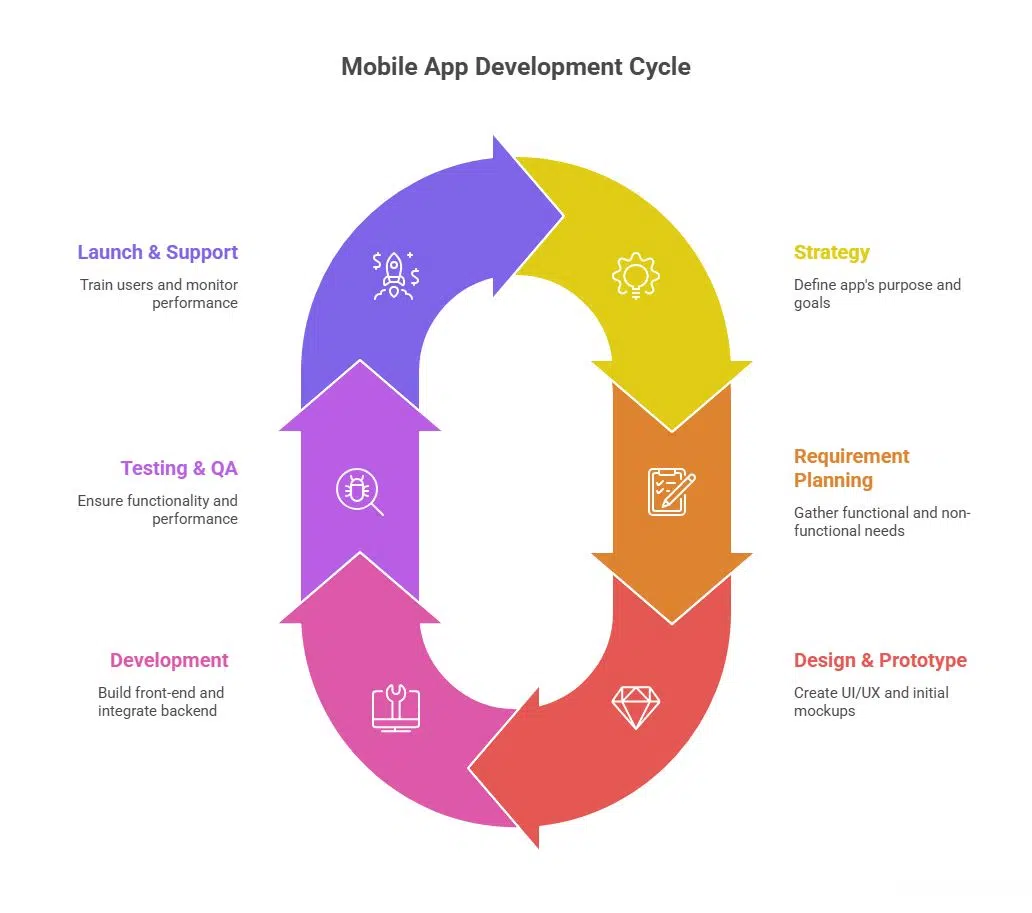 Once we understand your requirements, we will create the outline and initiate a custom mobile application development process personalized as per your organizational culture.
Our process for mobile app development includes:
Strategy - We start with defining the why behind your app. To understand your requirements better, we study your business goals, understand your app user needs, study the ROI, & problems that you wish to solve. We then study your stakeholders (internal users, external users, business owners and end customers). Based on their behaviors, we decide which platform technology native (iOS/Android) or cross-platform will best serve the device type. We further assess what systems to integrate such as ERP/CRM/legacy, or data flows, etc.
Requirement Planning - In the next phase, our project managers and key account executives work with your enterprise to gather functional requirements of the app. It will include what feature set you will want, what the app will do and how it will perform its functions. On the non-functional edge, we understand what security requirements your enterprise needs. What are the performance metrics you follow, and whether you wish to scale your app in the future. It assists us in defining scope, acquiring resources, setting budget & timeline.
Design & Prototype - The design phase is where our mobile app developers start with the initial UI/UX design of your enterprise app. We start with putting together a wireframe and building initial mockups. We share them with your enterprise bodies to review and iterate. As our stakeholders, you provide us with your valuable feedback to refine solutions before we move with the heavy development stages. We also suggest the architect for backend, databases, servers, cloud instances, and device management integrations.
Development - Our mobile app developers build the app’s front-end (mobile UI), and integrate backend services. We also configure relevant APIs and add any third-party integrations of existing enterprise systems with our custom enterprise mobile app solution. Our security teams will then add device management setups (MDM/EMM) and establish security layers by adding authentication and encryptions. At Branex, we follow agile methodology for developing enterprise mobility solutions which heavily depends on iterative releases & continuous feedback.
Testing & QA - To check whether the app’s functionalities and feature sets are working optimally, our quality assurance engineers run multiple functional tests to test the app features. We also run performance tests to identify and eliminate any performance bottlenecks occurring in the software application. We understand how poor performance can lead to poor user experience and therefore, we run tests across different devices and platforms. Our enterprise specific tests follow complete compliance/regulation checks & device management compatibility.
Launch & Support - Once the development phase is complete, we move the custom enterprise mobile app to the next rollout stage which is training users to adapt. During this stage, we sharply monitor the adoption and track performance using analytics. Our teams also study crash reports & collect user feedback to better understand what end-users need. As the user base grows, or business processes change, we scale the backend and add necessary integrations. We also launch new features, bug fixes, security patches and OS updates.
Once we understand your requirements, we will create the outline and initiate a custom mobile application development process personalized as per your organizational culture.
Our process for mobile app development includes:
Strategy - We start with defining the why behind your app. To understand your requirements better, we study your business goals, understand your app user needs, study the ROI, & problems that you wish to solve. We then study your stakeholders (internal users, external users, business owners and end customers). Based on their behaviors, we decide which platform technology native (iOS/Android) or cross-platform will best serve the device type. We further assess what systems to integrate such as ERP/CRM/legacy, or data flows, etc.
Requirement Planning - In the next phase, our project managers and key account executives work with your enterprise to gather functional requirements of the app. It will include what feature set you will want, what the app will do and how it will perform its functions. On the non-functional edge, we understand what security requirements your enterprise needs. What are the performance metrics you follow, and whether you wish to scale your app in the future. It assists us in defining scope, acquiring resources, setting budget & timeline.
Design & Prototype - The design phase is where our mobile app developers start with the initial UI/UX design of your enterprise app. We start with putting together a wireframe and building initial mockups. We share them with your enterprise bodies to review and iterate. As our stakeholders, you provide us with your valuable feedback to refine solutions before we move with the heavy development stages. We also suggest the architect for backend, databases, servers, cloud instances, and device management integrations.
Development - Our mobile app developers build the app’s front-end (mobile UI), and integrate backend services. We also configure relevant APIs and add any third-party integrations of existing enterprise systems with our custom enterprise mobile app solution. Our security teams will then add device management setups (MDM/EMM) and establish security layers by adding authentication and encryptions. At Branex, we follow agile methodology for developing enterprise mobility solutions which heavily depends on iterative releases & continuous feedback.
Testing & QA - To check whether the app’s functionalities and feature sets are working optimally, our quality assurance engineers run multiple functional tests to test the app features. We also run performance tests to identify and eliminate any performance bottlenecks occurring in the software application. We understand how poor performance can lead to poor user experience and therefore, we run tests across different devices and platforms. Our enterprise specific tests follow complete compliance/regulation checks & device management compatibility.
Launch & Support - Once the development phase is complete, we move the custom enterprise mobile app to the next rollout stage which is training users to adapt. During this stage, we sharply monitor the adoption and track performance using analytics. Our teams also study crash reports & collect user feedback to better understand what end-users need. As the user base grows, or business processes change, we scale the backend and add necessary integrations. We also launch new features, bug fixes, security patches and OS updates.
What is Custom Enterprise Mobile App Development?
Businesses, big or small, have consistently been experiencing a positive/negative setback. With COVID hitting hard and the great market dumps, it's no secret if your business isn’t online, it’s not visible to your target audience. But is going online enough? Not exactly. Times have changed and so have the solutions that sets your enterprise apart. Gone are the days when businesses would merge a few interactive features and name it a decent software. Enter 2025, custom enterprise mobile app development introduces personalized app experiences for customers and businesses of all sizes. A custom tailor made app that fits your business like it was meant to be. It’s the process of putting together a custom enterprise mobile app that directly engages with customers addressing their pain points & the business challenges which they are facing. The process includes planning, testing, and deployment ensuring the final product compliments the core internal strategies, inspires innovation and solidifies market presence.How We Design & Develop Custom Enterprise Mobile Apps?
At Branex, we are a team of talented mobile app developers bringing a cumulative experience of decades in building enterprise mobile app solutions. We have experience in planning the comprehensive enterprise application development lifecycle. Our teams will sit down with you to understand your project requirements and understand your enterprise end goals.
Once we understand your requirements, we will create the outline and initiate a custom mobile application development process personalized as per your organizational culture.
Our process for mobile app development includes:
Strategy - We start with defining the why behind your app. To understand your requirements better, we study your business goals, understand your app user needs, study the ROI, & problems that you wish to solve. We then study your stakeholders (internal users, external users, business owners and end customers). Based on their behaviors, we decide which platform technology native (iOS/Android) or cross-platform will best serve the device type. We further assess what systems to integrate such as ERP/CRM/legacy, or data flows, etc.
Requirement Planning - In the next phase, our project managers and key account executives work with your enterprise to gather functional requirements of the app. It will include what feature set you will want, what the app will do and how it will perform its functions. On the non-functional edge, we understand what security requirements your enterprise needs. What are the performance metrics you follow, and whether you wish to scale your app in the future. It assists us in defining scope, acquiring resources, setting budget & timeline.
Design & Prototype - The design phase is where our mobile app developers start with the initial UI/UX design of your enterprise app. We start with putting together a wireframe and building initial mockups. We share them with your enterprise bodies to review and iterate. As our stakeholders, you provide us with your valuable feedback to refine solutions before we move with the heavy development stages. We also suggest the architect for backend, databases, servers, cloud instances, and device management integrations.
Development - Our mobile app developers build the app’s front-end (mobile UI), and integrate backend services. We also configure relevant APIs and add any third-party integrations of existing enterprise systems with our custom enterprise mobile app solution. Our security teams will then add device management setups (MDM/EMM) and establish security layers by adding authentication and encryptions. At Branex, we follow agile methodology for developing enterprise mobility solutions which heavily depends on iterative releases & continuous feedback.
Testing & QA - To check whether the app’s functionalities and feature sets are working optimally, our quality assurance engineers run multiple functional tests to test the app features. We also run performance tests to identify and eliminate any performance bottlenecks occurring in the software application. We understand how poor performance can lead to poor user experience and therefore, we run tests across different devices and platforms. Our enterprise specific tests follow complete compliance/regulation checks & device management compatibility.
Launch & Support - Once the development phase is complete, we move the custom enterprise mobile app to the next rollout stage which is training users to adapt. During this stage, we sharply monitor the adoption and track performance using analytics. Our teams also study crash reports & collect user feedback to better understand what end-users need. As the user base grows, or business processes change, we scale the backend and add necessary integrations. We also launch new features, bug fixes, security patches and OS updates.
Why Custom Enterprise Mobile App Development Better than Traditional Development Practices?
Traditional mobile app development practices offer a one-size-fits all approach. As an enterprise, you want to establish a digital presence that distinguishes your business from the rest of the market. A custom enterprise mobile app development offers a tailored app development approach, one that meets your unique organizational requirements. To explain it more clearly, here’s what custom enterprise mobile app development has to offer:- Ownership - You own the enterprise solution. Every feature, every document, every patent.
- Better Control - Every pixel, every code, you take the reins on developing your solution, your way.
- Transparent Cost - You have complete exposure to where your dollars are going, which means no hidden charges.

 In my experience leading Sky Point Crane and ClimaShield Industries, I've seen staff augmentation transform how we tackle specialized projects. We often face the need for niche expertise in areas like 3D lift planning and advanced rigging technologies. By bringing in certified riggers on a project basis, we've been able to execute complex lifts more efficiently without the overhead of permanent hires.
Staff augmentation provides us with the flexibility to respond to the fluctuating demands of our projects. For example, during a large-scale telecom rigging project, integrating temporary experts helped us improve precision and safety, ultimately contributing to faster project completion. This approach allows us to align the right skills with the right tasks, ensuring we stay competitive and adaptable.
By leveraging temporary expertise, we maintain a focus on our core values, particularly solving customer problems with unique solutions. Staff augmentation enables us to put ourselves in our customers' shoes and deliver results without compromising on quality or safety. This method underlines our commitment to responsive service, meeting project timelines, and ensuring our operations are both cost-effective and innovative.
Dave Brocious, Managing Partner, Sky Point Crane
In my experience leading Sky Point Crane and ClimaShield Industries, I've seen staff augmentation transform how we tackle specialized projects. We often face the need for niche expertise in areas like 3D lift planning and advanced rigging technologies. By bringing in certified riggers on a project basis, we've been able to execute complex lifts more efficiently without the overhead of permanent hires.
Staff augmentation provides us with the flexibility to respond to the fluctuating demands of our projects. For example, during a large-scale telecom rigging project, integrating temporary experts helped us improve precision and safety, ultimately contributing to faster project completion. This approach allows us to align the right skills with the right tasks, ensuring we stay competitive and adaptable.
By leveraging temporary expertise, we maintain a focus on our core values, particularly solving customer problems with unique solutions. Staff augmentation enables us to put ourselves in our customers' shoes and deliver results without compromising on quality or safety. This method underlines our commitment to responsive service, meeting project timelines, and ensuring our operations are both cost-effective and innovative.
Dave Brocious, Managing Partner, Sky Point Crane
 Staff augmentation is changing the way companies scale their teams, and we've seen it firsthand in the
  Our work with organizations across industries shows that staff augmentation brings three major benefits. First, it lets companies quickly add specific skills when they need them - like bringing in AI experts or cybersecurity specialists for key projects without a lengthy hiring process. Second, it opens up access to global talent pools, which is essential as more teams work remotely. Third, it helps companies manage costs while staying competitive since they can scale their teams up or down based on business needs. What's particularly interesting is how staff augmentation is changing career paths. More professionals are choosing this model because it gives them variety in their work and control over their schedules.
Also Read:
Our work with organizations across industries shows that staff augmentation brings three major benefits. First, it lets companies quickly add specific skills when they need them - like bringing in AI experts or cybersecurity specialists for key projects without a lengthy hiring process. Second, it opens up access to global talent pools, which is essential as more teams work remotely. Third, it helps companies manage costs while staying competitive since they can scale their teams up or down based on business needs. What's particularly interesting is how staff augmentation is changing career paths. More professionals are choosing this model because it gives them variety in their work and control over their schedules.
Also Read:  Staff augmentation is changing the modern workforce, especially in technology sectors. At NetSharx Technology Partners, we've seen how this strategy enables companies to adapt quickly to evolving tech needs. By bringing in specialized cloud and cybersecurity experts temporarily, organizations can accelerate their digital change without the delay and costs associated with hiring full-time employees.
For instance, a client facing a complex migration to a scalable SD-WAN network was struggling with in-house capabilities. We deployed temporary cloud engineers familiar with the latest SASE technologies, reducing their transition time by 50%. This approach not only cut costs but also allowed their internal team to focus on core business strategies rather than technical firefighting.
With access to over 350 cloud and security providers, staff augmentation provides a unique opportunity to leverage a vast array of skills and experiences. This flexibility is crucial in the current landscape, where technological advancements outpace the ability of many companies to keep up internally. Through strategic partnerships, businesses can maintain a competitive edge and ensure their operations are aligned with the latest industry innovations.
Ryan Carter, CEO/Founder, NetSharx
Staff augmentation is changing the modern workforce, especially in technology sectors. At NetSharx Technology Partners, we've seen how this strategy enables companies to adapt quickly to evolving tech needs. By bringing in specialized cloud and cybersecurity experts temporarily, organizations can accelerate their digital change without the delay and costs associated with hiring full-time employees.
For instance, a client facing a complex migration to a scalable SD-WAN network was struggling with in-house capabilities. We deployed temporary cloud engineers familiar with the latest SASE technologies, reducing their transition time by 50%. This approach not only cut costs but also allowed their internal team to focus on core business strategies rather than technical firefighting.
With access to over 350 cloud and security providers, staff augmentation provides a unique opportunity to leverage a vast array of skills and experiences. This flexibility is crucial in the current landscape, where technological advancements outpace the ability of many companies to keep up internally. Through strategic partnerships, businesses can maintain a competitive edge and ensure their operations are aligned with the latest industry innovations.
Ryan Carter, CEO/Founder, NetSharx
 Staff augmentation is redefining workforce agility—allowing companies to scale fast without long-term risk.
I saw this firsthand when we needed to accelerate a marketing automation overhaul but didn't have the in-house expertise. Hiring full-time employees would have taken months, so we brought in specialized contractors through staff augmentation. Within weeks, they streamlined our CRM, optimized workflows, and trained our team—all without bloating payroll.
The biggest shift? Companies no longer need to "own" talent to stay competitive. Instead of committing to full-time hires for niche skills, businesses can tap into global experts on demand. Whether it's AI integration, cybersecurity, or high-growth marketing strategies, staff augmentation bridges the skill gap instantly.
But the key to success? Integration. We treated our augmented team as an extension of our internal staff—looping them into Slack, strategy meetings, and project roadmaps. This avoided the "outsider" effect and ensured seamless collaboration.
My advice? Think of staff augmentation as a competitive advantage, not a stopgap. It lets you stay lean, move fast, and adapt to market demands without the overhead of traditional hiring. The companies that master flexible talent models will outpace competitors in the modern workforce.
Noel Griffith, Chief Marketing Officer, SupplyGem
Staff augmentation is redefining workforce agility—allowing companies to scale fast without long-term risk.
I saw this firsthand when we needed to accelerate a marketing automation overhaul but didn't have the in-house expertise. Hiring full-time employees would have taken months, so we brought in specialized contractors through staff augmentation. Within weeks, they streamlined our CRM, optimized workflows, and trained our team—all without bloating payroll.
The biggest shift? Companies no longer need to "own" talent to stay competitive. Instead of committing to full-time hires for niche skills, businesses can tap into global experts on demand. Whether it's AI integration, cybersecurity, or high-growth marketing strategies, staff augmentation bridges the skill gap instantly.
But the key to success? Integration. We treated our augmented team as an extension of our internal staff—looping them into Slack, strategy meetings, and project roadmaps. This avoided the "outsider" effect and ensured seamless collaboration.
My advice? Think of staff augmentation as a competitive advantage, not a stopgap. It lets you stay lean, move fast, and adapt to market demands without the overhead of traditional hiring. The companies that master flexible talent models will outpace competitors in the modern workforce.
Noel Griffith, Chief Marketing Officer, SupplyGem
 Staff augmentation is reshaping the modern workforce by introducing flexibility and precision in workforce planning—two critical assets in today's fast-moving, project-driven economy. Instead of relying on a rigid hiring model, companies can tap into specialized talent pools on demand, allowing them to scale their workforce up or down as needs evolve. This isn't just a cost-saving measure; it's a strategy for staying competitive.
Take the tech sector, for instance. When a business needs to roll out a new app, they don't always have the luxury of hiring full-time developers. Staff augmentation allows them to onboard highly skilled contractors who hit the ground running and contribute immediately. When the project ends, those roles naturally dissolve, saving on long-term payroll and benefits.
From my experience, one of the biggest benefits is access to niche expertise. For example, during a large-scale digital transformation at a previous company, we leveraged staff augmentation to bring in data scientists and cybersecurity specialists—roles we didn't need full-time but couldn't do without in that critical period. It allowed us to execute the project at a higher level without overextending our permanent team or scrambling through lengthy recruitment cycles.
This model is also reshaping worker expectations. Highly skilled professionals now seek opportunities where they can work on impactful, short-term projects across industries rather than tying themselves to a single employer. It's creating a more dynamic labor market while forcing businesses to rethink their retention strategies for core staff.
Looking ahead, I expect staff augmentation to grow in influence as businesses embrace hybrid work models and global talent networks. The ability to assemble agile teams tailored to specific needs is becoming a cornerstone of workforce strategy. It's not just a way to fill gaps—it's a key driver of innovation and resilience in a constantly evolving landscape.
James Shaffer, Managing Director, Insurance Panda
Staff augmentation is reshaping the modern workforce by introducing flexibility and precision in workforce planning—two critical assets in today's fast-moving, project-driven economy. Instead of relying on a rigid hiring model, companies can tap into specialized talent pools on demand, allowing them to scale their workforce up or down as needs evolve. This isn't just a cost-saving measure; it's a strategy for staying competitive.
Take the tech sector, for instance. When a business needs to roll out a new app, they don't always have the luxury of hiring full-time developers. Staff augmentation allows them to onboard highly skilled contractors who hit the ground running and contribute immediately. When the project ends, those roles naturally dissolve, saving on long-term payroll and benefits.
From my experience, one of the biggest benefits is access to niche expertise. For example, during a large-scale digital transformation at a previous company, we leveraged staff augmentation to bring in data scientists and cybersecurity specialists—roles we didn't need full-time but couldn't do without in that critical period. It allowed us to execute the project at a higher level without overextending our permanent team or scrambling through lengthy recruitment cycles.
This model is also reshaping worker expectations. Highly skilled professionals now seek opportunities where they can work on impactful, short-term projects across industries rather than tying themselves to a single employer. It's creating a more dynamic labor market while forcing businesses to rethink their retention strategies for core staff.
Looking ahead, I expect staff augmentation to grow in influence as businesses embrace hybrid work models and global talent networks. The ability to assemble agile teams tailored to specific needs is becoming a cornerstone of workforce strategy. It's not just a way to fill gaps—it's a key driver of innovation and resilience in a constantly evolving landscape.
James Shaffer, Managing Director, Insurance Panda
 Honestly, staff augmentation is becoming a core strategy for businesses that need flexibility. Hiring full-time employees for every skill set is expensive, especially for startups managing tight budgets. Bringing in specialized talent on demand helps companies scale faster without long-term commitments. I've used this approach for everything from software development to marketing. Instead of spending months searching for a full-time hire, I bring in experts for high-impact projects. This keeps the team lean while still getting top-tier results.
Workforce expectations are shifting, and businesses need to adapt. Skilled professionals want flexibility, and companies need agility. Staff augmentation makes that balance possible. A startup might need a UX designer for a two-month sprint but not permanently. A growing e-commerce brand may require data analysts during peak seasons. Traditional hiring models don't support that kind of adaptability. More companies will adopt this approach as the demand for specialized skills keeps rising. It's already a core part of how modern teams operate.
Zarina Bahadur, CEO and Founder, 123 Baby Box
Honestly, staff augmentation is becoming a core strategy for businesses that need flexibility. Hiring full-time employees for every skill set is expensive, especially for startups managing tight budgets. Bringing in specialized talent on demand helps companies scale faster without long-term commitments. I've used this approach for everything from software development to marketing. Instead of spending months searching for a full-time hire, I bring in experts for high-impact projects. This keeps the team lean while still getting top-tier results.
Workforce expectations are shifting, and businesses need to adapt. Skilled professionals want flexibility, and companies need agility. Staff augmentation makes that balance possible. A startup might need a UX designer for a two-month sprint but not permanently. A growing e-commerce brand may require data analysts during peak seasons. Traditional hiring models don't support that kind of adaptability. More companies will adopt this approach as the demand for specialized skills keeps rising. It's already a core part of how modern teams operate.
Zarina Bahadur, CEO and Founder, 123 Baby Box
 While managing technical projects, we discovered that fixed teams often had expertise gaps or unused capacity, while augmented teams could flex their capabilities as needed. Then, I realized that the most valuable insight about staff augmentation came from tracking skill utilization patterns.
When implementing complex SEO projects, we found that bringing in specialized experts for specific phases was more effective than maintaining full-time specialists.
For example, during a major site migration, we augmented our core team with a technical SEO specialist for eight weeks rather than hiring permanently. This approach not only reduced costs but also brought in fresh perspectives from someone who had handled similar projects across different industries. The specialist improved our migration process based on experience our internal team hadn't encountered.
Project delivery speed increased by 40% because we could scale expertise exactly when needed. Plus, our core team learned from each specialist, gradually building internal capabilities while maintaining flexibility.
Matt Harrison, VP of Global Operations & Marketing, Authority Builders
While managing technical projects, we discovered that fixed teams often had expertise gaps or unused capacity, while augmented teams could flex their capabilities as needed. Then, I realized that the most valuable insight about staff augmentation came from tracking skill utilization patterns.
When implementing complex SEO projects, we found that bringing in specialized experts for specific phases was more effective than maintaining full-time specialists.
For example, during a major site migration, we augmented our core team with a technical SEO specialist for eight weeks rather than hiring permanently. This approach not only reduced costs but also brought in fresh perspectives from someone who had handled similar projects across different industries. The specialist improved our migration process based on experience our internal team hadn't encountered.
Project delivery speed increased by 40% because we could scale expertise exactly when needed. Plus, our core team learned from each specialist, gradually building internal capabilities while maintaining flexibility.
Matt Harrison, VP of Global Operations & Marketing, Authority Builders
 In my experience as a dentist and practice leader, I've seen staff augmentation transform dental care delivery. At UNO DENTAL SAN FRANCISCO, we implemented a paperless system by bringing in IT specialists temporarily. This allowed us to streamline operations and improve patient record management without long-term hires.
This approach provides flexibility and efficiency, crucial in healthcare where technology rapidly evolves. By integrating specialists as needed, we improved patient care and operational workflow, achieving an 80% patient retention rate. This model can be applied in various settings to optimize resources while maintaining high service standards.
Aghiad Kandar DDS, Chief Executive Officer, UNO DENTAL SAN FRANCISCO
In my experience as a dentist and practice leader, I've seen staff augmentation transform dental care delivery. At UNO DENTAL SAN FRANCISCO, we implemented a paperless system by bringing in IT specialists temporarily. This allowed us to streamline operations and improve patient record management without long-term hires.
This approach provides flexibility and efficiency, crucial in healthcare where technology rapidly evolves. By integrating specialists as needed, we improved patient care and operational workflow, achieving an 80% patient retention rate. This model can be applied in various settings to optimize resources while maintaining high service standards.
Aghiad Kandar DDS, Chief Executive Officer, UNO DENTAL SAN FRANCISCO
 Staff augmentation is revolutionizing the modern workforce by offering flexibility and efficiency elements in today's business environment. From my experience at Gig Wage, I've seen businesses streamline operations by leveraging independent contractors. Our platform is built to accommodate this demand, providing fast and flexible payroll solutions that allow companies to easily tap into gig workers' potential without the traditional HR overhead, thus empowering growth and adaptation.
Take, for example, a mystery shopper platform that used Gig Wage to eliminate a classic payroll manager role. The savings were reinvested into employee development, proving that augmenting staff with gig workers can cut costs significantly while focusing on core business growth. As someone who has transformed and optimized processes in the gig economy, I see staff augmentation enabling companies to meet special project needs with specialized, flexible talent quickly and efficiently.
Through my work with Gig Wage, I've witnessed gig contractors becoming integral to business strategy, not just as a temporary fix but as a long-term competitive advantage. In sectors like hospitality staffing and business process outsourcing, the ability to process payments rapidly for temporary workers allowed management to focus on strategic growth areas, affirming that staff augmentation is not just about filling gaps but enhancing overall business agility.
Craig Lewis, Founder & CEO, Gig Wage
Staff augmentation is revolutionizing the modern workforce by offering flexibility and efficiency elements in today's business environment. From my experience at Gig Wage, I've seen businesses streamline operations by leveraging independent contractors. Our platform is built to accommodate this demand, providing fast and flexible payroll solutions that allow companies to easily tap into gig workers' potential without the traditional HR overhead, thus empowering growth and adaptation.
Take, for example, a mystery shopper platform that used Gig Wage to eliminate a classic payroll manager role. The savings were reinvested into employee development, proving that augmenting staff with gig workers can cut costs significantly while focusing on core business growth. As someone who has transformed and optimized processes in the gig economy, I see staff augmentation enabling companies to meet special project needs with specialized, flexible talent quickly and efficiently.
Through my work with Gig Wage, I've witnessed gig contractors becoming integral to business strategy, not just as a temporary fix but as a long-term competitive advantage. In sectors like hospitality staffing and business process outsourcing, the ability to process payments rapidly for temporary workers allowed management to focus on strategic growth areas, affirming that staff augmentation is not just about filling gaps but enhancing overall business agility.
Craig Lewis, Founder & CEO, Gig Wage
 At Nerdigital.com, staff augmentation has been a game-changer in how we scale, innovate, and stay competitive. In today's fast-moving digital landscape, businesses can't always afford to wait months to hire and onboard full-time employees with specialized skills. Staff augmentation bridges that gap, allowing us to bring in top-tier talent on demand while keeping our core team lean and agile.
One of the biggest advantages is flexibility. When we needed AI specialists to enhance our machine learning algorithms, we quickly onboarded contract professionals with deep expertise - without the overhead of long-term commitments. This allowed us to execute projects faster and test new ideas without disrupting our internal operations.
Another key benefit is access to global talent. Instead of limiting ourselves to local hires, we tap into a worldwide pool of experts, ensuring we always have the best people working on the right projects. It's also an incredible way to foster knowledge transfer - our full-time team learns from external experts, strengthening our in-house capabilities over time.
That said, successful staff augmentation requires strong communication, clear expectations, and seamless integration into company culture. We ensure that augmented staff feels like an extension of our team by using structured onboarding, collaborative tools, and regular check-ins.
In the modern workforce, staff augmentation isn't just a trend - it's a strategic advantage. It enables companies to stay adaptable, reduce hiring risks, and focus resources where they're needed most.
Max Shak, Founder/CEO, nerDigital
At Nerdigital.com, staff augmentation has been a game-changer in how we scale, innovate, and stay competitive. In today's fast-moving digital landscape, businesses can't always afford to wait months to hire and onboard full-time employees with specialized skills. Staff augmentation bridges that gap, allowing us to bring in top-tier talent on demand while keeping our core team lean and agile.
One of the biggest advantages is flexibility. When we needed AI specialists to enhance our machine learning algorithms, we quickly onboarded contract professionals with deep expertise - without the overhead of long-term commitments. This allowed us to execute projects faster and test new ideas without disrupting our internal operations.
Another key benefit is access to global talent. Instead of limiting ourselves to local hires, we tap into a worldwide pool of experts, ensuring we always have the best people working on the right projects. It's also an incredible way to foster knowledge transfer - our full-time team learns from external experts, strengthening our in-house capabilities over time.
That said, successful staff augmentation requires strong communication, clear expectations, and seamless integration into company culture. We ensure that augmented staff feels like an extension of our team by using structured onboarding, collaborative tools, and regular check-ins.
In the modern workforce, staff augmentation isn't just a trend - it's a strategic advantage. It enables companies to stay adaptable, reduce hiring risks, and focus resources where they're needed most.
Max Shak, Founder/CEO, nerDigital
 I think staff augmentation is reshaping the modern workforce by offering businesses flexibility and specialized expertise without the long-term commitment of traditional hiring. I've seen companies struggle with

