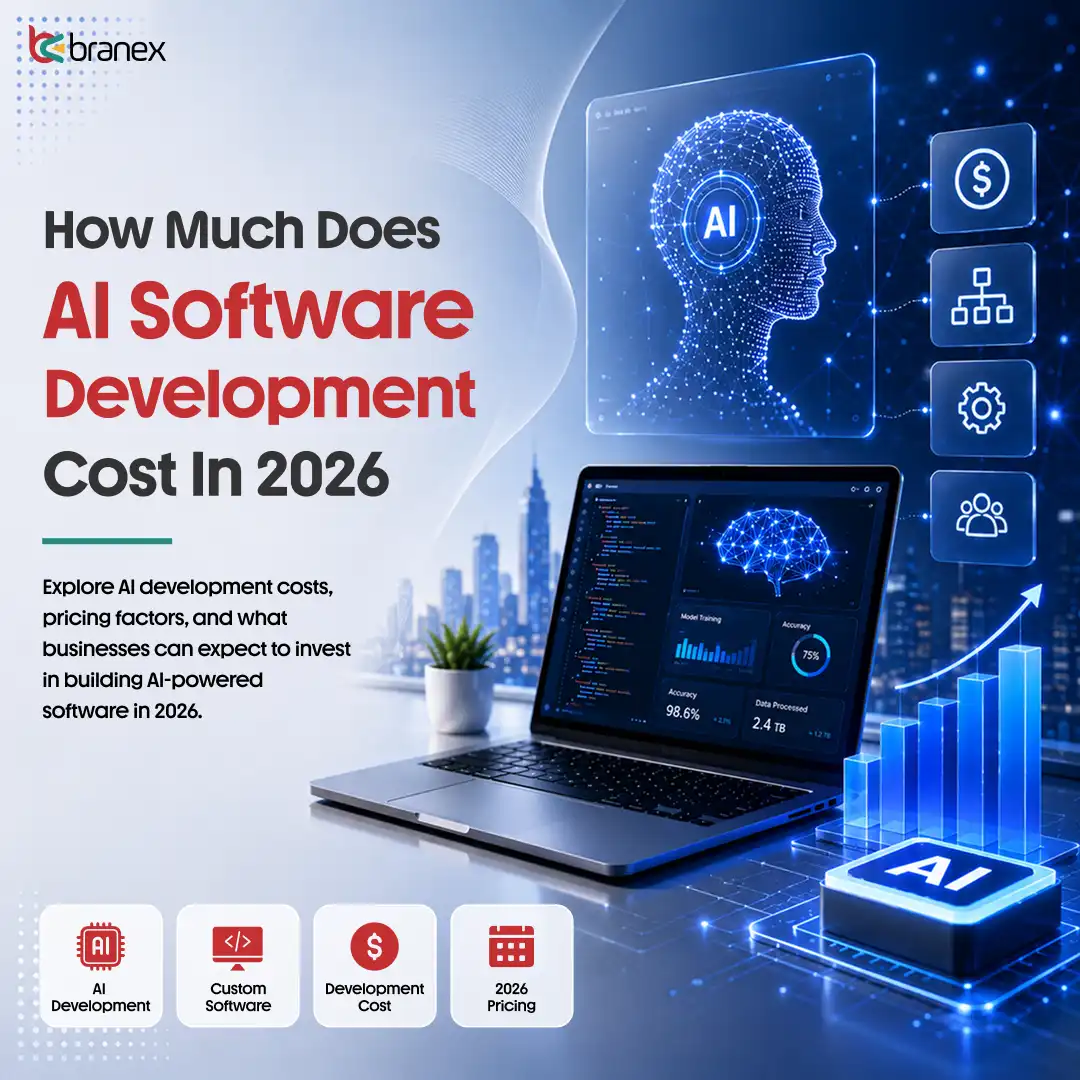
Building custom artificial intelligence software in 2026 costs between $20,000 for a focused implementation and $450,000+ for an enterprise platform.
For most mid-market American businesses, a production-ready AI application lands between $45,000 and $130,000. That range covers custom data ingestion pipelines, retrieval-augmented generation (RAG) architecture, role-based security, and integration with your core tech stack.
The variance exists because building AI differs fundamentally from traditional software development. You are not just writing deterministic code; you are engineering probabilistic systems that require specialized compute, dynamic data pipelines, and continuous model alignment.
Here is the thing: vendor quotes swinging from $15,000 to $1.5 million create massive friction for business leaders. Executives face pressure to deploy intelligence, but nobody wants to burn capital on an experimental science project.
Let us break down what you will actually pay, where the budget goes, and how to build an AI platform that yields positive returns from day one.
AI Software Development Cost by Project Type
The primary factor dictating your ai software development cost is the underlying architectural pattern. Connecting a pre-trained model to a simple database requires a fraction of the engineering needed for an autonomous vision system or multi-agent workflow.
Here is how pricing breaks down across commercial AI implementations in 2026:
| Project Type | Complexity Tier | Estimated Cost Range (USD) | Average Timeline | Primary Business Use Cases |
| Intelligent Chatbot & Agent | Low to Moderate | $20,000 – $45,000 | 6 – 10 weeks | Customer support triage, employee knowledge search, automated onboarding |
| Predictive Analytics Engine | Moderate | $35,000 – $85,000 | 10 – 16 weeks | Demand forecasting, churn modeling, predictive maintenance |
| Computer Vision System | High | $60,000 – $160,000 | 14 – 22 weeks | Quality inspection, document parsing, visual inventory tracking |
| Generative AI & LLM Integration (RAG) | Moderate to High | $45,000 – $130,000 | 8 – 14 weeks | Domain research assistants, contract analysis, automated report drafting |
| Custom Enterprise AI Platform | Very High | $150,000 – $450,000+ | 20 – 36+ weeks | Autonomous operations, real-time fraud detection, core product evolution |
1. Intelligent Chatbots and Autonomous Agents ($20,000 – $45,000)
Basic rule-based chatbots are obsolete. Modern conversational tools use lightweight LLMs coupled with vector search to pull context from internal databases and CRM records. Engineering centers on response latency, memory management, and guardrails to prevent hallucinations.
2. Predictive Analytics Engines ($35,000 – $85,000)
Predictive engines rely on machine learning development models trained on historical tabular records. Costs depend heavily on data health. If records live scattered across disconnected databases, data engineering will consume over half the budget.
3. Computer Vision Systems ($60,000 – $160,000)
Vision applications require deep learning models, custom dataset labeling, and GPU processing. Building an automated visual inspection tool or document parser demands strict precision. Edge deployment on physical cameras or IoT devices can push timelines past 20 weeks.
4. Generative AI and LLM Integration with RAG ($45,000 – $130,000)
Retrieval-Augmented Generation is the standard for companies building proprietary intelligence without training models from scratch. Your team indexes private documentation into a vector database, retrieves relevant chunks in real time, and passes that grounded context to an LLM.
5. Custom Enterprise AI Platforms ($150,000 – $450,000+)
These platforms serve as the operational core of an organization. Examples include multi-agent decision engines for logistics or automated underwriting platforms for fintech firms. This tier involves model fine-tuning, microservices architecture, real-time data streaming, and security compliance.
Branex Insider – Scoping Real AI Architecture
When business leaders ask us for an “enterprise AI platform,” our first step is never writing code. We conduct a technical data audit.
In over 70% of discovery sessions, we find that a client does not need a $300,000 custom foundation model. They need a modular RAG pipeline powered by a fine-tuned open-source model, structured data normalization, and tight API connections. We scope around the exact commercial outcome, which frequently cuts the initial capital outlay in half.
What Drives AI Development Costs Up or Down?
Two projects with the exact same functional description can have vastly different budgets. Understanding the technical mechanics behind cost drivers helps you allocate resources effectively.
1. Data Preparation and Pipeline Architecture
AI models are only as capable as the data feeding them. If records are messy, duplicate-heavy, or trapped in unstructured PDFs, data engineering represents your largest expense. This work involves cleaning raw records, creating continuous ETL pipelines, and setting up vector embeddings for semantic search.
2. Model Selection Strategy
The choice of model hierarchy dictates development and operational expenses:
- Commercial APIs (OpenAI, Anthropic, Google): Lowest upfront development cost ($20,000 – $50,000), but ongoing token costs scale directly with usage volume.
- Fine-Tuning Open-Source Models (Llama 3, Mistral): Moderate upfront cost ($50,000 – $120,000), delivering lower per-token operational costs, faster inference speeds, and complete data privacy.
- Custom Foundation Models Trained from Scratch: Very high upfront cost ($500,000 to millions). This path is rarely justifiable for non-research companies.
3. Compute Infrastructure and Inference Hosting
Training and running AI models requires specialized hardware. While training is a periodic expense, real-time inference runs continuously. Self-hosting open-source models on cloud GPU instances requires container orchestration via Kubernetes, adding DevOps complexity and recurring monthly cloud costs.
4. Integration with Legacy Systems
An isolated AI prototype is useless. The software must read from and write back to your production databases, ERP platforms, billing systems, and customer interfaces. Building custom middleware, webhook handlers, and secure API gateways between legacy databases and modern AI services adds engineering hours.
5. Security, Privacy, and Compliance
Handling sensitive customer records, financial transactions, or medical information requires dedicated security architecture. Zero-data-retention agreements, end-to-end encryption, role-based access control (RBAC), and SOC 2 Type II compliance add testing and validation requirements to the project scope.
Branex Insider – Token Economics and Inference Drift
Many development teams build AI software that works in testing but becomes an economic nightmare at scale. If every customer query triggers a large-context prompt through a frontier model, your monthly cloud bill will explode.
We implement semantic caching, prompt compression, and hybrid model routing. Low-complexity tasks route to small, local models costing fractions of a cent, while complex reasoning tasks route to frontier models. This architecture routinely cuts monthly inference expenses by 50% to 65%.
In-House vs. Outsourced AI Development: Cost Comparison
When executive teams decide to build AI capabilities, the immediate question is whether to hire an internal team or partner with an outside agency.
In the United States, hiring senior AI and machine learning talent is both slow and expensive. Building a balanced internal team requires a Lead ML Engineer, a Data Engineer, a Full-Stack Software Developer, and a Product Manager.
Here is a side-by-side financial comparison over a 12-month operational timeline:
| Expense Category | In-House US Team (4 FTEs) | Dedicated Outsourced Agency | Hybrid Model |
| Annual Base Salaries | $620,000 – $780,000 | $0 | $310,000 – $390,000 (2 FTEs) |
| Taxes, Benefits & Overhead (25%) | $155,000 – $195,000 | $0 | $77,500 – $97,500 |
| Recruitment & Hiring Fees (20%) | $120,000 – $150,000 | $0 | $60,000 – $75,000 |
| Tooling & Dev Infrastructure | $30,000 – $50,000 | Included in project fee | $20,000 – $30,000 |
| Annual Contract / Project Cost | $0 | $90,000 – $220,000 | $60,000 – $120,000 |
| Total First-Year Investment | $925,000 – $1,175,000 | $90,000 – $220,000 | $527,500 – $712,500 |
| Time to Launch First Version | 6 – 9 months | 2 – 4 months | 3 – 5 months |
| Talent Retention Risk | High | Low (agency manages staffing) | Moderate |
Hiring internally makes sense if AI is your primary core intellectual property as a venture-backed tech startup.
However, for established businesses seeking to modernize operations, automate workflows, or upgrade existing digital products, partnering with a specialized AI development company eliminates hiring lag and cuts first-year expenditures by up to 75%.
How Much Does It Cost to Build an AI Software? (Quick Answer)
To answer the central question directly: how much does it cost to build an ai software depends on whether you are assembling an MVP, a mid-scale operational platform, or an enterprise-grade system.
Here is the quick-reference breakdown for 2026:
- Entry-Level AI Tool / MVP ($15,000 – $35,000): Rapid proof of concept integrating commercial LLM APIs, a lightweight database, and a clean web interface to validate a specific workflow.
- Production-Grade Business Solution ($45,000 – $120,000): Fully customized application with automated data ingestion, vector search, custom business logic, secure authentication, and integration with your core CRM or ERP.
- Complex Enterprise AI Ecosystem ($150,000 – $450,000+): Multi-agent platforms with custom fine-tuned models, real-time data streaming, fault-tolerant cloud architecture, and strict compliance controls.
Where Your AI Development Budget Goes
Understanding the distribution of development spend helps keep budgets on track:
- Data Engineering & Pipeline Setup (30%): Cleaning data schemas, structuring ingestion pipelines, and creating vector embeddings.
- AI Architecture, RAG, & Model Integration (25%): Designing retrieval logic, fine-tuning models, and establishing response validation layers.
- Backend Logic, APIs, & User Interface (20%): Developing secure endpoints, admin consoles, and responsive frontends.
- Testing, Validation, & Security (15%): Benchmarking accuracy, preventing hallucinations, and securing data privacy.
- DevOps, Cloud Infrastructure, & Deployment (10%): Configuring Kubernetes clusters, containerization, and monitoring tools.
That allocation demonstrates a practical reality: 75% of your investment goes into standard software engineering, data plumbing, and security. The actual model integration is only one component of the broader system.
Why Do 85% of AI Projects Fail – and What That Means for Your Budget
Industry research from Gartner and technology analysts consistently points to a sobering benchmark: why do 85% of AI projects fail to reach production deployment?
The failure rate is rarely caused by the algorithms themselves. It happens because organizations treat AI as an isolated technology experiment rather than an integrated business asset.
1. Solving Problems That Do Not Move the Needle
Many organizations start by asking, “Where can we use AI?” instead of “What operational bottleneck is costing us the most time and money?” When an AI tool fails to deliver measurable cost savings or revenue growth within six months, executive sponsors pull the plug, writing off the entire development expenditure.
2. The Prototype Trap
Building a basic prototype inside a notebook or demo sandbox takes two weeks. Getting that same prototype to handle real-world dirty data, edge-case user inputs, and strict latency requirements takes months. Teams frequently underestimate the engineering rigor required to move from an initial demo to a production-grade system, exhausting their budget halfway through the build.
3. Ignoring User Workflow Integration
If your customer service reps or sales teams have to leave their primary dashboard and open a separate window to query an AI tool, adoption will plummet. Successful AI initiatives embed directly into the tools your team already uses daily.
The “30% Rule” for AI Budgets, Explained
When building a financial forecast for artificial intelligence, many business leaders ask: what is the 30% rule for ai?
The 30% rule states that you should allocate at least 30% of your initial software development budget annually for ongoing maintenance, infrastructure, and operational optimization.
If you spend $100,000 building a custom AI platform, you should plan to spend approximately $30,000 each year to keep that platform accurate, secure, and fast.
Here is how that annual budget breaks down:
- Cloud Compute & Token Consumption ($12,000 / 40%): Server hosting, vector database maintenance, and model API query costs.
- Data Drift & Model Monitoring ($8,000 / 27%): Continuous evaluation of model outputs, retraining on fresh data, and prompt adjustments.
- Feature Updates & API Upgrades ($6,000 / 20%): Adapting to newer LLM versions, updating dependencies, and building user-requested features.
- Security & Compliance Audits ($4,000 / 13%): Monitoring access logs, testing edge cases, and updating data privacy controls.
Ignoring this ongoing operational commitment leads to decaying accuracy, frustrating user experiences, and eventual platform abandonment.
How to Reduce AI Development Costs Without Cutting Corners
You do not need an enterprise budget to build high-impact artificial intelligence. By adopting a disciplined engineering approach, you can protect capital while delivering robust software.
1. Start with a Tight Proof of Value (POV)
Do not commit six figures to an unproven concept. Begin with a 3 to 5 week Proof of Value sprint designed to test technical feasibility and operational ROI on a single workflow. A focused POV proves model accuracy against your specific business data for less than $25,000 before you fund full-scale UI development and database integrations.
2. Prioritize Fine-Tuning Open-Source Models Over Massive Closed Models
Frontier commercial models are exceptional generalists, but they are often unnecessary for domain-specific business tasks. Fine-tuning a smaller open-source model (such as Llama 3 8B or Mistral 7B) on your specific domain data can match or exceed the accuracy of massive commercial models while reducing latency and long-term operating costs.
3. Normalize Data Before Writing Application Code
Investing in clean data structures before initiating model integration saves hundreds of engineering hours. When your data schemas are structured, validated, and easily searchable, setting up vector databases and ingestion pipelines becomes straightforward.
4. Deploy Semantic Response Caching
In most commercial applications, users ask variations of the same 50 questions repeatedly. By storing vector embeddings of previous answers in a fast in-memory cache, your application can return instant responses for identical or similar queries without calling the model API. This cuts token consumption dramatically.
5. Contract for Milestone-Gated Deliverables
Avoid open-ended hourly contracts that incentivize scope creep. Partner with development firms that structure engagements around clear technical milestones: data pipeline validation, core algorithm testing, frontend integration, and production deployment.
Branex Insider – The Milestone Validation Framework
We structure all custom development under strict risk-gated milestones. Our clients never sign a monolithic check and hope for the best six months down the road.
Milestone 1 proves model accuracy against real data. Milestone 2 delivers the operational core and API layer. Milestone 3 integrates the user interface and security controls. If a concept fails validation at Milestone 1, our clients pivot without burning capital on unnecessary frontend polish.
The Bottom Line: Making Your AI Investment Count
The conversation around ai software development cost in 2026 is no longer about whether your business can afford artificial intelligence. It is about how intelligently you structure the build to ensure rapid payback.
Whether your target is a $25,000 internal productivity agent or a $200,000 multi-system automation engine, success comes down to three non-negotiables:
- Clean, accessible data pipelines.
- Pragmatic architectural choices that control ongoing inference costs.
- Tight integration into your team’s everyday operational workflows.
When you treat AI as an operational multiplier rather than a novelty, the software pays for itself in reduced labor hours, faster turnaround times, and superior customer retention.
Ready to Plan Your AI Build?
Do not let uncertain estimates stall your digital roadmap.
Connect with our senior technical strategists at Branex for a consultative architecture audit. We will evaluate your data readiness, recommend the optimal model stack, and deliver a transparent, milestone-gated project blueprint tailored to your commercial goals.
Schedule Your Technical Architecture Consultation3.6
 Read More Blogs