Did you know that new app launches across Google Play Store and Apple App Store grew by 104% YoY in April 2026 alone? According to Moonstack Industry Ecosystem Report 2026, one of the biggest contributors behind this explosive growth is AI accelerated app development lifecycles.
According to DianApps Industry Analysis 2026, GitHub Copilot has helped mobile app developers complete routine coding tasks 55% faster. AI self healing test frameworks have cut down test maintenance efforts by up to 70%. According to the Stack Overflow Annual Developer survey, 84% of developers are already or planning to integrate AI tools into development stacks.
That is the positive side of AI that everybody is talking about. Unfortunately, there is another side of AI in mobile app development that no one talks about. According to Corporate GenAI deployment study, 70% to 85% of AI deployment efforts fail due to hallucinated code, technical debt and lack of human architectural direction.
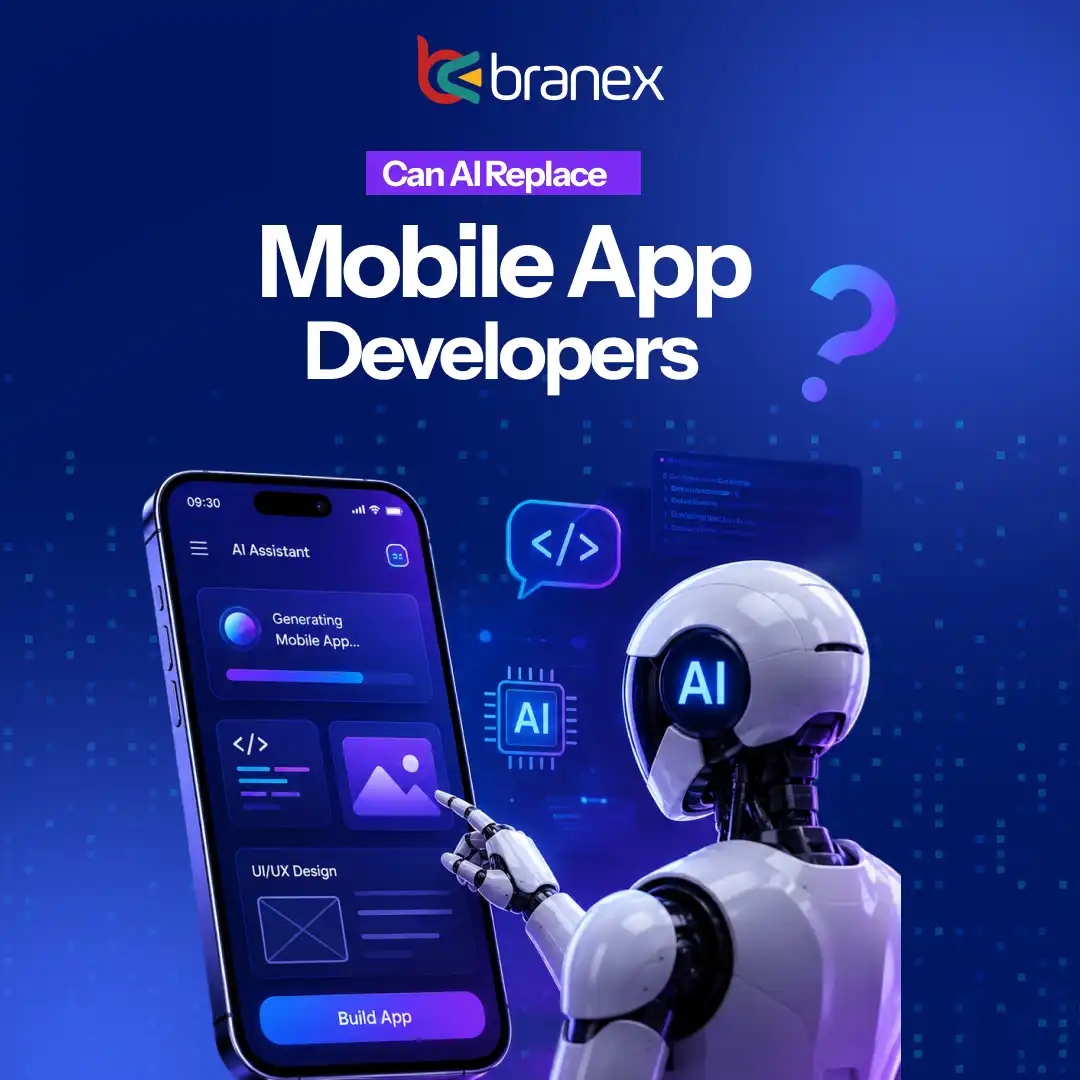
Studies have shown that AI’s accuracy drops from 34% to 25% in complex tasks if a human developer does not review it. So, can AI replace mobile app developers? That is exactly the question Branex tries to answer in this article.
What AI Can Do in Mobile App Development?
Here are some of the things AI can do in mobile app development.
1. Generate Code
AI is great at generating simple code. Moreover, it can also suggest functions and can create components as well. Research from McKinsey found that developers using generative AI tools can complete certain coding tasks twice as fast compared to traditional workflows.
2. Automate Testing
Mobile app testing is the most time consuming stage of mobile app development. AI can shorten the time required to test apps by:
- Generating test cases
- Detecting bugs
- Identifying vulnerabilities
- Simulating user behavior
Due to this, mobile app development teams can ship apps faster without impacting quality.
3. Assist with UI Design
AI tools can also help you create wireframes, provide layout suggestions and create design prototypes for your mobile apps. Even though it might not be perfect and requires human oversight, it can surely speed up the process.
4. Analyze User Data
AI’s real strength lies in analyzing large amounts of data quickly. Mobile app developers can use this to their advantage by feeding it user behavior data and asking it to provide actionable insights. Moreover, AI can also provide you feature recommendations, identify user engagement patterns, provide retention predictions and highlight personalization opportunities.
5. Create Documentation
Mobile app developers hate documenting code and AI can save them from this hassle by automatically generating documentation. This minimizes manual work and enhances team collaboration.
How AI is Transforming Mobile App Development?
AI’s role in app development is not limited only to coding. It extends far beyond that to the point that it has completely reshaped the way mobile apps are being developed. This has given rise to a new domain called AI App Development.
Faster Development Cycles
Mobile app developers can now create a minimum viable product quickly. Additionally, it can automate many mundane tasks which can allow your development team to focus more on business critical tasks.
Lower Development Costs
App development used to cost an arm and a leg. AI has leveled the playing field, enabling startups and small businesses an opportunity to create a proof of concept and prototype without putting a huge dent in their bank account.
Enhanced Productivity
According to McKinsey, generative AI can increase mobile app developer productivity by 20% to 45% across different tasks including coding, documentation and testing.
Better Personalization
AI can deliver better personalization thanks to recommendation engines, predictive analytics, smart chatbots and can even ensure dynamic content delivery. You can see this action in streaming apps and ecommerce apps.
Rise of Low-Code and No-Code Platforms
The rise of low or no code mobile app development platforms have democratized mobile app development. This means that you don’t need to be an expert to create a mobile app anymore. The intuitive drag and dopp interfaces of these tools along with the ability to speak to these tools in natural language makes mobile app development a hassle free process.
Limitations of AI
AI also has its fair share of shortcomings. This is what prevents it from fully replacing mobile app developers.
Lack of Business Sense
AI can generate code but where it falters is in business sense. It lacks the nuance of your customer behavior, doesn’t know about your business objectives and is also unaware of market dynamics and your competitive positioning in the market.
Limited Creativity
Another area where AI can not compete with humans is in creativity, originality, strategic thinking and decision making capabilities. Unfortunately, this shows when you create a mobile with artificial intelligence. Apps created by AI blend in the sea of sameness and don’t stand out from the crowd.
Context and Accuracy Issues
Hallucinations and accuracy are the two most commonly known issues associated with AI generated code. AI generated code might look accurate on the surface but when you dig a little deeper you can find many subtle errors.
Security Risks
AI generated code poses a new set of security threats. With no security guardrails in place, security vulnerabilities can not only make their way into the code but can also be exploited. This can also lead to complaince and data privacy issues.
Scalability
Scaling apps can be a daunting challenge. You need a robust architecture, secure infrastructure and seamless API integrations to extend the functionality of your mobile apps.
Why Are Human Developers Still Essential?
AI’s limitations have made human developers indispensable.
Strategic Thinking
Strategic thinking is where humans have a clear edge over AI. Mobile app developers do a much better job at critical thinking and problem solving. Combine that with user empathy, industry knowledge and better business sense, this gives human mobile app developers what AI can not replicate.
Custom Mobile App Development
Every business is different and has its unique requirements. Professional mobile app development services take your brand identity, operational workflows, customer expectations and growth objectives into account when developing a mobile app for your business.
User Experience
The user experience of a mobile app can make or break your app. Human mobile app developers understand this much better than AI. They take user psychology, customer journeys, emotional design principles and accessibility standards into consideration when developing a mobile app. Since AI lacks these nuances, the app created by AI fails to deliver a delightful user experience.
Complex Integrations
Modern mobile applications are complex. They integrate with ERP systems, CRM platforms, payment gateways and third party application programming interfaces. Human mobile app developers have the architectural expertise to pull this off while AI don’t..
Accountability
You can hold a mobile app developer accountable but the same can be said for AI based mobile app development.
AI vs Human Developers Comparison Table
| Capability | AI | Human Developers |
| Code Generation | Excellent | Excellent |
| Strategic Planning | Limited | Excellent |
| Business Understanding | Limited | Excellent |
| Creativity | Limited | Excellent |
| UI/UX Design Thinking | Basic | Advanced |
| Problem Solving | Pattern-Based | Context-Aware |
| Security Oversight | Limited | Strong |
| Custom Solutions | Limited | Excellent |
| Stakeholder Collaboration | No | Yes |
| Long-Term Product Vision | No | Yes |
The Future: AI + Developers Working Together
AI and mobile app developers should not compete with one another but work together to create memorable experiences for mobile users. Successful businesses have already understood this and are using both in conjunction. They are using AI to automate mundane tasks while their mobile app developers focus on product innovation, architecture, user experience and security.
Data also backs this approach as well. A recent study of open-source android app development and iOS app development found that AI-generated contributions perform best on mundane development tasks while more complex structural changes demand human review.
How Businesses Should Use AI in App Development?
Businesses should use AI for
- Rapid prototyping
- Code generation
- Automated testing
- Documentation
- Data analysis
- Workflow automation
Hiring a professional mobile application development company ensures that AI is used strategically rather than as a replacement for expertise.
Conclusion
Can AI Replace Mobile App Developers? The short answer is no. AI can improve productivity, speed up app development and automate repetitive tasks but can not replace creativity, strategic thinking and problem solving. The future of AI in mobile app development lies in collaboration rather than replacement. Organizations that combine AI capabilities with skilled development teams will be better positioned to build innovative, secure and scalable mobile applications.
Frequently Asked Questions
Can AI completely replace mobile app developers?
No. AI can automate coding, testing and documentation tasks but it cannot replace human creativity, strategic thinking, and business understanding.
Is AI useful in mobile app development?
Yes. AI improves productivity by generating code, automating testing, extracting insights from analytics and delivering personalized user experience.
What are the biggest limitations of AI in app development?
AI struggles with creativity, business context, complex architecture and accuracy.
Will AI reduce mobile app development costs?
Yes, AI can reduce app development costs and speed up delivery.
What is the future of AI in mobile app development?
The future involves AI and mobile app developers working together. AI will automate mundane tasks while mobile app developers focus on innovation, user experience and app architecture.
 Read More Blogs