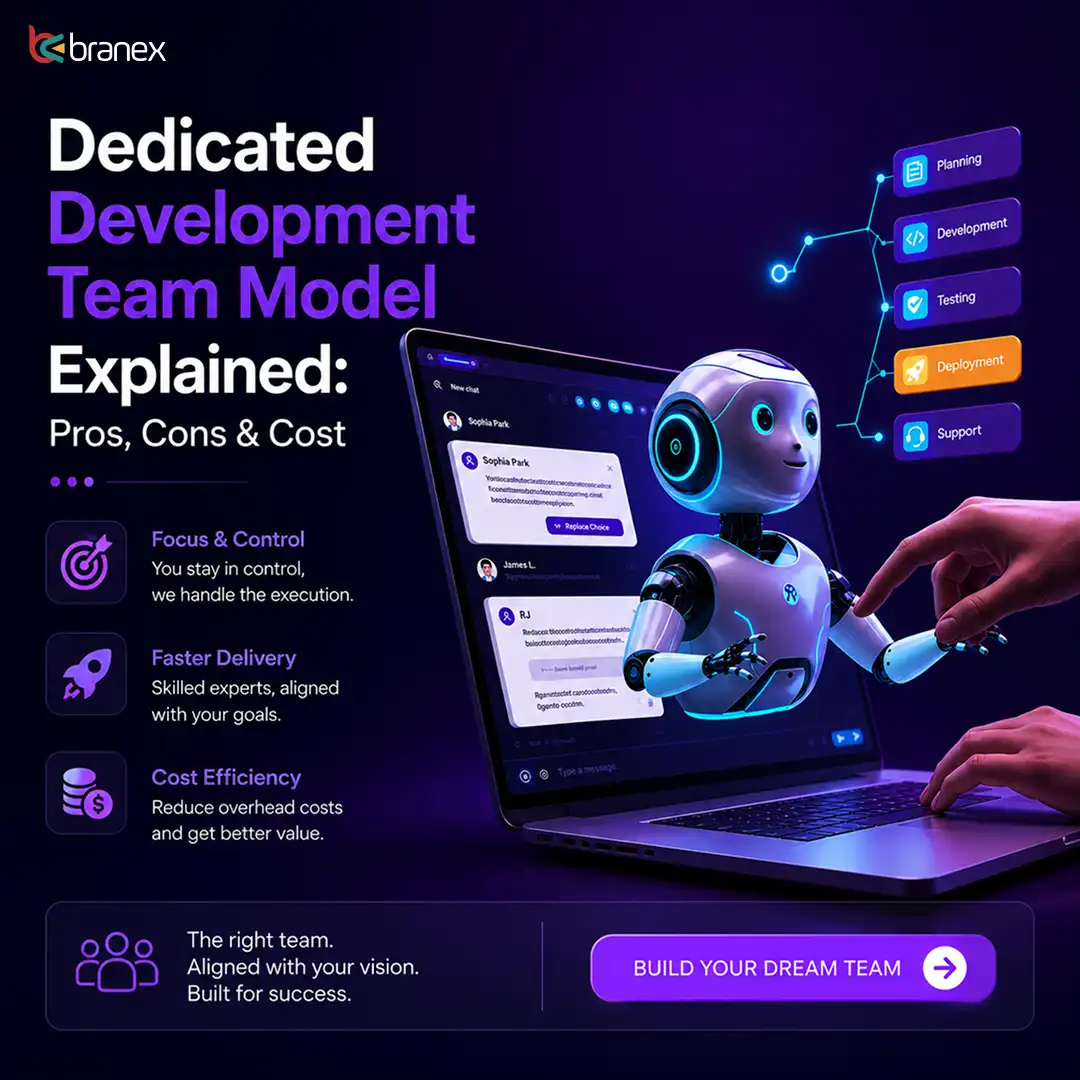
A dedicated development team model is a software outsourcing framework where an external technology partner provides a dedicated, full-time group of software engineers, designers, QA specialists, and product managers exclusively focused on your project. With 72% of employers globally struggling to find skilled technical talent according to ManpowerGroup’s Talent Shortage data, tech leaders increasingly rely on this model to maintain sprint velocity.
Unlike ad-hoc outsourcing, this remote unit operates as an organic extension of your in-house product team, adopting your processes, culture, and business goals while the vendor manages infrastructure, HR, and payroll.
For tech leaders scaling technical capacity without the overhead of domestic recruiting, this engagement model delivers a balance of product immersion and operational flexibility.
What Is a Dedicated Development Team?
A dedicated development team is an offshore or nearshore engineering unit assigned exclusively to a single client on a long-term basis. They do not juggle multiple accounts or split hours across external projects.
The dedicated development model is primarily leveraged by two different types of organizations:
- High-growth startups and scale-ups: Companies that need to extend their development runway, iterate on product-market fit, and scale engineering capacity rapidly without competing for scarce local talent.
- Mid-market to enterprise companies: Organizations embarking on long-term digital transformation initiatives, modernizing legacy systems, or launching secondary product lines that require sustained development continuity over 12 months or longer.
How the Dedicated Team Model Works, Step by Step
Implementing a dedicated development team follows a structured operational lifecycle that moves from technical scoping to autonomous delivery.
Step 1: Requirements and Role Mapping
You define the technical stack, product vision, delivery roadmap, and specific skill gaps. The engagement outlines required roles (such as Full-Stack Engineers, DevOps Architects, UI/UX Designers, and QA Automation Specialists) along with target seniority levels and communication preferences.
Step 2: Vetting and Team Assembly
The technology vendor sources and screens matching talent from their internal bench or specialized engineering network. You conduct final technical interviews, review code portfolios, and assess culture fit before approving every individual team member.
Step 3: Tool and Workflow Integration
The selected developers are onboarded directly into your tech ecosystem.
They adopt your day-to-day communication and collaboration tools (Slack, Microsoft Teams, Jira, Linear, GitHub, GitLab) and align with your agile cadences, including daily standups, sprint planning, and bi-weekly retrospectives.
Step 4: Co-Management and Ongoing Delivery
Management responsibilities are cleanly divided:
- Product & Technical Leadership (You): You dictate product strategy, sprint backlogs, architecture decisions, code reviews, and project milestones.
- Operational & Administrative Support (Vendor): The vendor manages workstations, hardware procurement, software licensing, local payroll, healthcare, compliance, ongoing training, and team retention.
Dedicated Team vs. Staff Augmentation vs. Project-Based Outsourcing
Selecting the correct engagement framework depends on scope clarity, management availability, and product lifecycle stage.
| Evaluation Metric | Dedicated Development Team | Staff Augmentation | Project-Based Outsourcing |
| Product Control | High (You manage backlog & roadmaps) | Highest (Integrated directly into your PMs) | Low (Vendor PM manages delivery) |
| Team Immersion | Deep (Single-client focus builds domain knowledge) | Moderate (Focused on isolated tasks/modules) | Low (Team shifts across clients) |
| Pricing Structure | Predictable monthly cost per developer | Hourly or monthly time-and-materials rate | Fixed-price or milestone-based fee |
| Scope Flexibility | High (Evolving requirements & pivots) | High (Task-driven execution) | Low (Rigid specs; change orders apply) |
| Ideal Use Case | Long-term roadmaps, continuous product scaling | Short-term skill gaps, immediate surge capacity | Well-defined MVP, legacy migration, one-offs |
| Contract Length | Typically 6 to 24+ months | 1 to 6 months | 1 to 6 months |
When performing an assessment of your dedicated team vs staff augmentation, staff augmentation plugs individual niche specialists into existing internal teams where the gaps exist, while a dedicated software team deploys a cross-functional, autonomous unit capable of owning full feature sets end-to-end.
Pros of the Dedicated Development Team Model
- Compounding Domain Expertise: Engineers stay on your product over quarters and years, mastering your technical architecture, business logic, and customer expectations. This reduces onboarding friction for new feature rollouts.
- Predictable Budget Forecasting: Invoicing is based on fixed monthly rates per engineer rather than fluctuating billable hours, allowing finance teams to forecast engineering burn rates accurately.
- Elastic Resource Scaling: Adding developers to ramp up sprint velocity or scaling down secondary roles (like UX/UI designers post-launch) requires standard notice periods (typically 30–60 days), bypassing local severance liabilities and severance red tape.
- Zero Administrative Drag: The vendor handles technical infrastructure, local tax compliance, labor laws, continuous professional development, and employee retention programs, freeing your leadership to focus on product strategy.
When It’s Not the Right Fit
The thing about the dedicated development team model is, this specific model is not universally applicable. If you have the following operational conditions, you can simply ignore this model and find one that’s a better fit.
- Short, Fixed-Scope Projects: If you need a simple corporate landing page, a standard e-commerce setup, or a fixed 6-week MVP with static specifications, traditional project-based outsourcing is more cost-effective.
- Limited In-House Leadership: Dedicated teams require clear product direction. If your company lacks a Product Owner, Technical Lead, or clear roadmap, the team risks idling or misinterpreting business requirements.
- Strict In-Person Mandates: If compliance, security protocols, or company culture necessitate physical co-location and on-premise hardware interaction, an onshore, in-house team is necessary.
How Much Does a Dedicated Development Team Cost?
Dedicated software team cost structures can differ based on different aspects such as regional labor markets, developer seniority, and technical specializations (e.g., standard web frameworks vs. AI/ML and embedded systems).
For most vendors, they bill a single & transparent monthly cost per engineer who easily covers the base salary, related benefits, local taxes, hardware deployment, and the associated operational overhead.
Here’s a quick glance at the breakdown of different tiered developers based on region types.
| Region | Junior Developer (1–3 yrs) | Mid-Level Developer (3–5 yrs) | Senior Developer (5+ yrs) | Solution Architect / Lead |
| United States & Western Europe | $8,000 – $11,000 / mo | $11,500 – $16,000 / mo | $16,500 – $22,000 / mo | $22,000 – $28,000+ / mo |
| Eastern Europe (Poland, Romania, etc.) | $3,500 – $5,000 / mo | $5,500 – $7,500 / mo | $8,000 – $11,500 / mo | $12,000 – $15,500 / mo |
| Latin America (Brazil, Colombia, Mexico) | $3,200 – $4,800 / mo | $5,000 – $7,200 / mo | $7,500 – $10,500 / mo | $11,000 – $14,500 / mo |
| South & Southeast Asia (Pakistan, India) | $2,000 – $3,200 / mo | $3,500 – $5,200 / mo | $5,500 – $8,000 / mo | $8,500 – $12,000 / mo |
Note: Rates reflect fully managed client costs (inclusive of vendor management fees, infrastructure, and benefits) rather than raw developer take-home salaries.
When Should You Choose This Model?
Here’s a diagnostic checklist to help you determine whether you should hire dedicated developers or pursue an alternate outsourcing model:
You need to ask:
- Is your project roadmap projected to last at least 6 to 12 months?
If yes, the ramp-up and domain-immersion investment will deliver a strong ROI. - Do you have an internal Product Owner or CTO to direct weekly priorities?
If yes, your organization has the structural capacity to guide a dedicated engineering team. - Are your technical specifications expected to evolve based on user feedback?
If yes, the agile adaptability of a dedicated team outperforms rigid fixed-cost contracts. - Is local engineering recruitment too slow or cost-prohibitive in your market?
If yes, building a dedicated offshore or nearshore team closes skill gaps while reducing engineering spend by 40% to 60%.
If you answered “Yes” to three or more of these questions, the dedicated development team structure is the optimal model for your development pipeline.
Scale Your Product with Branex!
Navigating technical scaling requires more than just filling seats, it demands vetted engineering talent that aligns with your engineering practices from sprint one.
When you partner with Branex to build a dedicated development team, you gain full-time senior engineers, architects, and QA specialists selected specifically for your technology stack. We manage local infrastructure, HR, and administrative operations while you retain complete control over your product vision and code repository.
Contact our technical consulting team today to structure and launch your dedicated engineering unit.
 Read More Blogs