Blogs

Add the best talent on the market, an agile skilled management & seamless involvement.

Blog Main Image
Highly Successful PPC Managers
Digital Marketing Productivity

9 Things Highly Successful PPC Managers Start To-Do In The Morning

branex-logo Team Branex
The first habit mentioned in Stephen Covey’s book is about being Proactive. It is about taking control of your situation. Regardless of how hard things get, you still draw on your inner motivation to start and finish on time. As they say, ‘What starts well, ends well.’ PPC managers are faced with so much pressure that sometimes they vent out their anger on those working alongside them. To maintain a safe and healthy workplace environment, it is best to follow some rituals every morning which can help PPC managers relax their minds in the daily grind and help them come up with more successful campaigns. Every campaign aims to drive sales or channel traffic. If the campaign is not working out, they need to change their approach and try out something else. And the only way PPC managers can achieve this is by following the morning rituals mentioned below. Here are 9-morning to-dos which can help you become a successful manager and manage your campaigns without any losses to the company.

1. Insert Negative Keywords

When you have a huge amount of money at stake, you cannot afford to take things lightly. Every click will cost you money. Therefore, every morning, the first thing you should do is sort out negative keywords and remove them from your list. Normally, on average, it is seen that people lose a lot of money on junk keywords, which results in harming your reputation. Early morning negotiations would be the perfect addition to your cup of Joe. Negative Keywords for PPC

2. Remove Unrelated Google Display Network Websites

The second ritual you need to do is to remove all the unrelated Google Display Network (GDN) websites which are costing you unsolicited dollars. Figure out if the website is bringing relevant traffic to your website or not. If not, remove it.

3. The Daily Ad Spend

This is actually a no-brainer. When you’re spending money, you need to keep track of the budget and check what you’re spending every single day. Make the necessary adjustments daily first thing in the morning to protect yourself from incurring any surprises down the road.

This is too much

4. Track the Leads

How many leads did you manage to generate the previous day? Is there something you need to adjust? Branex teams conduct a 10-minute scrum in the mornings,  discussing the impact of ads and campaigns. It is a nice way to start your morning with this amazing ritual. You can count the wins and motivate the team to achieve more.

5. Get a Bird’s-eye View

If you spot any major inconsistency, simply looking back over the day won't cut the bill; you also need to take a trip down the lane to view the bigger picture. Viewing your long-term campaign performance would help you see where the conversions started dropping off and why.

6. Follow Up with the Performance

Check if the campaign is working for a certain region or not. How is it making an impact on the target audience? Is the audience relevant and how can you improve the ad performance? Analyze the performance of every ad in the morning and improve as you get some results.

7. Keep an Eye on AdWords Alerts

Look out for AdWords account alerts, such as negated keywords or an about-to-expire credit card that can be impeding traffic. While you must be tempted to overlook most silly alerts, make sure to give them a cursory glance, perhaps while setting up shop.

stay alert everyone

8. Identify the Modifications

A PPC manager isn’t aware of all that conspires within an organization. You need to keep your ears and eyes open and be ready to improvise in a jiffy. Seeing major unexpected fluctuations in ad spend should indicate that something is cooking internally. For instance, if a new page is added, you need to make a PPC campaign for the page and check out the response it gets every day.

9. Prepare Yourself for Surprises

For newly launched campaigns and keywords, the first few days are the most crucial to survival. Do check the Google AdWords update daily so you can respond on the go.

surprised

The Final Thoughts

No two PPC managers can yield the same output. Every PPC manager will start their morning with a mix of rituals. The most successful managers will be the ones who analyze, update, and learn from their past experiences. But when the PPC managers have this habit of checking and updating the campaigns daily, they will not face any problems. As for surprises, even if there is a surprise, the PPC manager will be able to handle it without creating a fuss over it.
Wonderful Communication Tools
Innovation Productivity

5 Surprisingly Wonderful Communication Tools You Need To Start Using Right Now

branex-logo Team Branex
Effective communication is like a clever design. If the design is not simple, how will the user relate to it? Every word that you say should have a reason behind it, and every idea that you deliver should whisper a message to the listener. If the design is complex, how will people understand and relate to it? Communication plays an important role in all business models. It can make or break a company based on how it is handled. This is why it is indispensable to learn how to communicate effectively with a client, a business partner, or even your family members. It falls on Entrepreneurs and business managers to determine the right communication tools for their companies. This applies to both internal and external business communication tools. Let’s look at the 5 communication tools which served me right and helped me take my business to the next level.

1. Video Conferencing with BlueJeans

Everyone has their own way of attending and conducting video meetings. For me, BlueJeans fits the bill. It is a cloud-based video conferencing tool which can make your meetings more productive. The good thing is that the service is not just limited to a web browser, you can even use a mobile to attend the conference. Just choose a meeting venue and get started even from your home. BueJeans for Communication Tools Schedule your meetings on Outlook or integrate with popular business apps. Even if you don’t have an audio/video compatible phone, you can use any phone to join in the meetings.

2. Give a Boost to Productivity with TaskQue

If I can pinpoint one tool that saved me tons of time, I can proudly name TaskQue. I started using TaskQue two years ago, but now I thank my friend who discovered this wonderful tool. You can prioritize your tasks and even assign them to your idle resources. A project can be assigned to multiple resources and you can manage all of them under a single workflow. [embed]https://www.youtube.com/watch?v=0D3TKNnH5Cc[/embed] Eliminate the hassle of back-and-forth communication by collaborating under a single window. An amazing communication tool that helped me finish off projects ahead of time.

3. Zoom

If you’re looking for something on the lower end of the price spectrum, Zoom is for you. Video conferencing combined with cross-platform messaging and file-sharing features, makes this tool utterly fabulous. Zoom lets users conduct all types of online meetings, such as video conferences, one-on-one, training, and webinars, on the go. The service can be used on mobile devices as well as on desktops. It also incorporates a developer feature which can help you integrate video, voice, and screen sharing, and even apps which are already used in your company. The free version of Zoom can do one-to-one meetings and for groups, you can use 100 participants to take part in the meeting. A paid version offers admin tools, additional integration, and slight customization.

4. Zoho Meeting

Hold meetings and share live product demos with your team and customers. Zoho meeting is a comprehensive meeting solution that can help teams support remote working, and help businesses lead live meetings with prospects. You can sign in with Google, Facebook, or Yahoo accounts. Just enter the meeting ID and you’re all set to join the meeting room. You can hold product demos for your nearly launched products as well.

5. ClickMeeting

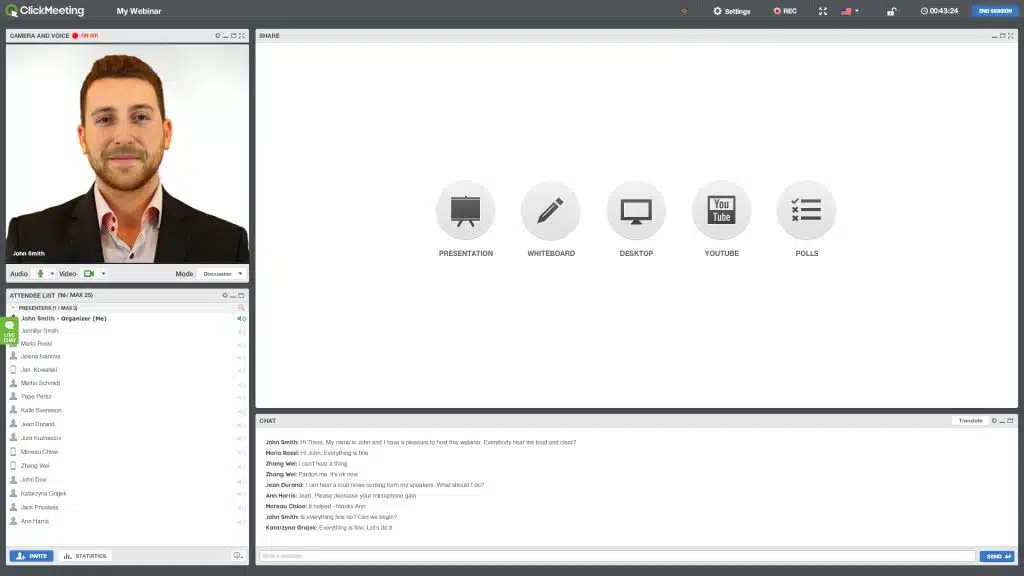
For businesses that give a lot of presentations, ClickMeeting is the right choice. You can even prepare your brand before the meeting. Brand your presentation with logos, theme, and even slideshows. dashboard During the presentation, you can add Q&A, polls, and CTAs. The webinar can also be saved for later viewing. One splendid feature is that you can add 25 attendees at any time. The enterprise edition lets you add up to 5,000 attendees with an option of multiple presenters.

To Wrap it All Up

If you’re not making mistakes, you’re not growing. Even the best communication tools can sometimes fall short. There are embarrassing mishaps that can have serious repercussions. On second thought, we believe that every employee deserves a second chance for poor judgment. Productivity benefits when employees aren’t spending time trying to figure out how to explain or make up for a communication misstep.
Justice League Logo Empowers of Leadership
Branding Productivity

How Each Justice League Logo Empowers Our Perception of Leadership?

branex-logo Team Branex
Today, we are going to reflect on how each Justice League superhero has an inspiring logo and how it dictates the lesson of true leadership using the right form of symbology. What do you feel when Superman rips the first three buttons of his shirt? What comes to your mind when the Bat Signal sparks up in the middle of the night? How do you feel when you see a yellow lightning bolt, an eagle-shaped W, or a mechanical red eye? Don’t you feel a sense of confidence building up, a sort of adrenaline rush pumping through your veins? That’s the kind of feeling every other employee seeks when they are working with potential leaders. Who can redefine the true essence of leadership other than your favorite superheroes? So, without further Ado, let’s delve in.

Batman

Just like bats revel in the depths of murky darkness, a true leader will always stay behind the curtains. If you know about Batman, you must also know that he is one of the few superheroes who doesn’t even have superpowers. And henceforth, he has to keep reminding himself not to go beyond his capabilities. The Batman logo embodies the fact that a bat is blind, yet it is able to successfully hunt its prey in the dark. Batman Logo Leaders infatuated with the Batman logo do realize that they aren’t super-humans, yet they are able to combat any difficulty coming their way. Batman thrives on the right strategy and those who follow in his wake are more likely successful in becoming strategic leaders themselves. Also Read: 5 Logo Design Failures: How to Avoid Them

Superman

How inspiring can an ‘S’ enveloped within a pentagon be, right? Well, to be honest, it can give you more hope than its fictional nature deserves. Do ask yourself what the Superman symbol reminds you of. Superman Logo Is it a bird? Is it a plane? No, it’s Superman. One of our childhood favorite superheroes is none other than Superman. The S in Superman symbol sends a very strong message that you are now “Safe.” Secrecy, Sentiments, and Security are the three traits of Superman and they are all represented in his logo. Besides, Superman himself is a very charismatic character and exudes the true essence of confidence in leadership.

Wonder Woman

She has a whip that can crush your ego and make you spill the beans. And she has a sword that can defend her from the most powerful enemies in the world and she has braces that can fend off bullets. She is the Queen of Amazon; she is none other than Wonder Woman. Wonder-Woman Logo If you look up closely, the ‘W’ in Wonder Woman forms an Eagle. An eagle hunts its prey from high above in the sky as they are the best observers. The ‘W’ of Wonder Woman reflects a similar essence. It is a symbol that empowers the perception that a leader should always be a keen observer.

Aquaman

He controls the oceans! He makes the fish swim in swarms around him. And he knows what he is doing and if he has his mind set on it, consider it done. Aqua Man really does inspire leadership with his strong and rather formidable personality. Aqua-man really knows how to portray himself with his charisma and presence. Aqua-Man Logo As far as the Aqua-Man symbol is concerned, it symbolizes the crown of the Aqua Man. Crown shows that there is one true leader and no other that can challenge him. Leaders who want to be the alpha of their packs can take inspiration from Aqua man and tread the same path.

Flash

He is fast! He is really, really fast! Flash is, by far, one of the fastest superheroes existing in the DC world. He has crossed all sound barriers and in the “Flashpoint Paradox,” he ran so fast that he even went back in time and altered the whole history of the DC Universe in order to save his mom. Flash Logo The symbol of Flash is a lightning bolt. It symbolizes speediness and agility. Flash runs at the speed of light, he even beats Superman when it comes to speed. Flash inspires the essence of quickness in leadership. Leaders seeking to be productive in their work can really take inspiration from them.

Cyborg

Last but not least, the symbol of Cyborg is a red-eye. His symbol doesn’t even begin to explain the power he exudes in his personality. Cyborg is a full-packed ultimate destruction machine. He is tactical and can transform into any massive destruction weapon of his choice. Cyborg makes sure that his enemies are floored to the ground; yet, he is very resilient and only uses his powers to defend the world. Cyborg Logo The symbol of Cyborg is a red-eye, enclosed within a C. It delivers the lesson of resilience among leaders. One way or another, when we see these symbols, they remind us of our favorite superheroes and often lead us to wonder how they would have acted in a particular situation when faced with calamities. As kids, they became our source of inspiration, they became our dream leaders who made sure we kept moving forward. Our favorite superheroes became our friends in imagination and our guiding lights. They not only inspire motivation but also the courage that a leader requires. So, have you given it a thought yet? Which one is your favorite?
How to Cultivate Learning Culture at Organizational Workplace
Guide Productivity

How To Cultivate Strong Learning Culture At Your Organizational Workplace

branex-logo Team Branex
Learning communicates the message of evolution and optimism. Only a few leaders are capable of understanding the depth of this fact, but those who do actually make their corporate workplace environment something of the next generation. For a team to effectively survive and thrive, it must introduce elements of adaptability so team members can intermittently benefit from them. One way of doing so is to continually coax the mind into feeding on skill-building constituents.
“Companies that learn the fastest and adapt well to changing environments perform the best over time,”

- Edward Hess (Professor of Business Administration at the University of Virginia’s Darden School of Business)

Many ardent millennials are seeking to join organizations which are effectively compassionate towards enlightening employees on the latest happenings in the world. In a nutshell, Generation Z has more faith in organizations rather than educational institutions when it comes to grooming personalities professionally. But, here’s the real question: Are organizations willing to implement such change? If you want to develop a learning culture within your organization, it is time you pay attention to the following:

What is a Learning Culture Within an Organization?

An organizational culture which promotes a development mindset among employees and encourages them to learn can be defined as a learning organizational culture. Different organizations have defined learning cultures differently in their own perspectives. For instance, New York Life Insurance Co. supports a learning culture and defines it as,
“Trying to make each moment about learning, about establishing the intention to learn in every interaction, every relationship and every chance to lead,”
- Michael Molinaro (Vice President of Talent Management). Whereas, when we talk about SAP, their dedication plays a vital role in explaining what a learning culture means to them. According to Dearborn of SAP:
You want people who are curious, committed and who understand their role in the bigger picture of your company
American Express has a total of 62,800 employees. They commemorate learning culture as a significant source that guarantees a high ratio of employee retention and satisfaction.

“High pulse rates lead to high retention, when employees are consistently learning, they are happy.”

David Clark (Senior Vice President and Chief Learning Officer) Hence, there is no fixed definition of a learning culture that can best be defined in words. But, one thing is for sure and backed by some of the research experts, such as Bersin, that organizations which promote a learning culture are 30% more likely to become future market leaders than industries which aren’t learning at all.

How to Cultivate a Perfect Learning Culture Within an Organization?

1. The Perception Change Among CEOs

CEOs of some of the most renowned organizations in the world, such as American Express, Bridgewater Associates, and Container Store, have cracked the myth that true success only comes when employees exhibit a true commitment to learning. Gone are the days when being smart meant being the most knowledgeable or having the right mindset to counteract pitfalls and mistakes. Today, among millennials, the definition of being smart has dramatically transformed on the corporate scale. As an estimate, it has been evaluated that organizations grow by leaps and bounds when they are able to critically think about what makes their specific product or service unique and stand out among other similar ones on the market. Therefore, how do organizations cross over such thresholds? They do it by outsmarting others. According to modern leaders and executives, critical thinking and motivated learning are the two most important factors which make an individual smart within an organization. Workplaces which motivate their employees to become critical thinkers and urge them to research greatly contribute to the development of a learning culture within an organization.

2. Expansive Learning Provides Meaningful Feedback

We live in an era where organizations tremendously concentrate their developmental interventions on the feel-good approach, rather than focusing on negative feedback. But in case you are looking to implement change, you wouldn’t want anything to come in the way that leaves you unsatisfied or in a state where you are left justifiable for your actions. If you want to improve the performance of your employees, you need to specify where they are wrong. Most managers avoid getting into difficult conversations with employees where they have to tell them off regarding their performance. Therefore, to avoid such interactions, they ultimately end up giving positive feedback instead of negative feedback. Now, this might not be an effective strategy if you are looking to fill the curiosity gap for focused learners of today. These days, people heed negative feedback to learn where they are lagging behind due to their ignorance and knowledge limitations. If employees are showing an inclination to listen, it is also essential that managers communicate negative criticism constructively and delicately, as people are less receptive to being questioned. A learning culture will only be promoted if things are delegated in the right manner.

3. Reward Those Who Promote Continuous Learning

It is impossible to observe any radical change taking place in the organizational culture of your team if you haven’t introduced a formal reward system that keeps the employees motivated. Even then, the effectiveness of implementation cannot be completely certified unless the rewards are lucrative enough. Although managers do understand the importance of effective learning, most of their ideas are short-term and are focused on optimizing performance. It is an unfathomable connotation that performance is maximized when a person is not learning. However, most managers fail to understand that boosting productivity can only guarantee short-term results, but it will tragically fail at helping them achieve the desired long-term goals. Bersin reports that an average employee only has 24 minutes of formal learning by analyzing statistics for more than 700 different organizations. Rewarding curiosity does not only mean that you are inclined towards praising your employees and helping them boost their morale, but it also means praising those who are eager to learn and develop. Ultimately, a climate develops where critical thinking becomes a core value for the employees. They acquire the necessary confidence and feel encouraged to ask questions of the authorities, even if it becomes an element of discord. Critical thinking is important for your business in case you want innovative solutions.

4. Hire People Who Are Curious to Learn

Most management faces problems surrounding the training and development of employees. However, the real cause of ineffective employee development does not lie in how they are being trained, but ask yourself, are they the right people to be hired at your organization? Hiring the right people significantly cuts your problem down by 50% and saves a whole lot of effort and cost incurred in training them. Effective training and development will easily help you pick out the potential ones from among the employees, rather than encourage them to go against their potential. But is having potential ones onboard where you should draw the line? Think again. You need people who are curious to learn because curiosity will trigger their minds to take a deeper leap, so they can resolve critical matters more effectively. Curiosity is an inbuilt feature which can only be unlocked when people are more inclined to explore. A culture formulated with people who are enthusiastic to explore and cover new ground is one that truly survives and thrives in the long run.

5. Build Risk-Taking Teams

Now, here’s the tricky part: you need to understand that people will fail and you need to accept it. It is an associated risk that comes with the establishment of learning cultures. Some leaders believe that they shouldn’t only tolerate, but also encourage the idea of supporting risk-takers if they are a part of a learning culture within the organization. They say if you’re too comfortable with what you are doing, then there is a high possibility that you will never face failure. In fact, if you fear what consequences failure will bring to your doorstep, you might become the person who falls short in risk-taking. For a leader, they must become better listeners and support teams even in the face of adversity. Risk-taking is not a bad option. If you are not taking risks, you aren’t experimenting to learn something new, and henceforth, you are relatively falling short of building strong teams that promote learning.

Final Thought

Cultivating a strong learning culture at your organizational workplace is essential for fostering growth, innovation, and employee satisfaction. By encouraging continuous learning, providing access to resources, and creating an environment that values curiosity and development, you can empower your team to thrive. At Branex, we believe that a learning-driven workplace not only enhances skills but also builds a more engaged and motivated workforce. Let’s work together to create a workplace where learning and growth are at the heart of everything we do!
Leadership vs Management
Innovation Productivity

Leadership vs Management: What Sets Them Apart and Who is the Real Winner?

branex-logo Team Branex
Leadership vs Management…. It’s a never-ending debate… A leader or a manager... which one is more successful? Can a manager be a great leader? What is the real difference between a leader and a manager? Unfortunately, not every manager is a leader. Unlike managers, leaders focus on people, inspire trust, originate, accept challenges, and always do the right thing. Leadership and management are not the same thing, but they both must go hand in hand. If truth be told, they are interconnected and complementary. Any attempt to separate the two is likely to create more predicaments than it can solve. Still, a lot of time has been spent by many entrepreneurs, thought leaders, business owners, and marketers in defining the true difference between leadership and management. “Management consists of controlling a group or a set of entities to accomplish a goal. Leadership refers to an individual's ability to influence, motivate, and enable others to contribute toward organizational success. Influence and inspiration separate leaders from managers, not power and control." - Harvard Business Review Remember, not every manager is a leader. I firmly believe that a successful manager can lead and manage interchangeably. Without excellent leadership qualities, a manager will not be able to accomplish the goals necessary for his business growth and success. In this age, empathetic, trust-based human leadership is critical to leading a team and running a profitable company. Here are some enormous differences between leaders and managers that every entrepreneur should know.

Managers Have Objectives, Leaders Create Vision

Many people believe that the primary task of a manager is to run business operations smoothly. There are standard processes and expected results from each process that a manager is responsible for. They focus on setting, measuring, and achieving ROI. They strive hard to reach or exceed their objectives. However, when it comes to leadership, it’s an entirely different story. They paint a clear picture of what they think is attainable and seek to inspire and engage their team in realizing that vision into reality. Leaders think beyond what their team members can do. They always motivate people to be part of a greater achievement. They truly understand that high-functioning teams can achieve more by working together than by working individually. Great leaders allow people to design their own jobs as much as possible put their own stamp on their job, and don’t take credit for their achievements. “Leaders aren't born, they are made. And they are made just like anything else, through hard work. And that's the price we'll have to pay to achieve that goal or any goal” -Vince Lombardi Leadership

Leaders Innovate, Managers Administer

Leaders are always looking for ways to innovate and come up with something effective even if things are working well. They always find advanced and better solutions for their teams. They believe that changes to the system do wonders in helping their business reach unprecedented heights of success. However, managers stick with the standard processes that work, and polish systems and structures to make them better. “Management is efficiency in climbing the ladder of success; leadership determines whether that ladder is leaning against the right wall”  - Stephen Covey

Leaders are Original, Managers Copy

Leaders work actively to build a unique personal brand. They stand out due to their authentic and transparent nature. On the other hand, managers mimic the competencies and actions that they have learned from others and adopt their leadership style instead of coming up with their own. “Management is about persuading people to do things they do not want to do. Leadership is about inspiring people to do things that they never thought they could.”  - Steve Jobs Steve Jobs

Managers Accept the Status Quo, Leaders Challenge It

Leaders are always willing to take risks even if they fail miserably. They don’t hesitate to make mistakes as they know that failure is the first step on the path to success. While managers make every effort to mitigate risks, they focus their concentration on controlling the situation, instead of embracing it. “Management is all about arranging and telling. Leadership is about nurturing and enhancing.” - Tom Peters

Leaders Think Long Term, Managers Work on Short-Term Goals

Leaders always stay motivated to achieve big, distant goals. They remain determined without the lust for accolades. However, managers work on short-term goals and look for regular rewards and appreciation. “The manager has a short-range view; the leader has a long-range perspective. Warren G. Bennis

Leaders Motivate and Inspire, Managers Assign Duties

Leaders know fully well that employees who work for them are efficient enough to perform their tasks. They see their people as highly competent and optimistic about their skills. Instead of taking over the reins, they give their employees the freedom to do their tasks on their own. They don’t micromanage and direct people on what to do and how to do it. On the flip side, managers take matters into their own hands and dictate to their team members the best way to accomplish a task. “You don't lead by hitting people over the head - that's assault, not leadership.”  - Dwight D. Eisenhower Boss vs Leadership Leaders Inspire Trust, Managers Rely on Control Leaders focus on people, they trust them to be the best that they can be. They build loyalty and trust by consistently believing in their competencies. Managers focus on the structures required to set and achieve objectives. They always ensure that systems are in place to attain the best results. They know the consequences if their workers get out of line. “The manager asks how and when; the leader asks what and why.”  - Warren G. Bennis Whether you are an entrepreneur having to contend with juggling all the major responsibilities of your company and becoming the jack of all trades in turn, or aspiring to become a great leader in the future, learn these important differences that set leaders apart from simple managers.
Importance of Collaborative Working in Digital World
Business Tips Productivity

The Importance Of Collaborative Working In Today’s Digital World

branex-logo Team Branex
Collaborative working allows teams to pool their expertise, foster innovation, and solve complex problems more efficiently. It enhances communication, encourages creativity, and breaks down silos, leading to better decision-making and faster project completion. I love to break my fast on the balcony. It lends me a unique sense of pleasure that I am unable to acquire through the hectic monotony of my life otherwise. When I got down to introspecting why that was so, I realized that it’s the charm of the serene morning sun coupled with the blissful chirping of the birds and the waves of positivity exuded in the wee hours of the morning that combine to instill in me such bouts of tranquility, and not the taste of my humble fare of bacon and eggs. As the holiday season finally encroached upon my life, I was happy to dive right into that time of the year that rejoices me the most. So on the very first day of the season, I woke up a tad early, microwaved my hot English muffin and a cup of black coffee (a rare luxury given my morning bouts of lethargy) and settled down in the balcony, wrapped up in a long coat to prevent the tendrils of winter chill from reaching deep into my bones. Right when I was about to unravel the crisp morning paper, I witnessed something unusual. I saw a pair of nesting sparrows. Since the need to have a safe home to keep out the worst of the weather becomes more crucial in winter than at any other time of the year, I saw both of them working together. One was flying straws and pieces of cotton, cloth, and other construction paraphernalia, while the other quickly weaved them together. Within a few hours, I could see that they had managed to put together a cozy nest that was going to be their shelter for the tough season. Their working together reminded me of what most of us forget to do in the digitally influenced world of today; Collaborative working. Also Read: 5 Surprisingly Wonderful Communication Tools Collaborative working is not a new concept for the working class. However, it’s not widely practiced, unfortunately. In this era, remaining connected is probably the most important factor for anyone and thanks to the marvels of the internet, we are now in a better position to effectively get in touch with people we know and care for or the ones we work with. Importance of Collaborative Working The rising waves of digital influence have rendered the means of collaboration clearer to us. Businesses that capitalize on collaborative working enjoy increased benefits in terms of productivity and effective conflict management and also create a viable workplace that respects the needs of individuals and conforms to the requirements of the team. This, in turn, fosters productivity. It dawned on me that collaborative learning is the dire need of responsible business corporations of today.

4 Benefits of Collaborative Working in the Digital World

Here are the benefits that I believe are going to become the by-products of the action mentioned above:

1. Recognize Individual Talents:

Individual talents are not recognized well until they are assessed within a team environment. Collaborative working challenges each member working within a team and distills their core talents by assessing what they are great at and what they do poorly. Once you are sure about the core competencies of your employees, you will be able to assign tasks to them according to their strengths, which is bound to reap better outcomes.

2. Scalability:

"Alone we can do so little, together we can do so much." - Helen Keller. The phrase effortlessly sums up the benefit that collaborative working can introduce to organizations. Problem-solving becomes easier and more effective, when multiple heads are put together, and the results that are achieved by sharing resources and leveraging their core competencies become more transparent and scalable. It gets easier to tap into unexplored markets and helps you in strengthening the connections that you have fostered with your customers. Scalability of Working Collaborative

3. Creative Catalyst:

Collaborative working ignites friction among team members. When more brains work together, more ideas are pooled in, hence the approval or rejection of some ideas takes place. Normally, this is termed team friction and is perceived as a negative. Alternatively, we could also summon this disagreement into something positive and create something that complements each of them. This creativity is more applicable to companies working in the design category. Online website design agencies are the ones that are going to get the maximum benefit from it. Creative Catalyst for Collaborative Working

4. Collaboration Propels Learning:

Collaborative working promotes learning within organizations. As more resources work together to create a probable solution for an issue, each of them optimizes the working capacity of their teammates beyond their comfort zone. This helps to increase the overall productivity and maximizes the learning and development curve of the individuals. Collaborative Working Promotes Learning Thankfully, we have multiple tools available that can be used to leverage collaborative working within organizations in the fast-paced digital age of today. Some of the most effective collaborative working tools are:
  • Online workspaces
  • Forums
  • Blogs
  • Social media &
  • Company wiki
The benefits of using each of these collaborative working tools are pretty obvious and I didn’t find it of much importance to include them here. However, their usage provides comprehensive and easily accessible resources to everyone within the organization. Alternatively, there are digital branding agencies that can help online brands put their best foot forward within their specific industries and can also instill in budding businesses the benefits of collaborative working.
Productivity Hacks For Entrepreneurs
Business Tips Productivity

Boost Efficiency 7 Productivity Hacks Every Lazy Entrepreneur Should Try

branex-logo Team Branex
Entrepreneurship is like a labyrinth, there are no rules and everything is continuously changing for entrepreneurs. You have to be ready for what comes and even then you have to make sure you truly understand what you are faced with. Moreover, Startups are like F1 cars on a race track. You can drive them slow, not crash, and complete the race or you can drive them fast, risk crashing, and Win!

It's Okay To Say ‘No’

Saying ‘No’ is an art. And not everyone can say no to anyone all the time. But, that doesn't mean you will have to say ‘Yes’ to everything that comes your way. As an entrepreneur, you will be faced with thousands of decisions each day, and with those decisions, you need to decide ‘Yes’ or ‘No’. Now the thing is, the more you say ‘Yes’ to things that are unimportant to you or are beneficial for your company, the less you need to worry about saying ‘No’ to everyone else. Now, as per Stephen Covet, there are certain things that are important but not urgent, and then there are things that are urgent & important. If the thing you are saying ‘Yes’ to isn’t urgent but important, you can easily say ‘No’ for the moment and analyze it later to make room for work. Trust me, saying no to your boss, client, or peers won’t hurt if you do it respectably.

The 5 am Rule

Join the 5 a.m. club. The way you start your day determines the rest of the day you will have. Right after you wake up at 5 am.  Do the following:
  • Spend the first 20 minutes on exercise.
  • Invest the next 20 minutes in rehearsing your goals, and plans for the day.
  • Devote the next to learn something new. Whether be it a motivational video, a book, or some inspiring blog.
FACT: From 5 am to 8 am are “The Golden Hours” that the most successful achievers in the world use to set up their days for success. The way you begin your day really does determine how you live your day. Maintain this routine for at least 66 days and note the difference. Waking up early gives you an advantage over others. When everyone is sleeping, you, on the other hand, are busy working on yourself. Doing the necessary work. But keep in mind to NOT THINK ANYTHING NEGATIVE in that particular period of time. Here is why you need to make waking up early a de rigueur part of your daily routine.

Challenge Yourself in the Early Hours of the Day

Entrepreneurs Challenge It is said that if you have multiple agendas in your to-do list, do the ones that challenge you the most when your day begins. Because in the morning when you are fresh, you can come up with multiple solutions to a single problem. The best approach I use as an Entrepreneur to solve difficult problems is, to close my eyes and see the task already done in my mind. I have completed the task and people are praising me for the task well done. This same approach has been followed by many successful Entrepreneurs, from Bill Gates to Richard Branson to Larry Page.

Keep a Notebook With You At All Times

Miracles happen in an instant. Robin Sharma wrote his whole book when he was on his way to work. Einstein presented the Theory of Relativity when he was wandering around. It is a good practice to keep a notebook with you at all times. You never know when, and where you get inspiration, and for that, you need to write it down. Every day spend some time going through your notebook. Pick ideas, and concepts, add your flavor to them, and use them in your daily routine. The best is to use apps like Evernote to do work for you. Easy to handle, and available on all platforms you can use it easily to jot down all your thoughts in one page.

Meditate, Whenever, Wherever You Can

It is good to meditate in the early hours of the day, while some people prefer to meditate at night too. Depending upon your convenience meditate whenever you can and wherever you can. Meditation makes space in your brain to think of new ideas and on the other hand, clear your mind to re-organize ideas that are already there. If you are interested in Medication go grab a copy of Meditations by Marcus Aurelius. A complete guide for anyone starting out in meditation.

Find Something That Excites You & Treat Yourself With It

Remember when you were a kid and you got really excited about your new toy train, or when you used to play with your Playgo? Yes, keep that memory in mind and find something that excites you at the same level today. As we grow old, we lose the touch of our childhood. Which makes us frustrated at times, and we make decisions that cost us a lot of money. After a long working day, treat yourself to that one thing. For instance, for me, it is a cup of Coffee. After every day I take this one cup and enjoy every sip of it. No matter how worried I am, I get the peace I want after that cup of Coffee.

Be Optimistic At All Times

I am not saying that ignore the negative. I am only suggesting that everything has two sides of the coin. For an Entrepreneur to be successful it is important to see the bright side of the coin. It is an extremely rare trait in the young breed of so-called-Entrepreneurs but it is one of the most important habits, and traits you need to be successful. And that my friends sum up some business hacks that are beneficial for lazy Entrepreneurs. No matter whether you are a startup or a struggling Entrepreneur there is no harm in trying something that is tested & verified by successful souls out there.
whatsapp