Blogs

Add the best talent on the market, an agile skilled management & seamless involvement.

Blog Main Image
Staff Augmentation Changing Remote Work
Business Tips Staff Augmentation

Future of Work: How Staff Augmentation is Changing Remote Work in 2025

branex-logo Team Branex
In the dynamic job market of tomorrow, remote work isn't just a fad but an enduring paradigm shift by 2025. According to a recent study, 72% of companies believe staff augmentation improves access to specialized skills. Staff augmentation is the table-turner, rewriting the employment rules as we know it.  Consider a scenario where the world is your talent pool, and physical borders do not constrain you.  This is the power of staff augmentation, taking remote collaboration to amazing heights.  Soon, your team might consist of experts worldwide, all working together effortlessly as if distance was never a constraint.  The standard office setup environment breaks the employee free from the bounds of working in a fixed workspace.  In this article, we are going to take you on a journey of staff augmentation to unlock newer opportunities and reshape the future of your career.  Industry insights and research back everything we do.  So, without further ado, let’s begin. 

The Rise of Staff Augmentation

Rise of Staff Augmentation Ever wished you could snap your fingers and have a senior developer or a seasoned UX designer join your team—just for as long as you need them? That’s staff augmentation: a savvy way to bolster your core crew with off‑site experts (often working remotely) who step in to tackle specific project challenges. You skip the drawn‑out hiring process, plug these specialists directly into your workflow, and then scale back when their part is done. No long‑term contracts, no extra office overhead—just the exact skills you need, exactly when you need them. In today’s remote‑first world, this on‑demand approach empowers organizations to tap into a global talent pool—whether it’s a fintech startup that onboarded three QA engineers in just two weeks to meet a critical deadline or an e‑commerce platform that brought in a security specialist within a month to clear a compliance audit. By scaling your team up or down as project needs evolve, you eliminate overhead on office space and benefits, hand‑pick candidates to maintain quality, and end contracts the moment deliverables are met—keeping your core staff laser‑focused on the big picture.

How Staff Augmentation Redefines Team Dynamics? 

Staff Augmentation Define Team Dynamics Staff augmentation doesn’t just fill skill gaps—it transforms your team into a fluid network of in‑house and remote specialists. Traditional silos disappear when a UX designer in Buenos Aires, a QA engineer in Bangalore, and your product manager in New York converge on the same sprint. Digital tools—Slack channels, shared whiteboards, daily stand‑ups via Zoom—become the glue that fosters trust and cohesion. 75 % of remote workers report feeling connected to their colleagues or clients, challenging the myth of isolation. And companies that proactively build community—through virtual coffee breaks or quarterly in‑person meetups—see engagement and collaboration improve dramatically. Tapping into global talent doesn’t just plug holes—you turbocharge innovation. A Harvard Business Review analysis of global teams found that diverse perspectives lead to more creative solutions and deeper market insights. Another study shows that distributed teams excel at decision‑making and adaptability, spotting blind spots and pivoting faster than homogeneous groups. One remote professional said, “I've worked with an amazing designer from Argentina, and our distance never hindered our collaboration.” Imagine what could happen when distance isn’t a hurdle but a launchpad for your next big idea.

1. Dramatically Lower Staffing Costs

Imagine saving almost half (or more) of what you’d pay a full‑time U.S. developer—just by tapping into talent in Eastern Europe or India. Same skills, way lower cost. Instead of bearing the $200 K+ annual cost for a full‑time senior developer in the U.S., companies can engage equivalent talent via staff augmentation in Eastern Europe or India for roughly $96 K or $57 K per year, respectively—cutting total staffing spend by 40–70 % without compromising on expertise.

2. Faster Time‑to‑Market

Need to hit the market yesterday? Bring on three QA pros in two weeks and shave 25 % off your release cycle. You get the speed without the scrambling. When a fintech startup needed to hit a tight release window, they onboarded three QA engineers in just two weeks. This rapid scaling shaved 25 % off their development cycle, letting them launch ahead of competitors and seize early adopters.

3. On‑Demand Skill Gap Coverage

Stuck on a HIPAA compliance headache? Snap your fingers and have a specialist on call within days—no more “waiting for approvals” slowdowns. Projects with niche requirements—like HIPAA compliance in healthcare—often stall for want of expertise. One provider plugged in a remote compliance specialist within days, avoiding costly delays and ensuring regulatory adherence from day one.

4. Seamless Team Scaling

Want to jump from 10 to 50 engineers in three months? Done. No HR bottlenecks, no endless interviews—just match the people to the workload. Imagine expanding your development crew from 10 to 50 engineers in under three months—no endless interviews, no HR logjams. That’s exactly what companies partnering with staff augmentation firms achieve, matching talent to demand and slashing backlog by over 60 %.

5. Zero Office‑Space Overhead

Why lease more desks when you can have remote UX designers collaborating from home? Save on real estate and redirect that cash into product innovation. By tapping remote experts, you sidestep the need to lease additional desks or equip new workstations. Virtual offices and home‑based setups can reduce facilities costs by up to 50 %, freeing capital for R&D instead of real estate.

6. Turbocharged Innovation Through Diversity

Mix a designer in Argentina, an engineer in Bangalore, and your PM in New York—and watch those fresh perspectives fuel breakthrough solutions. Diverse management teams—spanning ethnicity, gender, and geography—are 35 % more likely to outperform industry financial medians, and gender‑diverse groups are 15 % more likely to do so. Firms with “2‑D” diversity report 45 % higher market‑share growth, showing how global perspectives spark breakthrough ideas.

7. Focus on Core Competencies

Offloading specialized, time-consuming tasks—like API integrations or backend performance tuning—to augmentation experts allows your in-house team to double down on what they do best. One SaaS company reported a 40% jump in product development velocity after shifting operational burdens to contracted specialists, freeing their core team to focus on long-term growth strategies.

8. Built-In Quality and Compliance

When audit season rolls around, you need your airtight documentation and security protocols spotless. Augmented professionals—whether ISO-certified compliance officers or seasoned DevSecOps engineers—ensure every box is checked. One healthcare provider passed a surprise HIPAA audit with zero violations after bringing in an external compliance lead for six weeks.

9. Burnout Prevention During Peak Periods

Instead of pushing your core team to the brink, you bring in reinforcements. One global e-commerce company staffed up temporarily during its holiday sales surge, reducing employee overtime by 65%. The result? Happier teams, better performance, and no missed deadlines—even in crunch mode.

10. Rapid Market Expansion

Expanding into new territories isn’t just about translation but cultural fluency. A mobile app developer aiming to enter the Latin American market onboarded native-language UX testers through staff augmentation. The result? A 15% jump in user satisfaction and a 30% faster go-to-market time across Spanish-speaking regions.

11. Access to Global Innovation

Tapping into global talent doesn’t just bring more hands on deck—it brings fresh thinking. An AI startup paired its USA-based engineers with a team of machine learning specialists in Eastern Europe, and within months, they’d cut model training time by half. Different time zones, different schools of thought, and one shared outcome: breakthrough performance. Also Read: Benefits of Staff Augmentation For Your Business

What Are the Challenges Associated with Staff Augmentation? 

Challenges of Staff Augmentation

1. Cultural and Communication Gaps

When working with augmented staff, especially remotely, cultural differences and communication styles can cause misunderstandings. Time zone differences, language barriers, and varying work hours can lead to slower response times and missed opportunities for collaboration. Sometimes, team members struggle to interpret feedback or company culture, affecting productivity and project alignment.

Example:

A USA-based company working with a software development team in India experienced delays in project delivery due to miscommunication about project timelines and expectations. The different work hours and lack of immediate feedback led to confusion, ultimately pushing deadlines back by weeks.

Solution:

  • Establish Clear Communication Protocols: Use collaboration tools like Slack or Microsoft Teams, and set up regular check-ins (e.g., weekly video calls) to maintain alignment.
  • Invest in Cultural Sensitivity Training: Provide teams with resources to understand cultural differences and working styles.

2. Integration with In-House Teams

Integrating augmented staff with in-house employees can be a challenge. Augmented staff might feel disconnected or struggle to understand the company's internal processes and culture. Collaboration becomes risky, especially if the augmented team doesn’t fully align with in-house workflows. 

Example:

A marketing firm hired augmented designers to help with a high-priority project. However, the designers had difficulty adapting to the in-house team’s project management tool, leading to delayed progress and frustration on both sides.

Solution:

  • Create an Onboarding Plan: Develop a clear onboarding process that includes introductions to tools, workflows, and company culture.
  • Assign a Liaison: Designate someone on the in-house team to act as the go-to person for augmented staff.

3. Quality Control and Oversight

Ensuring that external workers maintain the same level of quality as in-house employees can be tough. Without direct supervision, it’s harder to monitor their output closely. This makes it essential to establish clear guidelines, checkpoints, and frequent reviews to ensure that the quality of work matches expectations.

Example:

A health-tech company outsourced the development of an app to an external team. Despite the team’s experience, they didn’t fully adhere to the company's rigorous quality assurance processes, resulting in multiple bugs and glitches when the app was rolled out to users.

Solution:

  • Implement Progress Reviews and Checkpoints: Set up frequent code reviews, project milestone check-ins, and a process for feedback.
  • Use Project Management Tools: Tools like Jira can help track progress and ensure the team meets quality standards.

4. Dependence on External Talent

When businesses rely too heavily on augmented staff, they risk creating a dependency on external talent, which can be problematic if the talent leaves or is unavailable. This can also create challenges in transitioning knowledge back to the in-house team when the augmented workers are no longer involved.

Example:

A fintech company hired a contractor to develop a critical module for their platform. The contractor left halfway through, leaving the in-house team to pick up the pieces without proper documentation or knowledge transfer, causing a significant delay in the project.

Solution:

  • Knowledge Transfer Process: Document key workflows, knowledge, and project nuances. Encourage regular knowledge-sharing sessions to ensure in-house teams can take over seamlessly after the augmented team completes their tasks.
  • Cross-Training: Train in-house teams on augmented team responsibilities to avoid knowledge silos.

5. Security Concerns

Sharing sensitive data and intellectual property with remote workers or external agencies always carries security risks. Without robust security protocols in place, businesses risk data breaches, misuse of confidential information, or other cybersecurity issues. Businesses must ensure that augmented staff are trained on security policies and sign appropriate non-disclosure agreements (NDAs).

Example:

A healthcare company employed augmented developers to help build a new system. Despite using secure channels for data transfer, one of the external contractors inadvertently shared sensitive patient information with unauthorized personnel, leading to a breach of privacy regulations. Solution:
  • Implement Strong Security Protocols: Use secure communication channels like encrypted emails and VPNs. Ensure that augmented staff adhere to strict confidentiality agreements (NDAs).
  • Monitor Access Levels: Limit access to sensitive information and ensure that only authorized personnel can access key data.

6. Managing Multiple Contracts and Vendors

If a business is working with more than one staff augmentation agency or hiring contractors individually, managing multiple contracts can become complex. Different payment structures, timelines, and legal considerations need to be tracked carefully to avoid mismanagement or oversight.

Example:

An e-commerce company hired three different vendors to supply augmented marketing professionals, developers, and data analysts. This confused overlapping timelines and payment schedules, and the HR team struggled to ensure smooth collaboration between the various contractors.

Solution:

  • Use Vendor Management Tools: Centralize contract management using software like SAP Ariba or a vendor management system (VMS) to streamline payments, timelines, and communications.
  • Appoint a Vendor Manager: Designate a specific team member to oversee vendor relationships and ensure all parties stay aligned.

7. Scalability Issues

While staff augmentation offers flexibility, scaling up quickly to meet project demands can be challenging if the talent pool is limited or specific skills are required. If an urgent need arises but the right talent isn't available at the right time, businesses may experience delays or quality compromises.

Example:

A SaaS company needed to scale its development team from 10 to 40 engineers within three months to meet an urgent product deadline. However, the company struggled to find enough qualified developers within the short timeframe, delaying the project by a month.

Solution:

  • Work with Agencies with Large Talent Pools: Partner with staff augmentation services with a broad network, allowing for quick scaling when necessary.
  • Assess Project Needs Regularly: Continuously evaluate project demands and adjust your team size accordingly to avoid over-staffing or under-staffing.

8. Lack of Long-Term Commitment

Augmented staff are often brought in for short-term projects, which can lead to a lack of long-term commitment or investment in the company's future goals. They might be less motivated to go the extra mile compared to full-time, permanent employees who are directly invested in the organization’s success.

Example:

A tech startup hired a senior developer through staff augmentation to help with a time-sensitive product launch. Once the project was completed, the developer moved on to another project, leaving the startup with no one to maintain or improve the product, causing a disruption in post-launch support.

Solution:

  • Set Expectations from the Start: Ensure that the augmented staff understands the temporary nature of their roles, with clear project timelines.
  • Knowledge Transfer: Encourage knowledge sharing to reduce the dependency on one person, preparing the in-house team to take over if needed.

9. Legal and Compliance Challenges

Different regions and countries have varying labor, tax, and contract laws. When businesses hire remote workers from other countries, they must navigate a complex web of legal requirements, such as international labor laws, tax regulations, and benefits obligations. These complexities can expose businesses to legal risks if not managed correctly.

Example:

A U.K.-based company hired remote workers in the Philippines but failed to comply with the country’s local tax and labor regulations. This resulted in unexpected fines and a lengthy legal process to correct the oversight, impacting the business’s reputation.

Solution:

  • Ensure Augmented Staff Are Certified: When dealing with highly regulated industries (e.g., healthcare, finance), ensure the external talent is certified or well-versed in the required compliance standards.
  • Regular Audits: Conduct regular audits to ensure the augmented team meets industry regulations and compliance benchmarks.

10. Skill Mismatch

Although staff augmentation provides access to a broad talent pool, there’s always the risk of a skill mismatch. Even with extensive vetting, augmented staff may not have the exact expertise needed for certain tasks, causing delays and possibly requiring additional training or adjustment to meet project goals.

Example:

A digital marketing agency hired a remote SEO specialist through staff augmentation. Despite their strong resume, the specialist was unfamiliar with the agency’s specific SEO tools and methods, leading to initial delays in optimizing the client’s website for search engines.

Solution:

  • Foster a Unified Team Culture: Encourage social activities or team-building exercises that include in-house and augmented staff to create a more cohesive unit.
  • Communication and Transparency: Maintain open lines of communication between in-house and augmented staff to prevent isolation or feelings of exclusion.

Wrapping Up

In conclusion, staff augmentation transforms remote work by helping businesses grow, innovate, and access specialized talent from anywhere.  It allows companies to quickly adapt to changing needs, cut costs, and tap into a global talent pool.  However, challenges like communication gaps and quality control need attention.  With the right tools and strong collaboration, companies can overcome these challenges and fully benefit from staff augmentation in today’s remote work environment. Ready to upgrade your team’s capabilities? Contact Branex, a leading staff augmentation service provider in the USA, to find the right talent for your business needs today!
Benefits of Digital Transformation for Business
Business Tips Digital Transformation

Why Digital Transformation Is a Game-Changer for Businesses

branex-logo Team Branex
People from around the world, specifically business owners, believe digital transformation is critical for their business. Today, almost every modern enterprise claims that digital transformation is simple and incredibly rewarding.  However, it’s multifaceted and its implementation can often be complex and filled with many challenges. In fact, a recent study by McKinsey & Company found that 70% of digital transformations fail to meet their objectives, largely due to underestimating the complexities involved. The process can make a business person’s mind spin. But here’s the crux: Digital transformation is worth every dime. According to a report from IDC, global spending on digital transformation is expected to reach $3.4 trillion by 2026, signaling how critical it has become across industries. Organizations that successfully embrace it report up to a 20% increase in operational efficiency and a 30% boost in customer satisfaction.  Are you a business owner or an enterprise administrative body looking to implement digital transformation company-wide? If you’re feeling skeptical, here are 5 benefits that will surely convince you. We hope this article becomes a source of inspiration, so you become better equipped with information and feel more confident about digital transformation.  So without further ado, let’s dig in. 

What Are the Key Benefits of Digital Transformation? 

Benefits of Digital Transformation Listed below are 5 business benefits for adapting digital transformation as a guide

1. Increased Customer Satisfaction 

Today’s customers have set the bar high, expecting both personalization and convenience in equal measure. They want services tailored to their specific needs, but they don’t want the hassle of constant human interaction for simple tasks like managing software licenses or making updates. They expect things to just work—smoothly and automatically. Digital Transformation Improving Customer Experience That’s where digital transformation steps in. Businesses can meet these expectations by adopting digital tools like industry-specific or location-based software license management and automating routine processes. In fact, McKinsey reports that companies focusing on digitalization see up to a 20% increase in customer satisfaction. Such innovations not only streamline business operations; eventually, they create a frictionless experience that leaves customers feeling understood. 

2. Drive Data-Based Insights 

One of the most significant advantages of digital transformation is the ability to harness and analyze data, transforming it into actionable insights that can drive revenue. In the past, businesses often struggled with fragmented data scattered across various disconnected platforms—or worse, some organizations didn’t leverage data at all. However, digital transformation offers a streamlined approach to data collection and analysis, enabling centralized storage and sophisticated tools that facilitate informed decision-making. Data-driven Digital Transformation For instance, consider a retail company that underwent digital transformation. By implementing an integrated customer relationship management (CRM) system alongside data analytics tools, the business was able to consolidate customer data from online and offline channels. This enabled them to track purchasing behavior and preferences in real-time. As a result, they discovered that a significant segment of their customers favored eco-friendly products. Armed with this insight, the company launched a targeted marketing campaign featuring sustainable products, resulting in a 30% increase in sales for that category within just three months.

3. Enable Software Monetization 

In 2015, Satya Nadella, CEO of Microsoft, famously stated, "Every company is a software company." This insight has become increasingly relevant, as businesses must shift from a product-centric approach to embracing software to maximize their return on investment (ROI). Many companies, however, find themselves unsure of how to initiate this transition. This is where digital transformation comes into play. Organizations can create a framework to explore new revenue streams, protect their software licenses, and increase customer engagement with data-driven insights by implementing a software management solution like Sentinel. Software Monetization in Digital Transformation For instance, a manufacturing company could offer IoT solutions to monitor equipment performance, creating a new income source while keeping customers connected. Similarly, a cybersecurity firm can safeguard its software with a robust licensing framework, building trust and ensuring compliance. Engaging customers through feedback can lead to product improvements and loyalty, while access to critical business data helps make informed decisions. Ultimately, embracing software monetization is a strategic move that positions companies to thrive in a digital-first world.

4. Deliver High-Quality User Experience

A great user experience (UX) is at the heart of customer satisfaction. Digital transformation allows businesses to refine their user experience by offering faster, more intuitive, and personalized services. Using the right digital tools, companies often simplify user interactions, reduce friction, and meet customer’s growing demands for a hassle-free experience.  User Experience in Digital Transformation For example, implementing AI-powered chatbots allows businesses to offer 24/7 support. These bots are well equipped to quickly solve user queries and instantly respond to them. Now, individuals don’t have to wait for minutes to receive half-baked answers. Without human intervention or hiring staff augmentation for hiring chat specialists, people receive information through a streamlined digital interface without hassle.  Besides, a streamlined digital interface can make navigating your product or service simple and enjoyable. Companies that invest in UX improvements through digital transformation report a significant boost in customer loyalty and retention. In a world where user experience can make or break a business, delivering quality experiences is essential for success.

5. Encourage Collaboration & Improve Communication 

Digital transformation also fosters better collaboration and communication within organizations. Integrating cloud-based platforms allows teams to collaborate in real-time, regardless of location, and work together more efficiently. Tools like Microsoft Teams, Slack, and Trello allow for instant communication, file sharing, and project management, breaking down silos that often hinder productivity. Improve Communication in Digital Transformation In fact, according to a McKinsey study, companies that use collaborative tools see a 20-30% increase in productivity.  For example, a company with remote teams spread across the globe can rely on these digital tools to ensure everyone stays aligned on tasks and objectives. It not only improves the speed of project delivery but also enhances creativity and contributes to problem-solving by encouraging cross-functional collaboration. As a result, employees feel more connected, engaged, and empowered to contribute to the business’s overall success.

Concluding Thoughts 

Digital transformation is not just a growing trend. It’s a crucial digital marketing strategy for businesses who are looking to stay competitive in a constantly growing digital world. While the journey may be complex and filled with challenges, the rewards are undeniable. From improving customer satisfaction and driving data-based insights to enabling software monetization and enhancing collaboration, the benefits of embracing digital transformation far outweigh the risks.  Companies which are willing to invest their time and resources into this process often themselves are more agile, innovative, and better positioned in the market.  Branex, a digital transformation company, isn't on the run for survival; it’s one of those firms that’s all geared up to take the leap. 

Looking to build your application or website solution? 

How to Start an Ecommerce Business
Business Tips eCommerce Guide

How To Start An Ecommerce Business In 2024?

branex-logo Team Branex
Are you interested in launching your very own eCommerce business this year? You're not alone—eCommerce sales in the United States are projected to surpass $1 trillion by the end of 2024, according to eMarketer.  We've all been there—dreaming of our own online store where we can sell our products.  Many have envisioned starting an eCommerce business, but only a few have turned that dream into reality. If you're looking to build your online store but aren't entirely sure where to begin, this article is your perfect guide. Hopefully, this step-by-step guide will help you to understand the best knowledge you require to start your eCommerce business. Ready to explore in depth and detail how to create one?  Here’s the perfect eCommerce website development guide to help you start an eCommerce business. 

What is an Ecommerce Business? 

Ecommerce Business Before we initiate on how to build an eCommerce store, you need to understand what an eCommerce business is. eCommerce refers to purchasing and selling products and services online.  According to the U.S. Census Bureau, online sales accounted for 15% of total retail sales in 2023, a figure that's steadily increasing. In the simplest of terms, an eCommerce website is your virtual storefront. It allows your customers to purchase what they want from the comfort of their desktop or mobile device.  Even though a store may have a brick-and-mortar presence, an eCommerce business operates solely through the Internet, making it the easiest and fastest way to make a quick purchase online.

What Are the Different Types of eCommerce Businesses? 

Types of eCommerce Business Generally, there are four different types of eCommerce businesses: 
  • B2B (Business to Business): A B2B model involves selling products or services to other businesses. This model is ideal for handling bulk orders or managing recurring transactions. 
  • B2C (Business to Consumer): In a B2C model, businesses sell directly to individual consumers. The best example of a B2C eCommerce store is one that also has a physical retail presence, like Target or Walmart.
  • C2B (Consumer to Business): In this model, individuals sell their products or services to businesses. An example is consumers offering feedback, content, or services to businesses in exchange for compensation. Websites like Fiverr are great examples of C2B transactions.
  • C2C (Consumer to Consumer): This model enables consumers to sell products to other consumers. Etsy and eBay are prime examples of C2C platforms where people sell handmade crafts, vintage items, and other goods directly to other consumers.

Things You Need to Know: Starting an eCommerce Business in 2024

1. Choose Your Niche

Niche for eCommerce Business This step is essential to follow if you’re going for a business-to-customer (B2C) website. If you already have a physical store or you're looking to create a marketplace, then you can skip the following step. In the case of a brick-and-mortar presence, your niche is already determined by the products you’re selling in your store. However, in an online marketplace, it’s the customers who drive the sales by listing their products. First things first, if you’re planning to launch your eCommerce store, it’s crucial to know what type of products you wish to sell online. Whether it’s home decor or apparel, your product selection will shape your brand. To ensure profitability, focus on products that are best-sellers in your chosen niche. Conduct competitor analysis to see what’s trending. For example, "athleisure" has been a booming niche, with sales increasing by 36% in 2023, according to Statista. Once you've identified the right niche, consider your audience. It’s important that your target market feels passionate about purchasing from you. A strong connection with your niche can significantly increase customer loyalty and repeat business.

2. Choose a Business Model

For every eCommerce presence, there are three different business models through which you can sell products online. Your choice will depend on how much control you want over the store. Dropshipping Model
  • Dropshipping: Dropshipping is a model where you sell products without holding inventory. When a customer places an order, you purchase the item from a third-party supplier who ships it directly to the customer. This model requires minimal upfront investment but can result in lower profit margins. According to a report by Grand View Research, the global dropshipping market is expected to reach $557.9 billion by 2025, driven by its ease of entry and low risk.
  • Wholesaling: Wholesaling involves purchasing products in bulk from manufacturers at lower prices and then selling them at retail prices. This model requires upfront capital for inventory and storage but allows for higher profit margins per sale. With wholesaling, you have greater control over product selection, pricing, and inventory management. However, it also carries the risk of unsold stock, which can impact profitability.
  • Manufacturing: In this model, you create your products and sell them directly to customers. Manufacturing offers complete control over product design, quality, and branding, giving your business a unique edge. However, it requires substantial investment in production facilities, materials, and research. The rewards can be significant, with higher profits and stronger brand loyalty, but the risks are also greater due to the complexities of managing the entire supply chain. 
Our eCommerce development services offer store solutions built on any of the above-mentioned business models.

3. Register Your Business

Register Your eCommerce Business According to Harvard Business Review, a strong, memorable business name can increase brand recall by up to 70%. Once you have decided on the type of product you’re going to sell and the business model you’ll use for your eCommerce store, your next task is to select the best business name. Your business name will reflect on your website’s domain and across other online platforms, including review sites and social media. Choose a name that’s unique, easy to remember, and available as a domain. Make sure to register your business legally and obtain the necessary licenses to operate. This step not only legitimizes your business but also protects your brand.

4. Picking the Right eCommerce Platform

Ecommerce Platform Choosing the right eCommerce platform is one of the most critical decisions you'll make for your online business.  While there are plenty of options available, it’s essential to choose a platform that satisfies your business needs. Here are some popular platforms:
  • Shopify: Known for its ease of use and extensive app ecosystem, Shopify is ideal for beginners and small to medium-sized businesses. It offers a range of customizable themes and integrates with various third-party tools, making it a versatile choice.
  • WooCommerce: If you prefer flexibility, WooCommerce is a great option. As a plugin for WordPress, it offers robust customization options and scalability, allowing you to grow your store as your business expands.
  • Magento: For larger enterprises with more complex needs, Magento offers unparalleled customization and scalability. However, it requires a higher level of technical expertise to manage effectively.
When choosing your platform, consider factors like ease of use, scalability, and customization options. If you anticipate rapid growth, ensure the platform can handle increased traffic and sales without compromising performance.  A study by Statista found that 29% of eCommerce businesses experienced significant platform-related challenges due to scalability issues, so make sure your choice can grow with you.

5. Designing Your Website

Designing Your Website for Ecommerce Business Your website is the digital face of your brand, and first impressions matter. A well-designed, user-friendly site can boost your conversion rates. Here’s how to create a compelling eCommerce website:
  • Choose a Theme or Hire a Designer: If you're using platforms like Shopify or WooCommerce, you can select a theme that suits your brand. Many of these themes are customizable, allowing you to tweak colors, fonts, and layouts. For a more unique look, consider hiring a professional web designer who can create a custom design that reflects your brand's personality.
  • Make It Responsive: With over 54% of web traffic coming from mobile devices, your website must be responsive. It means your website can deliver seamless results on smartphones, tablets, and desktops. A responsive design not only improves user experience but also boosts your site's search engine ranking.
  • Essential Pages: Your website should include key pages like Home, About Us, Shop, Contact Us, and Privacy Policy. These pages not only provide important information but also build trust with your customers. According to a Nielsen Norman Group study, clear and easy navigation can increase user retention by 40%, so ensure your site is easy to explore.

6. Setting Up Payment Gateways

Payment Process A smooth payment process is vital for customer satisfaction and can be a determining factor in whether a shopper completes a purchase. Here’s how to set up payment gateways: 
  • Integrate Popular Payment Options: Customers expect flexibility in payment methods. Integrate options like PayPal, Stripe, and credit card processors to cater to a wide audience. PayPal, for instance, is trusted by over 400 million active users worldwide, making it a reliable choice for your store.
  • Ensure Security: Payment security is non-negotiable. Implement SSL certificates to encrypt transactions and protect customer data. A study by the Baymard Institute found that 18% of customers abandon their carts due to concerns about payment security, so prioritize a secure checkout process.
  • Ease of Use: Simplify the payment process as much as possible. Allow guest checkouts and minimize the number of steps required to complete a purchase. The smoother the process, the less likely customers are to abandon their carts. According to a study by Barilliance, the average cart abandonment rate is nearly 70%, so a streamlined checkout can improve conversions.

7. Adding Products

Adding Products on Ecommerce Business Once your website is set up, it's time to populate it with products. How you present your products can make or break your online store's success. Follow these tips to ensure your products shine:
  • High-Quality Images: Invest in high-quality images for each product. Clear, detailed photos can increase sales by 30%, according to a Shopify report. Consider multiple angles, zoom options, and even 360-degree views to give customers a comprehensive look at your products.
  • Detailed Descriptions: A good product description does more than just list features; it tells a story. Describe the benefits, materials, and uses of the product. Incorporate keywords naturally to improve search engine visibility, but keep the tone conversational. 
  • Organize into Categories: Properly organizing your products into categories improves navigation and increases the shopping experience. Categories should be intuitive, allowing customers to easily find what they're looking for. A well-organized store not only improves user experience but also encourages more browsing, increasing the likelihood of multiple purchases.

8. Implementing SEO Strategies

SEO Strategies Search engine optimization (SEO) is the backbone of your online store's visibility. Without it, your beautifully designed website might as well be invisible. Here’s how to implement effective SEO strategies:
  • Optimize for Search Engines: Start by identifying relevant keywords that your target audience is searching for. Tools like Google Keyword Planner or Ahrefs can help you discover high-traffic keywords related to your products. Integrate these keywords naturally into your website's content, including product descriptions, titles, and meta tags.
  • Meta Tags and Descriptions: Meta tags are like a sneak peek of your webpage. Ensure each page on your website has a unique meta title and description. These not only help search engines understand the content but also entice users to click on your site from search results. According to Moz, well-crafted meta descriptions can increase click-through rates by up to 5.8%.
  • Quality Content: Content is still king. Regularly update your site with high-quality content, such as blog posts, product guides, and customer testimonials. Content marketing can drive organic traffic to your site, improving both your search rankings and customer engagement.
  • On-Page and Off-Page SEO: Don’t just focus on what’s happening on your website. On-page SEO involves optimizing individual pages, while off-page SEO focuses on activities outside your website that impact rankings, like backlinks from reputable sites. According to Backlinko, websites with high-quality backlinks are 3.8 times more likely to rank higher on Google.

9. Setting Up Shipping Options

Shipping for Ecommerce Business Shipping is a critical component of your eCommerce business, directly impacting customer satisfaction and your bottom line. Here’s how to set up effective shipping options:
  • Choose Shipping Methods: Decide which shipping methods you’ll offer. Will you provide flat-rate shipping, or will you offer free shipping to encourage more sales? A study by Invesp shows that 93% of online buyers are encouraged to purchase more products if free shipping is available.
  • Integrate with Shipping Carriers: Partner with reliable shipping carriers like FedEx, UPS, or USPS. Many eCommerce platforms offer easy integration with these carriers, allowing you to automate shipping calculations and print labels directly from your website. This can save you time and reduce errors in the shipping process.
  • Set Clear Shipping Policies: Transparency is key. Clearly outline your shipping policies on your website, including delivery times, costs, and return processes. Customers appreciate knowing what to expect, and clear policies can reduce cart abandonment. According to Statista, 56% of U.S. shoppers abandoned their carts due to unexpected shipping costs.

10. Testing and Launching Your Site

Launching Your Site for Ecommerce Business The moment of truth is here—your site is ready to go live. But before you hit that launch button, thorough testing is crucial. Here’s a step-by-step guide to ensure a smooth launch:
  • Perform a Full Site Audit: A comprehensive audit checks for any technical issues that could affect your site’s performance. Use tools like Google Search Console or SEMrush to identify broken links, missing meta tags, or slow page load times. A study by Kissmetrics found that 47% of consumers expect a web page to load in 2 seconds or less, so addressing these issues is vital.
  • Test User Experience: Navigate through your site as if you were a customer. Test the product search, navigation, and checkout process to ensure everything is intuitive and glitch-free. Don't forget to test the mobile version of your site—mobile shopping accounted for 72.9% of global eCommerce sales in 2021, so mobile responsiveness is a must.
  • Payment Process: Run multiple test transactions to ensure that the payment process works seamlessly. Check for any delays or errors, as these could frustrate customers and lead to lost sales.
  • Launch and Promote: Once you’re confident everything is working perfectly, it’s time to launch. Announce your site through social media channels, email marketing campaigns, and online ads. Create a buzz around your launch with promotions, discounts, or even a giveaway to attract initial traffic.

Concluding Thoughts

Starting an eCommerce business in 2024 offers incredible opportunities, but success requires careful planning and execution. When it comes to choosing the right platform, you want an eCommerce website which is user-friendly, follows the best SEO marketing strategy, and offers easy payment & shipping options. Always remember, the key is to stay adaptable, continuously optimize, and keep your customers happy and at the heart of every decision. Ready to turn your eCommerce dream into reality?  The time to start is now.  Branex is a premier custom website development company specializing in top-tier eCommerce solutions. We deliver high-end eCommerce websites tailored to your needs, utilizing platforms such as Shopify, Magento, and other bespoke software platform solutions.
Disruptive Technologies and IT Outsourcing are Shaping the Future of Business
Business Tips Outsourcing

How Disruptive Technologies and IT Outsourcing are Shaping the Future of Business?

branex-logo Team Branex
In this transformative digital world where we live, everything is driven by technology for IT Outsourcing.  It often becomes increasingly difficult to adapt and survive. But thanks to digitally empowered technologies and robust innovations, we must learn to adapt and survive. The digital age has brought a fundamental shift in the way we work, interact, and conduct business. If we want to stay competitive and stay ahead of the game, we need to be agile, responsive, and open to embracing disruptive change.  IT outsourcing is one such way. It allows organizations to overcome traditional practices adopted by businesses for decades. Effective IT outsourcing binds third-party offices to form rigid contracts and follow a one-size-fits-all approach. In this article, we are going to explore the innovative approach to learn how new technologies and strategies are reshaping the IT outsourcing landscape.  We will also learn how businesses can continue to grow by reimagining the digital age. We will also check out some success stories, and define the future of this dynamic field for good. 

What is IT Outsourcing? 

IT Outsourcing IT outsourcing, also known as contracting out IT services, is a formidable business practice, one that requires third parties to assist, organize, and perform IT functions successfully.  Today, businesses can outsource many IT tasks such as programming, application development, web app development, digital marketing, technical support, and more.  IT outsourcing is an effective business strategy that's massively adopted by banks, educational institutions, healthcare institutions, and other financial services worldwide. For a business to successfully implement an IT outsourcing model within its respective organization. Business owners need to communicate the organization’s vision and mission with the third-party IT vendors

Traditional IT Outsourcing - What Are the Limitations & Challenges? 

Traditional IT Outsourcing Traditional IT outsourcing is a robust strategy for all kinds of organizations (may it be an enterprise or a small business). However, just like with everything else, IT outsourcing also has its fair set of limitations & challenges. It can also create a roadblock to the organization’s ability to achieve success & stay competitive. The three foremost concerns associated with traditional IT outsourcing are: 

1. One-Size-Fits-All Approach

Traditional outsourcing often follows a standardized model, offering limited flexibility to customize services. This can make it difficult for organizations with unique requirements to have their specific needs met. As a result, businesses may struggle to find a perfect fit for their IT functions, leading to inefficiencies and dissatisfaction.

2. Complex Vendor Selection

With multiple providers offering similar services, comparing and evaluating proposals becomes a complex task. Organizations may face challenges in effectively assessing cost structures, service quality, and the true capabilities of each vendor. This complexity can lead to increased risk and uncertainty in the decision-making process.

3. Data and Legal Risks

Outsourcing sensitive IT functions can expose organizations to potential data management issues and legal violations. Ensuring data privacy, security, and compliance with regulations can be challenging, especially when working with multiple vendors or across different jurisdictions. Data breaches, mismanaged data, or non-compliance with legal requirements can have significant financial and reputational consequences.

4. Lack of Agility

Traditional outsourcing contracts are often long-term and rigid, making it difficult for organizations to adapt to changing market demands or new technologies. The lengthy negotiation and implementation processes inherent in traditional sourcing can further hinder an organization's ability to respond quickly and effectively to disruptive forces.

5. Talent and Skill Gaps

In some cases, outsourcing can lead to a loss of control over talent and skill management. Organizations may encounter challenges in accessing specialized skills or managing the transfer of knowledge effectively. This can result in skill gaps within the organization and a potential overreliance on external providers for critical functions.

What Are the Different IT Outsourcing Models? 

IT Outsourcing Models When you’re opting to work with an outsourced IT vendor, you will be asked what preferred model of outsourcing would you choose. Well, the short answer is that there are several models, and each is different from the other based on the model’s structure and its relative pricing.  The four models that are predominantly found in the market are; staff augmentation, project-based outsourcing, dedicated software development team, and offshore development center (ODC). These 4 are quite abundantly used in many organizations nowadays.  The one that you choose for your particular business model depends on the project's nature, the resources on hand, and the budget you have. 

1. Staff Augmentation

If you’re experiencing skill gaps or talent gaps within your existing teams, then staff augmentation is a successful IT outsourcing model for your business. This particular model is not only adopted by IT-based companies but it’s also successful among non-IT companies as well. It takes away the burden of hiring full-time workers for on-demand skills for your specific project. In this type of IT outsourcing model, the staff you outsource to work on your project is under the vendor’s payroll. In this model, you only pay for the service you get; once the contract ends, the third-party vendor will simply take care of the compensation and benefits offered to the augmented staff. 

2. Project-Based Outsourcing

If your project is small, and you want to onboard a team for a limited time, then project-based outsourcing is your best option. In this type of IT outsourcing model, the two parties decide on the timeline of the project and set the budget mutually. Once the requirements & specifications of the project are communicated, the vendor will start with the project without much guidance or any input from the client. However, you have the liberty to ask the client for clarification. In such models, you can also conduct review meetings and take follow-ups as the project progresses. 

3. Dedicated Software Development

A dedicated software development team model is one where you need an entire group of IT professionals specifically chosen to work on your digital project. It will include all IT staff members such as project managers, business managers, programmers, data scientists, quality assurance engineers, and other similar experts. The dedicated software developers outsourced by a software development company are technically yours until the contract terms end. Unlike full-time paid employees, you don’t have to worry about administrative & human resource expenses; it’s all managed by the vendor who takes care of everything. 

4. Offshore Development Center (ODC)

Last but not least, ODC is an outsourcing model where an organization sets up a dedicated IT resource team from another country. In this IT outsourcing model, you don’t have to deal with lowered labor costs or tax cuts/returns for the team you onboard. In fact, they hire a local agency from the targeted country. A third-party vendor will eventually take care of the complete regulatory compliance, recruitment, and office facilities for your specific team. 

Disruptive Technologies - The Driving Force Behind Change! 

Disruptive Technologies Technology is truly termed as disruptive when it succeeds in bringing about major changes in processes and mechanisms. It’s a tool that works as a source that implements change within user behavior. A disruptive technology holds enormous capability to change people’s lives.  It creates its own values and risks. Such innovations lead to the development of predictable patterns and replace outdated previous technologies. It carves the path to introducing more modern & robust solutions overall. Harvard professor Clayton Christensen introduced the concept of disruptive technology in his article, “Disruptive Technologies: Catching the Wave” published in 1995. The concept didn’t become quite the success story until late 1997 when he openly shared the concept in one of his best-selling books, “The Innovator’s Dilemma” that really explored the disruptive innovation theory in depth & detail.  As Christensen puts it, disruption starts at the core of innovation. It begins when a group of consumers take into account certain characteristics that only a few appreciate. 

How Disruptive Innovation Changes the Market’s Direction? 

Disruptive Innovation Disruptive, in its essence, is something that breaks or bursts spontaneously.  When we talk about disruptive technologies, they are also characterized as such. These technologies potentially exist based on factors of simplicity, accessibility, and affordability.  They coexist with previous technologies, for a time without replacing them completely. However, until it is fully implemented, organizations and users have to go through a period of adaptation.  For example, the iPhone was launched back in 2007 by the company Apple.  It revolutionized the use of the Internet on mobile phones. Once the smart era began, it changed the entire ecosystem leading to innovation and forcing the market to improve its products & services likewise.  Before we knew it, competitors such as Android and many others emerged. Today, we are living in an era of smartphones where everything and every task that we perform is done on smart technologies.

How Disruptive Technologies Lead to IT Outsourcing - A Few Good Examples!  

Disruptive Technologies Lead to IT Outsourcing It is no secret that disruptive technologies have relatively expanded the business world.  Today, we are observing how many disruptive technologies are contributing to staying competitive, reducing overall costs, and creating multiple access points for businesses. Here are some practical examples showing how disruptive technologies are contributing to IT outsourcing. 

1. Cloud Computing

A mid-sized retail company faced challenges with its on-premises IT infrastructure, particularly during peak shopping seasons. To address these issues, they decided to outsource their IT needs to cloud service providers such as Amazon Web Services (AWS) and Microsoft Azure. This strategic move allowed them to scale resources dynamically, accommodating varying demands without substantial investments in hardware. As a result, the company experienced reduced costs, enhanced high availability, and improved disaster recovery capabilities. Outsourcing to cloud service providers enabled the retail company to focus on its core business operations while leveraging advanced cloud technologies.

2. Artificial Intelligence and Machine Learning

A healthcare organization aimed to enhance patient care through AI-driven diagnostic tools but lacked the internal expertise required to develop such systems. To overcome this hurdle, they outsourced the project to a specialized IT firm with proficiency in artificial intelligence and machine learning. The outsourced team successfully developed AI algorithms capable of analyzing medical images and predicting patient outcomes. This innovation led to more accurate diagnoses and personalized treatment plans, significantly improving patient care and operational efficiency within the healthcare organization.

3. Blockchain Technology

A financial services company sought to create a secure and transparent transaction platform utilizing blockchain technology. Recognizing the limited availability of experienced developers in this nascent field, they opted to outsource the project to a firm with a proven track record in blockchain development. This decision facilitated the rapid development of a robust blockchain-based system, ensuring secure and transparent transactions for their clients. By outsourcing to experts, the financial services company was able to navigate the complexities of blockchain technology and achieve its strategic objectives efficiently.

3. Internet of Things (IoT)

A manufacturing company aimed to implement IoT solutions to monitor equipment performance and predict maintenance needs. The complexity of IoT integration, which included sensor deployment and data analysis, prompted them to outsource these tasks. They partnered with an IOT service provider specializing in IoT solutions. This collaboration resulted in enhanced operational efficiency, reduced downtime, and allowed the manufacturing firm to concentrate on its core competencies. By leveraging external expertise, the company successfully integrated advanced IoT technologies into its operations.

4. Robotic Process Automation (RPA)

A large insurance company wanted to automate repetitive back-office tasks, such as claims processing and data entry. To achieve this, they outsourced their RPA initiatives to a firm with expertise in automation. The deployment of bots significantly reduced processing time and errors, allowing employees to focus on higher-value activities. This strategic move not only improved overall efficiency but also enhanced the accuracy and speed of routine tasks, thereby driving operational excellence within the insurance company. 

5. Big Data and Analytics

An e-commerce development company sought to leverage big data to better understand customer behavior and refine its marketing strategies. They outsourced their data analytics needs to a specialized firm capable of handling vast data volumes and employing advanced analytical techniques. This collaboration yielded actionable insights that informed targeted marketing campaigns and increased sales. By outsourcing its big data initiatives, the e-commerce company was able to harness the power of data analytics to drive business growth and improve customer engagement.

6. Cybersecurity

A medium-sized enterprise recognized the escalating threat of cyberattacks and the critical need for robust cybersecurity measures. Building an in-house cybersecurity team proved costly and complex. Consequently, they outsourced their security operations to a managed security service provider (MSSP). The MSSP provided 24/7 monitoring, threat detection, and incident response, ensuring the company’s data and systems remained secure. This partnership allowed the enterprise to safeguard its digital assets effectively while focusing on its core business functions.

Concluding Paragraph

The future of business is being shaped by disruptive technologies and IT outsourcing.  Organizations that can harness these tools effectively will gain a competitive edge and unlock new growth opportunities. IT outsourcing empowers businesses to access specialized skills and innovative technologies, enabling them to focus on their core strengths.  By adopting this strategy, businesses can overcome talent gaps, rigid traditional practices, and high costs associated with in-house operations. Do you want to outsource your IT expertise?  Hire a dedicated development team for your next-gen software solution only at Branex Whether you’re looking for a dedicated custom software team or some other IT outsourcing model, we are your perfect destination for your IT project management. 
Benefits of Staff Augmentation
Business Tips Staff Augmentation

Staff Augmentation Key Benefits for Business Growth

branex-logo Team Branex
Nowadays, staff augmentation has become a norm in many industries. The benefits of having a remote workforce far outweigh having in-house resources. Today, countless businesses invest in staff augmentation because they face immense challenges while hiring and retaining the right talent at their workplace. Some charge an unscrupulously high salary, while others come to work to become master procrastinators. Having a remote or off-shore expert working behind the scenes to build your brand eventually fares best and meets your business goal in incredible ways. They offer you a solution that outweighs what any in-house resource has to offer eventually. Hiring a remote workforce to do your bidding is often called IT staff augmentation. So what exactly is remote IT staff augmentation, and why has hiring skilled software developers and IT experts off third-party services become a norm? Why have many businesses shifted their goals towards onboarding resources to work with them on short-term or contractual conditions? In this article, we will offer you complete knowledge of what staff augmentation is, its benefits, and how it can help your business.

What is Staff Augmentation? 

So you want to increase your staff, you want to increase your workforce. [video width="1920" height="1080" mp4="https://branex.com/blog/wp-content/uploads/2024/05/7647633-hd_1920_1080_30fps.mp4" loop="true" autoplay="true"][/video] In simple terms, staff augmentation means simply outsourcing your workforce for projects that require special attention. Maybe you’ve got a client who is trying to build an app or software that has a complex structure. Or maybe it’s something out-of-the-box or completely innovative. Your current development team does not have the capacity or the capability to build such a software experience. Now, if you opt to hire a software developer to do the job for you, you will need to invest a great deal of time and resources to get the software built. With staff augmentation, you don’t have to worry about such things. Instead, you can simply hire a software development team that’s working off-shore and is equally skilled & innovative to build that app solution. Now, you don’t have to worry about legal hassles and you can simply avoid organizing documentation for full-time employment.

Why Do You Need Staff Augmentation? 

[video width="2732" height="1440" mp4="https://branex.com/blog/wp-content/uploads/2024/05/5981901-uhd_4096_2160_25fps.mp4" loop="true" autoplay="true"][/video] Staff augmentation is an invaluable strategy.  Suppose you’re a business looking to enhance your operations or earn a competitive edge by coming up with a more robust digital solution. In that case, staff augmentation can help you achieve that goal.  Here are a few reasons why we think staff augmentation is good for your business: 
  • With staff augmentation, you can hire resources from anywhere in the world. It gives you access to a wide pool of talent, mostly skilled professionals who have an innovative edge. Staff augmentation equips you with a team that has a more diverse skill set and fresh perspective. 
  • An augmented staff model can give you greater flexibility within your teams. You are more well-equipped to scale up your business with off-shore teams without worrying about market demands or fulfilling the complex project requirements of your clientele. 
  • Staff augmentation also leads to cost savings. If you’re running low on budget and you need more key players working on your digital model, staff augmentation can open doors to affordability. With staff augmentation services, you don’t have to pay for office space, and equipment or make any long-term salary commitments. You can simply scale up staff & optimize resources all the while minimizing any unnecessary expenses with effective staff augmentation. 
  • The recruitment and training process of in-house employees can be a long one and definitely a cumbersome one. With staff augmentation, you don’t have to worry about reducing the time or effort spent on hiring and training these employees. While your business maintains momentum, you can easily focus on your business’s core activities and do worthwhile things. 
  • Another benefit of investing in staff augmentation is that it mitigates project risk across multiple teams. When you engage in staff augmentation, it takes the burden off the shoulders of your core team and you can easily avoid the risk of burnout. Your critical projects are subdivided into smaller tasks and are sent forward to more competent teams effectively.

What Are the Different Types of IT Staff Augmentation? 

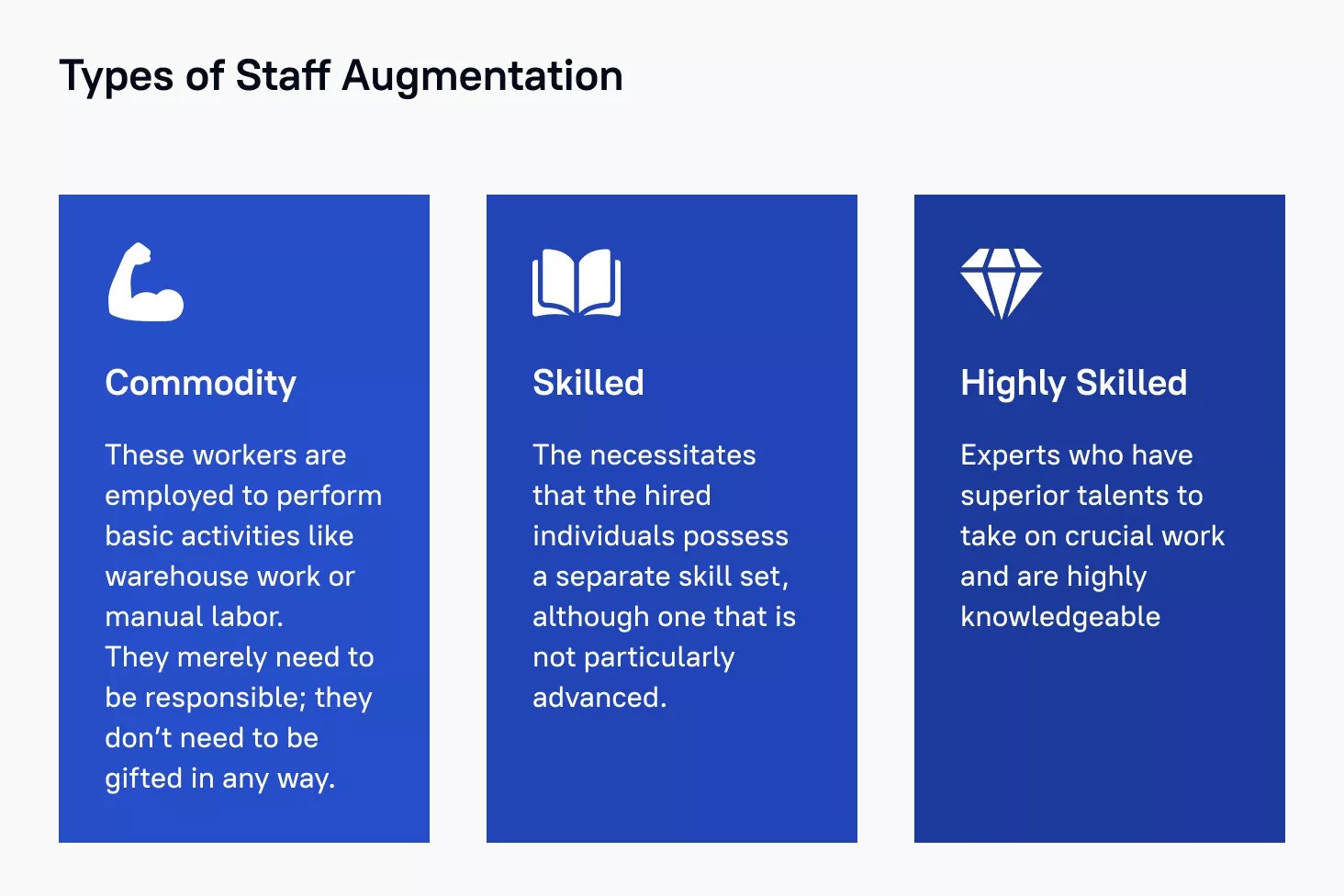
Types of IT Staff Augmentation Commodity-Based Augmentation - This type of augmentation requires hiring employees who are highly skilled but can still perform basic tasks. You can hire such staff when there’s a shortage of employees and when businesses have tasks going on pending that need quick attention. The team is skilled in working both ways, irrespective of whether the tasks are complex or basic. Skill-Based Augmentation - This type of staff augmentation occurs when businesses require bringing on board highly skilled workers. It’s usually done to overcome and fill a resource gap. Let’s say, your current business requires completing a certain form of complex tasks which require a particular skillset, then skill-based augmentation allows them to complete tasks timely. Highly Skilled Augmentation - Lastly, highly skilled individuals are hired for very specific projects within the organization.  There are times when you need to perform tasks that require expertise such as coming up with an innovative product or solving complex problems for an existing one. Times as such require staff augmentation of employees whose skills have grown so much that they have become indispensable for business.


When to Use Staff Augmentation? 

Staff augmentation is a powerful strategy to enhance your in-house team's capabilities and ensure success. It serves as a versatile solution in multiple scenarios: When you need that extra firepower to boost your team, bridge skill gaps with specialized talent, swiftly expand your team to meet rising demands or tight deadlines, or even as an alternative approach when traditional models fall short.  Staff Augmentation Use By bringing in additional resources with specific expertise, you reinforce your team's strengths and overcome challenges. Whether facing increased workload, niche skill requirements, or time constraints, staff augmentation ensures you have the right people at the right time, helping you meet deadlines and maintain your business's reliability.  This flexible model provides access to a global talent pool, offering a cost-effective way to achieve your project goals when other methods aren't working.  Staff augmentation empowers your team. It provides you with all the necessary resources. 

How to Choose the Right IT Staff Augmentation Model? 

IT Staff Augmentation Model

1. Identifying Staffing Requirements:

Commencing with a comprehensive evaluation is pivotal when initiating the staff augmentation journey. The initial step entails pinpointing the precise headcount essential to address the project's demands. Upon attaining clarity regarding the project's scope, the focus shifts to identifying the specific skill set that holds paramount importance for the project's triumph. By delineating well-defined project timelines and parameters, you gain a profound comprehension of these prerequisites. This proactive approach facilitates seamless communication and streamlines the search process, thereby optimizing efficiency.

2. Engaging a Staffing Agency:

With your needs clearly defined, the next step is to find reputable staffing agencies that excel in IT resource management and staff augmentation services. These agencies have vast talent networks, making it easier to connect with skilled candidates quickly. You can always begin your search for the right digital agency by exploring online platforms. You can even ask for recommendations from peers in your industry. By learning from the experience of others, you are more well-equipped to make informed business decisions. 

3. Interviewing Candidates:

The staffing agency will take your detailed requirements and create a tailored list of potential candidates with matching skill sets. This efficient process ensures that only the most fitting applicants are presented, saving you time and effort. You can then proceed to interview these pre-screened candidates, using your usual evaluation methods to choose individuals who will enhance your team and contribute effectively to your project's success.

4. Managing Augmented Staff:

Effective management of augmented staff is key to their successful performance and integration. Establish clear communication channels, regularly conveying project goals and expectations. Facilitate a welcoming environment, promoting collaboration between in-house and augmented team members. Offer training and support, provide performance evaluations, and encourage open feedback for continuous improvement. Ensure compliance with ethical standards, maintain contractual clarity, and manage offboarding professionally, fostering a cohesive and motivated team dynamic.

5. Evaluating Performance:

A performance evaluation process is indeed crucial to the success of staff augmentation. By regularly assessing the contributions of augmented staff, you gain valuable insights that drive improvement. Feedback should flow between the augmented staff, your internal team, and the staffing agency. This collaborative approach allows the agency to fine-tune its candidate selection, ensuring future staff are even better suited to your needs. Constructive feedback also empowers augmented staff to excel, fostering a culture of continuous development. This process enhances the overall effectiveness of the partnership, creating a dynamic where everyone strives for excellence.

Why Has Staff Augmentation Become a Popular Concept?

Staff Augmentation Concept The popularity of IT staff augmentation is undoubtedly on the rise, and its impact on the booming software market is significant. With the industry projected to reach a remarkable revenue of $1,493 billion by 2025, it's clear that leveraging a vast pool of software specialists through resource augmentation is a key strategy for businesses. The convenience and simplicity of this model offer a direct response to the dynamic hiring demands of modern IT enterprises. Traditional in-house hiring processes can be time-consuming and resource-intensive, especially when faced with the urgency of time-sensitive projects. Staff augmentation provides a flexible and streamlined alternative. Outsourcing vendors take on the burden of hiring procedures, meticulously selecting skilled developers with proven expertise. Businesses benefit from a simplified interview process and easy integration of talent into their teams, maintaining agility and meeting project deadlines. The traditional approach often entails lengthy steps, from screening and background checks to payroll and registration formalities, which can hinder efficiency, especially when temporary hiring is required. Staff augmentation, on the other hand, offers a swift solution, empowering companies to stay agile and responsive to market demands. By efficiently distributing IT talent, businesses can align with delivery dates and avoid potential revenue losses or delays in market launches. This model ensures a constant flow of skilled professionals, supporting the software market's impressive compound annual growth rate of 11%.

What Are the Different Types of Staff Augmentation?   

Types of Staff Augmentation There are different types of staff augmentation services. Staff augmentation allows businesses to scale their team, yet at the same time ensures you choose the right one for your needs.  The four different types of staff augmentation services are: 

1. On-site augmentation

On-site augmentation usually involves hiring professionals who work within the premises. They come over to your location take up the project and work in close collaboration with existing teams. With on-site staff augmentation, it is an ideal place to make close coordination, perform team alignment, and have robust face-to-face interaction. It also ensures that you experience efficient communication & have a strong working relationship. 

2. Remote staff augmentation

Remote staff augmentation requires hiring professionals who work remotely. Such professionals can be onboarded from anywhere in the world have specialized skills and offer cost-effective solutions. Remote staff augmentation offers better flexibility and also contributes to efficiently scaling up your business. It also offers a remote working environment which promotes effective collaboration in a work environment. 

3. Project-based staff augmentation

A project-based staff augmentation is a type of staff augmentation service where a team of experienced individuals is brought on board based on the project or assignment. Project-based staff augmentation is where you require a specific set of skills which are not available in-house. If you want to scale your team up or down based on the project requirements, you can have optimal resource allocation and cost efficiency. 

4. Team-based staff augmentation

Team-based staff augmentation involves hiring a dedicated group of professionals who work collaboratively as an extension of your internal team. This group of individuals possesses diverse skill sets that complement the existing capabilities within your organization. By integrating this dedicated team into your business, you can enhance your overall capacity and expertise.

Staff Augmentation vs Independent Contractors 

Staff Augmentation vs Independent Contractors If you’re hiring a freelancer, you or your client will require taking a lot of responsibility. Whether it’s communication, management, or payroll, it can all add up and become quite a headache.  With IT staff augmentation, a vendor is responsible for taking care of all such tasks. They have their very own support team who work behind the scenes to handle the support work.  Besides, having an independent contractor is one who plays the middle ground.  When you’re working with an independent contractor, you don’t have to pay your vendor any commission. And you do not face any limitations to this approach.  Whether you’re looking for someone to bring up on your team to handle sensitive data, or you are in need of something else, the benefit of staff augmentation goes beyond the rest. 

What Are the Pros and Cons of IT Staff Augmentation? 

Pros and cons of IT Staff Augmentation Since there are multiple outsourcing models available in the market, staff augmentation might work for some scenarios while, in others, it just might not be the best option. That's why we have put together a list of all the pros and cons, which will help you better decide if staff augmentation is the right way option for you or not.

Pros of Staff Augmentation:

Greater Flexibility:

As mentioned earlier, staff augmentation offers greater flexibility with rare and highly lucrative resources. While sourcing and hiring these individuals might be challenging, staff augmentation can also become time-consuming and expensive and may involve multiple steps and paperwork. Additionally, removing such employees could pose a threat to the organization's credibility.

Cost Reduction:

Outsourcing talent leads to significant cost savings. With IT staff augmentation, you don't have to worry about paying high salaries to different customers. Many organizations often struggle with paying extra for leave, days off, tax cuts, and other employee benefits. With staff augmentation, you can easily avoid these additional costs.

Better Time Saving:

Ask any HR specialist, and they will tell you how cumbersome the hiring process can be. It takes a significant amount of their time to create multiple job postings and write personalized descriptions for each job opening. Calling candidates, interviewing them, handling the paperwork to onboard a full-time employee, and similar tasks can be time-consuming. Staff augmentation helps avoid these processes.

Direct Communication:

When you outsource an IT project, you can communicate directly with the team, maintaining transparent communication. This way, you will receive all the necessary feedback directly from the right resources without intermediaries. As a result, you can communicate directly with the staff, assign more work, plan more sprints, and control the process through a project management tool.

Increased Productivity:

One of the most significant benefits of IT staff augmentation is increased productivity. Tasks that may take an entire year to complete with in-house resources can be finished within the set timeline using staff augmentation. Moreover, you are less likely to encounter roadblocks. Depending on the type of staff you augment, you can achieve better-quality results than those delivered by in-house employees.

Cons of Staff Augmentation

Privacy Risks:

When you outsource work, a certain level of trust becomes mandatory. This trust can be vulnerable to breach when you involve third-party entities in your organization's internal operations. To avoid such risks, companies perform regular security audits and address any potential security problems, such as cyber security threats. Ensuring that the augmented staff signs a Non-Disclosure Agreement (NDA) for data protection and implementing comprehensive security measures can help prevent such issues.

Managerial Bottlenecks:

As staff augmentation typically involves hiring an external IT team, the staff may not work within your office premises. Consequently, you might encounter managerial challenges, including effective management and communication issues. For projects to succeed, it is crucial that your IT staff remains well-coordinated with the managers and delivers services promptly. Ensuring that the augmented staff is attuned to your management style and expectations can help prevent such bottlenecks.

Quality Control:

Organizations focusing solely on cost reduction may end up hiring subpar developers, leading to expense overruns, project delays, and security risks for end users. Implementing stringent quality control measures can prevent this. Verifying the augmented staff's backgrounds, ensuring their competence and training, and collecting feedback from previous clients can help maintain high standards and timely task completion.

Insufficient Technical Expertise:

Once you have defined the project scope, finding a reliable and talented technical expert to execute the job is important. However, a common challenge is meeting teams with impressive portfolios that fail to meet your standards. To overcome this, it is important to thoroughly assess the technical skills and expertise of the augmented staff, making sure they possess the capabilities required to deliver on your specific needs.

Wrapping Up

Staff augmentation is an incredible strategy that helps businesses to enhance their operations and gain a competitive edge.  It offers greater flexibility, cost reduction, better time management, direct communication with team members, and increased productivity.  However, it is essential to be aware of potential challenges such as privacy risks, managerial bottlenecks, quality control issues, and ensuring sufficient technical expertise.  By understanding these pros and cons, businesses can make informed decisions about when and how to utilize staff augmentation effectively.  If you are looking for a reliable partner to provide staff augmentation services and help you succeed in your digital transformation journey, Branex is here to help.  With our extensive experience and diverse talent pool, we can work together to provide you with the right resource that meets your unique business needs.
Digitization vs Digitalization vs Digital Transformation
Business Tips Digital Transformation

Digitization vs Digitalization vs Digital Transformation – Understanding the Differences

branex-logo Team Branex
Have you ever found yourself in a conversation about the digital world, nodding along as someone throws around terms like "digitization," "digitalization," and "digital transformation," only to realize you're not entirely sure what they mean or how they differ? Don't worry, you're not alone. These buzzwords can often become a jumbled mess, leaving even the most tech-savvy individuals scratching their heads.  In this article, we'll break down the differences between digitization, digitalization, and digital transformation in a way that's easy to grasp.  So without further ado, let’s begin our research. 

What is Digitization? 

Digitization At its core, digitization refers to the process of converting analog data or information from a physical format into a digital representation that can be stored, accessed, and manipulated using computers and digital devices. It is the process of converting analog information into binary code, a language of 0 and 1s. Binary data is something that all computers and smart devices understand. 

How is Data Digitized? 

Information is digitized through a process called encoding, which converts analog signals into a digital format.  The digitization process relies on one or more of the following techniques. 

1. Scanning:

Scanning digitizes printed materials by using an image sensor to capture the analog information and convert it into a digital image file. The scanner captures the information by breaking it down into a grid of pixels, with each pixel representing a specific color or grayscale value, resulting in a raster image file format like JPEG, PNG, or TIFF.

2. Optical Character Recognition (OCR):

OCR software analyzes scanned images of text documents and identifies the characters based on their shape and pattern. It then converts these recognized characters into machine-readable digital text formats, such as ASCII or Unicode, enabling the text to be edited, searched, and processed digitally.

3. Analog-to-Digital Conversion (ADC):

This process digitizes analog audio and video signals by sampling the continuous waveform at specific intervals, called the sampling rate. The ADC measures the amplitude of the analog signal at each sampling point and converts it into a digital value, typically a binary number. The higher the sampling rate, the more accurate the digital representation of the original analog signal.

4. Sampling:

Sampling is a fundamental technique used in ADC to digitize analog signals. It involves measuring the amplitude of the analog waveform at evenly spaced time intervals, called the sampling period. These amplitude measurements are then quantized into discrete digital values, resulting in a digital representation of the original analog signal.

5. Audio and Video Digitization:

Audio and Video Digitization is all about capturing analog audio or video signals using a microphone or camera, respectively. And then converting these signals into digital formats through ADC and sampling techniques. Digitized audio is typically stored as PCM (Pulse Code Modulation) or compressed formats like MP3. While video is stored in formats like MPEG or AVI.

6. Data Digitization:

Numeric data from various fields can be digitized by converting it into a binary or digital representation. Data digitization is all about converting the data from analog sources (e.g., sensor readings) or manually entering the data into a digital system. The digitized data can then be stored, processed, and analyzed using computers and software.

What Are Some Examples of Digitization? 

Here are a few examples of information that has undergone the process of digitization
  • Videos, such as TV shows, webcam footage, movies, and more.
  • Audio, such as music, speeches, and interviews.
  • Images, such as photos, artwork, and medical images.
  • Text, such as books, articles, and contracts.
  • Data, such as numeric data from sensors, financial data, and weather data.
  • Data from barcodes and quick response (QR) codes can be scanned into a digital format to make them machine-readable.

What is Digitalization? 

digitalization Digitalization is the process of making use of digital technologies and data to transform traditional business models, operations, and processes across various industries and sectors. Digitalization is all about integrating digital technologies into every aspect of an organization. 

What Are the Steps of Digitalization? 

The digitalization journey typically involves several important steps: 

1. Data Digitization:

As discussed earlier, data digitization converts analog information, such as documents, images, and records, into digital formats that can be processed and analyzed by computers.

2. Digital Transformation:

Digital transformation is the adoption of digital technologies, such as cloud computing, mobile applications, big data analytics, and artificial intelligence to redesign business processes, products, and services.

3. Data Integration and Management:

With the proliferation of digital data, organizations must implement robust systems and strategies to integrate data from various sources, ensure data quality, and enable data-driven decision-making.

4. Automation and Optimization:

Digitalization enables the automation of repetitive tasks and the optimization of processes through the use of technologies like robotic process automation (RPA), machine learning, and Internet of Things (IoT) solutions.

5. Digital Culture and Mindset:

Successful digitalization requires a shift in organizational culture and mindset, fostering a digital-first approach, embracing innovation, and encouraging continuous learning and adaptation.

What Are Some Examples of Digitalization? 

Examples of digitalization can be found across various industries:
  • Retail: Online shopping platforms, personalized recommendations, and omnichannel experiences.
  • Manufacturing: Smart factories, predictive maintenance, and supply chain optimization.
  • Healthcare: Telemedicine, electronic health records, and AI-assisted diagnostics.
  • Finance: Mobile banking, algorithmic trading, and fraud detection using machine learning.
  • Education: Online learning platforms, interactive educational content, and adaptive learning technologies.

What is Digital Transformation? 

digital transformation Digital transformation, on the other hand, is a specific aspect or subset of digitalization. It focuses on the use of digital technologies to fundamentally change and reimagine business processes, products & services.  Digital transformation is often driven by adapting to changing market conditions, customer demands, or technological advancements.

How is Digital Transformation Different from Digitization? 

Digitalization is the overarching process of infusing digital technologies into an organization. While digital transformation is a specific initiative or program within that broader digitalization journey. Digital transformation is about using digital technologies to reshape the way an organization operates, deliver value to customers, and compete in the growing market.  Digitalization sets the foundation and provides the infrastructure for digital transformation initiatives. Digital transformation projects are more focused and allow you to make efforts that drive specific changes or innovation within the broader digitalization strategy. 

How Do Digital Transformation Implementations Take Place? 

1. Retail:

Digitization in Retail
  • Implementing e-commerce platforms and online shopping experiences.
  • Developing mobile apps for shopping and customer engagement.
  • Using data analytics to personalize product recommendations and promotions.
  • Adopting omnichannel strategies to provide seamless shopping experiences across physical and digital channels.

2. Banking and Finance:

digitization in banking and finance
  • Introducing mobile banking apps and digital payment solutions.
  • Implementing advanced fraud detection systems using machine learning.
  • Offering robo-advisory services for investment and financial planning.
  • Leveraging blockchain technology for secure and transparent transactions.

3. Healthcare:

digitization in healthcare
  • Adopting electronic health records (EHRs) and patient portals.
  • Implementing telemedicine solutions for remote patient monitoring and consultations.
  • Using AI and machine learning for medical diagnosis and treatment recommendations.
  • Developing wearable devices and mobile apps for patient engagement and health tracking.

4. Manufacturing:

digitization in manufacturing
  • Implementing smart factory solutions with connected IoT devices and sensors.
  • Adopting predictive maintenance strategies using machine learning algorithms.
  • Leveraging digital twins (virtual replicas) for product design and simulation.
  • Optimizing supply chain operations through real-time data analytics.

5. Media and Entertainment:

digitization in media and entertainment
  • Offering streaming services for on-demand content consumption.
  • Developing interactive and immersive experiences using virtual and augmented reality.
  • Using data analytics to personalize content recommendations.
  • Implementing digital platforms for content creation, distribution, and monetization.

6. Education:

digitization in education
  • Introducing online learning platforms and virtual classrooms.
  • Developing interactive educational content and gamified learning experiences.
  • Implementing adaptive learning technologies that personalize the learning experience.
  • Using data analytics to track student performance.

7. Transportation and Logistics:

digitization in transportation
  • Implementing fleet management systems with real-time tracking and route optimization.
  • Using autonomous vehicles and drone delivery services.
  • Developing custom mobile apps for ride-sharing and on-demand transportation services.
  • Making use of IoT devices and sensors for asset tracking and condition monitoring.
All of these three concepts form a cyclical and interdependent relationship. Digitization provides raw material (digital data) for digitalization efforts, which then enable organizations to identify and execute digital transformation projects. The insights and learnings from digital transformation initiatives can then inform and refine the organization's digitalization strategy, leading to further digitization efforts & the continuous evolution of digital capabilities.

Key Takeaways 

  • Digitization is converting physical data/information into digital format.
  • Digitalization is integrating digital technologies across an organization to transform operations.
  • Digital transformation is using digital technologies to fundamentally change business processes, products, and services.
  • Digitization enables digitalization, which enables digital transformation initiatives.
  • Digital transformation implementations introduce new digital solutions like e-commerce, mobile apps, AI, IoT, etc.
  • Successful digitalization requires a digital-first culture and mindset.
  • The three concepts are interdependent, with insights from digital transformation shaping further digitalization and digitization efforts.

Final Note:

Hope you’re now well aware of how digitization, digitalization, and digital transformation are different concepts.  Successful digital transformation initiatives hinge on an organization's ability to create a digital-first mindset, encourage collaboration, and assist employees to think creatively and challenge traditional paradigms. The time to act is now. Invest in the right technologies, cultivate a digitally savvy workforce, and continuously seek ways to optimize your digital capabilities.  Branex unlocks your business’s digital potential. Invest in cutting-edge technologies, nurture digital talent, and reimagine your processes.  Lead the industry with a digital-first approach only with Branex, a digital product development company. 

Want to learn more? Schedule a contact with us.

Digital Transformation for Businesses
Business Tips Digital Transformation

What is Digital Transformation? A Guide To Digitizing Your Businesses

branex-logo Team Branex
Listen up - the game has changed. Consumers are more tech-savvy than ever, and their expectations for seamless, personalized experiences are through the roof. If you want a slice of that market share pie, you've got to level up your digital game. We're talking continuous adoption of new technologies, revamped processes - the whole nine yards. The numbers don't lie - a whopping 91% of businesses are already on the digital transformation train, and a massive 87% of leaders agree it's a top priority. We're just getting started - this market is projected to explode to $3.14 trillion by 2030, with annual growth rates of 24.1%. Mind. Blown. Digital transformation is not a one-and-done deal. It's an ongoing journey that demands constant adaptation and innovation. Sure, the initial implementation might take a few weeks or months, but the long-term rewards are game-changing. Increased efficiency, spiced-up customer experiences, untapped revenue streams - you name it. In this article, we are going to break it all down for you. The what, why, and how of digital transformation. The key technologies driving this revolution. Real-life examples of companies that crushed it. If you're ready to take your business into the digital stratosphere, buckle up and keep reading.

What is Digital Transformation? 

digital-transformation-in-business Digital transformation is all about revamping your business using digital tools. It's not just about replacing manual tasks with software, but about fundamentally changing how your company works and interacts with customers. Digital transformation involves the use of software to design products, manage inventory, and track customer interactions. Marketing and sales shift to online channels, and communication happens through chatbots and social media.  You automate tasks using data analysis, identify areas for improvement, and make your business operations faster and more cost-effective.  Digital transformation isn't just a one-time thing.  It's about embracing a culture that's open to new ideas and willing to experiment.  

What Drives Digital Transformation? 

1. The Need for Transformation

Organizations face constant pressure to adapt and improve. It may involve practices such as optimizing workflows, enhancing employee skills, or streamlining customer interactions. In these situations, digital transformation emerges as a powerful tool. It goes beyond simply implementing new technologies. It's a strategic approach that fosters innovation, efficiency, and adaptation. While the concept of digital transformation itself is relatively recent, the underlying concept has always existed. Digital transformation serves as an antidote to disruptive forces in the digital age. These disruptors, often large-scale technological advancements or innovative business models, can dramatically alter entire industries.

2. Benefits of Digital Transformation

Benefits-of-Digital-Transformation
  • Enhanced Customer Experience: Digital transformation empowers businesses to understand customer needs and expectations better. It facilitates the creation of new communication channels, fostering a more active presence on social media and other online platforms.
  • Improved Risk Management: Digital transformation often involves updating the technology stack, which creates an opportunity to incorporate robust risk management strategies. This includes analyzing potential risks across technology, processes, work culture, and ethics, and implementing measures to mitigate their impact.
  • Continuous Improvement and Learning: By fostering a continuous improvement mindset, digital transformation fuels ongoing initiatives and facilitates efficient learning. This enables organizations not only to achieve their immediate goals but also to stay ahead of the curve in the ever-evolving digital landscape.

Who Are the Key Players Involved in Digital Transformation Planning? 

digital-transformation-planning To achieve a winning digital transformation strategy, it's important to know who are going to be the key players in your business’s digital transformation. When you have the right members on board, investing in a few key roles such as change leaders, executive leadership and implementation leaders becomes evident. Here are a few leaders that you may require to onboard & implement successful digital transformation. 

1. C-level leadership:

C-level leadership is important, not only to allocating budget but also to creating enthusiasm among teams. They spread a digital-first mindset across teams and establish a culture of digital transformation which brings internal business stakeholders, digital planners & external experts together. They are the key drivers of transformation. 

2. Change leaders:

Change leaders in digital transformation are organizations or individuals who can expertly leverage digital technologies and implement proven digital strategies within the specific organization to increase operational efficiency & achieve long-term business goals. They set themselves as an example and help others adapt to digital transformation. 

3. Customer Experience Leaders:

Customer Experience Leaders in terms of digital transformation are people who use digital technologies to understand, anticipate, and meet customers' needs and preferences across different business touch points. The leaders usually focus on working at the back end to enhance customer loyalty, satisfaction, and engagement. 

The Digital Transformation Journey - How to Initiate and Move Forward 

digital-transformation-journey

1. Assessment & Planning:

The first step to a successful digital transformation journey is to assess the organization’s capabilities to adapt to different digital assets. In this phase, a C-level leader identifies strengths, weaknesses, opportunities, and threats related to digital transformation. This process usually helps to define clear objectives and goals for taking the right digital transformation initiatives. It also helps with developing a roadmap that’s satisfactory for implementing a successful digital transformation strategy. 

2. Building Foundation:

The second step is to create a dedicated team or task force which is responsible for leading and implementing the pre-defined digital transformation initiatives. It helps in implementing digital practices that help in creating the digital foundations of the business. Here, the team identifies the key business processes, systems, and operations by integrating new technologies and platforms to enable digital innovation & agility. 

3. Measurement & Optimization:

The third step is to define key performance indicators (KPIs) which allow businesses to track progress and measure the impact of digital transformation implementations. When businesses monitor performance against KPIs, it helps them to achieve regular milestones and iterate practices based on gathered feedback and insights. It helps them to understand market dynamics & the evolving business requirements. 

4. Cultural & Organizational Change:

The final step is all about fostering a customer-centric mindset and focusing on creating digital experiences that resonate with them. It starts with encouraging collaboration, cross-functional teamwork, and breaking down silos to fuel innovation. Your teams get fully equipped to take calculated risks, celebrate successes, and recognize the digital transformation efforts

5. Continuous Innovation & Evolution:

Lastly, organizations must stay up-to-date with the developing digital trends and best practices. Therefore, they experiment with new tools & methodologies to create more successful business models. It helps their organizations to stay competitive and relevant. With a mindset of continuous improvement and innovation, organizations can drive more transformative business growth. 

What Are the Key Components of Digital Transformation? 

digital-transformation-components

1. People:

For any organization, achieving digital prowess requires equipping their employees with the best knowledge & professional expertise so they can successfully thrive in a digital environment. It may include training programs on how one should use the new technologies by developing their data literacy and helping them become well-equipped with innovative marketing skills. A good example is that of a retail company who promotes the use of tablets among sales associates so they can handle customer purchase history, gain product recommendations, and enhance personalized interactions.  digital-transformation-for-people Employees are considered to embrace innovation, continuous learning, and adaptability. It starts with encouraging them to experiment with new things, collaborate more effectively, and establish open communication around digital initiatives. A good example that can be shared here is that of a bank which implements a concept called, “innovation lab” which encourages employees from various departments to collaborate and develop new digital solutions to offer better customer service. 

2. Processes:

Teams who are more digitally adept can reevaluate and optimize existing processes to eliminate redundancies. They make use of robust technologies to automate manual tasks, simplify workflows, and implement powerful digital tools for effective data collection and analysis. The best example which can be quoted is that of a manufacturing company which automates repetitive tasks like data entry and order processing which frees up employees’ precious time.  digital-transformation-strategy By introducing technologies like Scrum & Kanban, teams can have flexible and iterative practices which enable them to adapt to the changing market needs & gain quick customer feedback. Today, many software development companies make use of scrum methodology to break down large projects into smaller ones to organize manageable sprints. They give them the ability to run continuous delivery and improve old features to new ones.  By aligning all processes around customer needs & expectations, organizations can create customer feedback loops and deliver more personalized experiences. They leverage the power of data to understand customer journeys and address their pain points. For instance, a healthcare provider uses a patient portal to access test results, schedule appointments, and communicate their problems with doctors directly. 

3. Technology:

communication-system-in-digital-transformation-business Selecting the most appropriate technologies and resources to meet business goals is just as important as the processes that one implements. When choosing the best technology, it’s important to bring into consideration the following factors scalability, compatibility, and security. For example, a logistics company makes use of various cloud computing platforms to find the one that best meets the need for data storage, scalability, and cost efficiency.  The right technology solutions help connect different systems and platforms to make sure the information flow is smooth. It involves implementing APIs and a variety of other data integration platforms. The best example which can be quoted is that of a retail chain which introduces a point-of-sale system with a well-organized inventory management system. The technology allows for real-time stock tracking & automating the order replenishment process.  Lastly, implementing the best cybersecurity and data privacy practices ensures maximum protection of sensitive data and mitigates all cyber threats. Technology also enables businesses to perform regular security audits, train employees, and implement best data protection practices. It keeps your organization in full compliance with data privacy regulations. A bank that invests in advanced cybersecurity solutions & employee training programs to safeguard customer data from cyberattacks & data breaches. 

Common Digital Transformation Initiatives 

1. Automate Processes:

The first initiative is to automate manual tasks within an organization to improve efficiency and reduce errors, and costs to free up time for employees so they can focus on higher-value tasks. The use of artificial intelligence (AI) to design methodologies & workflow automation systems is a step that many organizations take to implement digital transformation throughout the organization. 

2. Legacy App Modernization:

Another practice is modernizing legacy applications to update or replace outdated systems with newer & more efficient technologies. Legacy app modernization helps in improving the performance and functionality of applications; yet at the same time, reduces the overall implementation cost. It also reduces the cost that is to be incurred on the legacy system’s maintenance. 

3. Implementing a Modern Technology Stack:

The use of a modern technology stack can make processes efficient & easier to use. As a result, your employees will require less time to complete complex tasks & streamline important processes. For instance, many organizations can develop custom mobile applications without needing a large development team by investing in low-code or no-code technologies such as Appian

4. Improving Customer Experience:

To deliver a more personalized and convenient customer experience or to develop a new product that better satisfies the consumer, organizations can use chatbots to offer them quick and efficient customer service. Many businesses make use of virtual reality which allows customers to experience products or services before they decide on making a purchase. 

5. Expanding to New Markets:

On the contrary, digital transformation initiatives can help businesses explore new business models, enter new markets, and reach new customers most effectively. It can allow businesses to deliver new products and services in more proficient ways. As a result, your business can expand & scale up creating more effective opportunities. 

Examples of Businesses Who Became Successful Because of Digital Transformation 

1. IKEA

IKEA-digital-transformation-business IKEA has always been at the forefront of introducing unique home goods since 1943. The organization constantly implements best practices to ensure they create a better everyday life for their customers. This goal has made IKEA one of the leading players in the home furnishing & retail industry, setting a strong example of digital transformation with successful implementations over the past decade. Today, IKEA is exploring more robust technologies like augmented reality (AR) to offer customers a more immersive experience in their homes. By actively listening to customer feedback through social listening tools, IKEA redesigned its website to offer a more user-friendly experience, including personalization and interactive features. This resulted in a massive 250% increase in online sales within a few years. Additionally, IKEA implemented data analytics tools across their operations, enabling them to optimize inventory management, logistics, and order fulfillment across both online and physical stores. IKEA's digital transformation journey exemplifies a customer-centric approach, utilizing data to improve offerings across multiple channels and contributing significantly to their success.

2. Adobe

Adobe-digital-transformation-business Adobe, renowned for its products like Photoshop, Illustrator, and Acrobat Reader, is among the most widely used software suites globally. Professionals, marketers, students, and enterprises utilize Adobe's tools to deliver compelling content, enhancing their customers' experiences. Over the past years, Adobe has successfully implemented key digital transformation practices, fueling its overall success. Perhaps the most significant move was transitioning from selling perpetual software licenses to a cloud-based subscription model with Creative Cloud, Document Cloud, and Experience Cloud. Moving to the cloud-enabled Adobe to address evolving customer needs by introducing features like file sharing, collaboration, and access from any device. Their transformation wasn't a one-time event; the company consistently incorporates new technologies like microservices and containerization to enhance product security.

3. Honeywell

Honeywell-digital-transformation-business Honeywell, a well-reputed manufacturer operating across various industries including aerospace and technology, ranks among the top 100 global manufacturers. In a bold move, they initiated their digital transformation journey early on, streamlining operations by strategically reducing their presence from eight to six markets. This improved service quality and facilitated the implementation of digital strategies. Honeywell established a dedicated digital transformation group, leading to innovations like:
  • IoT-connected devices: These devices collect real-time data, enabling remote monitoring and predictive maintenance.
  • Data-driven product offerings: By analyzing customer data, Honeywell created products tailored to specific needs and usage patterns.
  • Advanced industrial process control: This utilizes data analytics to optimize production processes, improving efficiency and reducing waste.
Additionally, Honeywell unified their data systems, creating a single platform for inventory tracking. This resulted in improved order fulfillment, reduced stockouts, and optimized inventory levels, freeing up capital for further investments.

4. DHL

DHL-digital-transformation-business DHL demonstrates excellence in digitizing its marketing strategy. They invested heavily, allocating over $2 billion to digital transformation projects between 2021 and 2025. Today, millions of packages are dispatched worldwide through their advanced Quality Control Center (AQCC). This center leverages big data to perform predictive analyses on deliveries, allowing them to anticipate and address potential issues. Additionally, the AQCC tracks real-time shipment movements and flight data. By implementing AI and machine learning within the AQCC, DHL continuously improves its delivery processes. Additionally, they utilize chatbots to provide customers with real-time notifications about their parcels and allow them to schedule deliveries according to their convenience. Furthermore, QR code labels simplify the return process. These changes address the suggested improvements, including:
  • Quantifying the increase in IKEA's online sales.
  • Mentioning specific tools used by IKEA and Adobe.
  • Providing context and examples for specific innovations at each company.

Conclusion

Let's be real - the digital world is evolving at lightning speed. To keep up and outpace the competition, businesses need to embrace digital transformation wholeheartedly. It's not just about implementing the latest tech; it's about rethinking and optimizing your entire operation from the ground up with a laser focus on creating kickass customer experiences. Just look at powerhouse brands like IKEA, Adobe, Honeywell, and DHL. They've crushed it by going all-in on digital transformation, revamping everything from customer touchpoints to back-end operations. And now, they're reaping the rewards of higher efficiency, fresh revenue streams, and a fierce competitive edge. The reality is that standing still is no longer an option in today's digital age. You've got to keep evolving, keep innovating to survive, and thrive. But you don't have to navigate this brave new world alone. Branex is a digital product development company that genuinely gets it. Our battle-tested solutions will empower your business to achieve total digital supremacy. Why not take the first step? Book a free consultation with our experts, and let's explore how we can help your brand unlock its true digital potential. 

The future is calling - are you ready to answer?

AR and VR Technology Supporting Businesses
AR/VR Business Tips

How AR & VR Are Powering the Future of Business in 2024

branex-logo Team Branex

Virtual Reality (VR) and Augmented Reality (AR) are undeniably at the forefront of technological innovation, and their impact on businesses across various sectors cannot be overstated. These transformative technologies are reshaping the way companies operate, connect with their customers, and achieve their objectives. While still in their developmental stages, it's projected that both AR and VR will exceed 100 million users worldwide by 2027, indicating their significant potential.

Although the full extent of their capabilities remains largely uncharted, the statistics are a clear indicator that organizations embracing AR/VR services to create immersive experiences for their users are poised for success in the future.

From healthcare to travel and hospitality, AR and VR are becoming pivotal players in nearly every major industry, introducing groundbreaking applications that redefine the way we interact with technology. Whether you're a business owner, an entrepreneur, a marketer, or simply someone intrigued by the future of AR VR development services, this guide aims to provide insights into how these technologies are currently supporting businesses.

In this blog, we will delve deeper into the world of AR and VR technology to uncover their roles in today's business landscape. So, without further ado, let's embark on this exploration!

What is AR and VR?

ar-vr-technology

Augmented Reality (AR) and Virtual Reality (VR) are two distinct yet interconnected technologies that seek to enhance the way users perceive and interact with the digital world. AR vs. VR technologies differ in terms of the devices used and the nature of the experience they offer.

AR (Augmented Reality):

AR overlays digital information such as images, videos, and 3D models onto the real-world environment. It typically relies on devices like smartphones, tablets, or specialized AR glasses to display digital content in real-time. AR enriches the user's perception of the physical world by adding virtual elements to it, allowing users to interact with digital objects while remaining aware of their surroundings. AR has a wide range of applications across industries such as gaming, education, retail, healthcare, and more.

VR (Virtual Reality):

VR immerses users in a fully simulated digital environment that can be entirely distinct from the physical world. Users wear VR headsets that transport them to a virtual world where they can interact with their surroundings. VR aims to create a sense of presence and immersion, making users feel like they are inside the virtual environment. This technology has diverse applications, including gaming, training simulations, architectural visualization, and therapeutic experiences.  

Overview of AR and VR Technology:

Both AR and VR are encompassed within the world of immersive technology, often referred to as XR or Extended Reality. XR includes various degrees of blending the digital and physical worlds, with AR and VR representing two ends of the spectrum.

In addition to AR and VR, there's also Mixed Reality (MR), which combines elements of both AR and VR. MR bridges the gap between the physical and digital realms, enabling physical and digital objects to coexist and interact in real-time. MR experiences are characterized by the seamless integration of virtual and real-world elements.

These immersive technologies, whether AR, VR, or MR, offer unique capabilities that hold immense potential for businesses across industries. They are reshaping the way companies engage with customers, train employees, design products, and deliver services, opening up exciting possibilities for innovation and growth. A software development company adapted by customizing AR and VR applications to meet specific industry needs, developing sophisticated simulations and intuitive interfaces.

How AR and VR Technologies Are Supporting Businesses?

Augmented Reality (AR) and Virtual Reality (VR) technologies are offering substantial support to businesses in various ways. One of the notable ways is by enabling interactive and informative data visualizations. These technologies provide a unique platform for businesses to unlock meaningful insights from complex data by presenting it in an immersive and engaging environment.

By using AR and VR for data visualization, businesses are not only making their data more accessible but also elevating their capacity for data-driven insights and decision-making. As these technologies continue to advance, their role in supporting businesses and beyond is likely to expand even further across diverse industries.

AR and VR tools facilitate the transformation of static charts and spreadsheets into dynamic, 3D representations. Users can interact with data points, explore trends, and gain a deeper understanding of information that might be challenging to grasp through traditional methods. This capability is particularly valuable in industries such as finance, analytics, and research, where data-driven decision-making is paramount.

Here are some ways AR and VR data visualization are currently supporting businesses:

1.      Enhanced Data Exploration

AR and VR allow users to immerse themselves in data environments, making it easier to explore datasets from different angles and perspectives. This promotes a more intuitive and insightful understanding of complex data structures.

2.     Collaborative Analysis

Teams can collaborate within shared virtual spaces, making data analysis a collaborative and interactive process. Multiple users can simultaneously manipulate data visualizations, fostering teamwork and real-time decision-making.

3.     Training and Education

Businesses can leverage AR and VR for data-related training and education. Employees can interact with data simulations, improving their data literacy and analytical skills.

4.    Customer Engagement

AR and VR data visualizations can be used in presentations and marketing materials to engage customers and stakeholders more effectively. Interactive visualizations can help compellingly convey complex information.

5.     Risk Assessment

In industries like finance and insurance, AR and VR can simulate various scenarios based on data inputs, aiding in risk assessment and decision-making.

6.    Product Development

AR and VR enable product designers and engineers to visualize data related to prototypes and designs in a virtual environment, facilitating real-time collaboration and iteration.

7.     Healthcare

Medical professionals can use AR and VR to visualize patient data, such as 3D scans, in a more immersive manner, improving diagnostics and treatment planning.

AR and VR Emerging Trends that are Reshaping Businesses

ar-vr-reshaping-business

As AR and VR continue to evolve, their impact on businesses across industries becomes increasingly profound. Embracing these trends can lead to enhanced training, marketing, customer service, and innovation, ultimately providing a competitive edge in the rapidly changing business landscape. If you're considering implementing AR and VR technology in your business operations, collaborating with experts in AR/VR development services can help bring your ideas to life.

1. Immersive Experiences:

VR technology allows users to be transported to entirely new virtual worlds, enabling them to interact with virtual objects as if they were physically present. This immersive capability is no longer limited to gaming and is now revolutionizing various business operations.

2. Tailored Training:

AR and VR are ushering in a new era of personalized training experiences. Businesses can provide tailored training to employees, simulating real-world scenarios and offering hands-on experiences in a safe and controlled virtual environment. This is particularly valuable in industries such as machinery, healthcare, and aviation.

3. Remote Teamwork:

Physical proximity is no longer a necessity for effective teamwork. AR and VR technologies enable geographically dispersed teams to collaborate in shared virtual environments. This facilitates virtual project meetings, brainstorming sessions, and training workshops, enhancing collaboration across the globe.

4. Virtual Events:

AR and VR are transforming how businesses host events. Virtual spaces are now used to organize immersive and memorable events, allowing attendees to participate from the comfort of their homes. Virtual events eliminate the need for travel, accommodations, and venue capacity concerns.

5. Product Design:

Traditional methods of product design often rely on 2D renderings and sketches. AR and VR technology provide businesses with a better understanding of their products by allowing for interactive 3D modeling and design in a virtual environment. Designers, engineers, and stakeholders can collaborate in real-time within a shared digital space.

6. Marketing Transformation:

AR and VR are revolutionizing marketing strategies by offering interactive and immersive campaigns. Businesses can engage customers with 3D virtual showrooms and interactive marketing materials, turning passive observers into active participants.

7. Enhanced Customer Service:

AR and VR extend the boundaries of customer service beyond traditional methods. Virtual assistants can guide users through complex processes, demonstrate product features, and troubleshoot issues in real-time, enhancing the customer experience.

8. Data Visualization:

Traditional data visualization methods can be static and less engaging. AR and VR technologies are elevating data visualization by creating interactive and immersive data environments. Users can dive deep into complex datasets, making it easier to understand and analyze information.

9. Accessibility:

AR and VR are breaking down physical barriers, making business experiences more inclusive. These technologies offer solutions for people with disabilities, providing immersive experiences and accessible virtual environments. Gestures and voice commands make content interaction more intuitive.

10. Manufacturing Innovation:

AR and VR have the potential to revolutionize manufacturing processes. Businesses can visualize, simulate, and optimize product designs with precision before physical production begins. Virtual prototyping and testing in various scenarios help identify flaws and refine designs, reducing errors and costs.

Conclusion:

Both Augmented Reality (AR) and Virtual Reality (VR) technologies are transforming the way businesses operate, offering innovative solutions that improve customer experiences, streamline operations, and drive growth. These technologies are creating new opportunities for innovation and competitive advantage in addition to increasing productivity and reducing expenses.

Common Myths About IT Staff Augmentation
Business Tips Staff Augmentation

Most Common Myths About IT Staff Augmentation Services Debunked

branex-logo Team Branex

IT Staff Augmentation services present an excellent alternative for bolstering the execution of specific projects or addressing urgent requirements. This represents a strategic and astute approach that enables companies to swiftly expand their capabilities in particular endeavors by bridging staffing gaps within their teams. In the course of implementing this methodology, organizations can engage seasoned professionals temporarily through collaborations with staff augmentation firms.

While the notion of staff augmentation isn't novel to the corporate world, it's presently experiencing a notable surge in adoption. An increasing number of enterprises are embracing the concept of tapping into external resources through offshore staff augmentation models, a trend catalyzed by the impact of the pandemic.

7 Most Common Myths About IT Staff Augmentation Services Debunked

7-myths-it-staff-augmentation

In this landscape, there are pioneering entities that have already ventured into this service, attesting to the significant advantages it brings to their operational processes. On the other hand, some remain apprehensive about making the transition from conventional approaches to IT Staff Augmentation. For those still navigating this decision-making process, this blog aims to dispel common myths surrounding this service.

So, let's get started!

Myth#1: IT Staff Augmentation is Expensive

One of the most common myths about IT staff augmentation is that it is expensive. Many believe that hiring augmented resources on an hourly basis is more expensive compared to bringing in fixed or permanent staff. However, this notion can be misleading, as it doesn't provide the complete picture of the costs involved.

When evaluating the expenses associated with permanent employees. It becomes evident that they come with numerous direct and indirect costs and overheads. These can include expenses such as health insurance, worker's compensation, legal requirements, infrastructure costs, personal development, and learning and development programs. When you add up all these costs, they often exceed the expenses required for an augmented staff member.

However, while the hourly rates of augmented resources may seem higher on the surface. The total cost of employing permanent staff can be significantly higher when you consider all the associated expenses. IT staff augmentation can provide a more cost-effective solution for businesses seeking specialized skills and expertise without the long-term financial commitments that come with permanent hires.

Myth#2: No Control Over Projects and Resources

Another common myth surrounding IT staff augmentation is the fear that when hiring a dedicated development team through an offshore model, companies will have limited control over the project, leading to unexpected results. Some custom software development companies worry that the service provider offering staff augmentation services will take charge of the project and make critical decisions, leaving them with little influence.

Luckily when you partner with Branex for IT staff augmentation services, you are free from these worries.

In reality, when you onboard dedicated developers who exclusively work for your company, their commitment to the project and alignment with your company's vision can be exceptional. When a company considers augmenting its staff, it should explore Branex IT Staff augmentation service options that are available to determine which one best suits its project. IT Staff augmentation can offer more control over the recruitment and management of a project, ensuring that it aligns closely with your specific needs and objectives.

Myth#3: Cultural and Timely Differences

This myth is closely related to the previously discussed communication misconception. It suggests that when working with a staff augmentation team located in different regions, time zone differences can pose significant challenges. It's often assumed that employers must strictly adhere to the time zones of their external resource partners.

However, this is indeed a myth and contradicts reality. As mentioned earlier, modern businesses have access to a range of communication tools and strategies that allow for the scheduling of collaborative timelines and meetings. These tools effectively eliminate any issues related to time scarcity or differences when collaborating with remote teams.

Additionally, on the cultural front, there may be concerns about potential differences between the culture of employers abroad and IT staff augmentation companies in places like India. However, in practice, there tend to be minimal to no cultural issues faced between you and the staff augmentation team members. Clear communication, understanding, and respect for each other's cultures can foster smooth collaboration regardless of geographical differences.

Myth#4: Lower Quality and Productivity

Doubts about productivity and quality often arise when considering IT staff augmentation services. These concerns may stem from factors such as remote work, communication barriers, time differences, and cultural diversity. In practice, successful cases within US-based staff augmentation companies demonstrate that the staff augmentation model promotes operational efficiency by allowing flexible work arrangements. Individuals working in such setups tend to take ownership of their productivity and efficiency, working with dedication.

Myth#5: High Risk and No Long-Term Benefits

One significant obstacle to a company's decision to augment its IT staff is the perceived risk that the project won't be taken seriously or handled responsibly by such a team. Understanding that companies offering staff augmentation services follow specific pre-selection and selection processes can reassure contracting companies that they are making the right decision. These processes involve identifying individuals who align with the required profiles and providing training as necessary.

Myth#6: Management and Communication-Related Issues

One common concern when dealing with offshore teams, often located in different time zones is the potential for cumbersome communication challenges that can hamper project-related interactions. However, when it is seen as a cohesive team integrated into the company rather than a group of independent contractors. It's clear communication channels within the team can mitigate potential communication inconveniences throughout the project and modern technological communication tools provide effective solutions to this issue.

Business professionals and augmented teams can seamlessly collaborate and communicate remotely without significant obstacles. By scheduling and coordinating communication with augmented staff, you can streamline the work process, regardless of geographical differences. Several communication tools have emerged as champions in ensuring smooth collaboration and data sharing:

  • Confluence: This team collaboration tool serves both internal and external resources. It provides an online, easily accessible space where your internal team members and augmented staff can engage in knowledge-based collaboration. Confluence offers a dedicated area for generating project ideas, capturing suggestions, granting access, and collaborating seamlessly. All team members on Confluence can access the content, ensuring a streamlined work process.
  • Microsoft Teams: Ensuring the success of a software development project often requires conducting meetings, receiving feedback, and conducting reviews. Microsoft Teams has been a part of the tech landscape for some time. But its rapid expansion was witnessed, particularly after the onset of the pandemic and the rise of remote work. Microsoft Teams offers a user-friendly communication platform for both internal and external team members.
  • Slack: Slack is a messaging and communication tool that enables employers to stay connected with external resources. This tool allows you to send messages and create an efficient workspace for collaboration. Slack's mobile app facilitates easy message exchange, file sharing, and integration with other tools like Google Docs, Dropbox, Skype, and Jira.

Myth#7: Data Security Risks

Data security, including privacy and confidentiality, is a major concern for companies when outsourcing work. To address this issue and ensure data security. It's crucial to thoroughly vet the company from which you plan to outsource resources. The data policies of the staff augmentation company should align with those of your organization. And you should scrutinize the consequences of any potential data breaches. Companies need to establish a formal Non-Disclosure Agreement (NDA) with both the resources and the staff augmentation company before commencing any work. These practices serve as safeguards against data or privacy breaches, ensuring the security of your company's sensitive information.

Let Branex Be Your Partner In Achieving Your Business Goals

setting-business-goals

IT Staff Augmentation services offer a strategic and intelligent approach for companies to enhance their project execution and address pressing requirements efficiently. It bridges staffing gaps within teams by enabling businesses to swiftly access seasoned professionals temporarily through collaborations with staff augmentation firms.

While some myths surrounding IT Staff Augmentation may deter companies from exploring this valuable resource. It's important to debunk these misconceptions to realize the benefits of this approach fully. To tackle the advantages of IT Staff Augmentation and dispel these myths. Branex IT Staff Augmentation services can be a valuable partner.

Branex offers expertise in managing augmented teams, ensuring alignment with your project's goals, and leveraging modern communication tools to optimize collaboration across diverse locations. So, partner with Branex to unveil the true potential of IT Staff Augmentation. Ensuring the success of your projects and achieving your business goals with confidence.

How to do Staff Augmentation the Right Way
Business Tips Staff Augmentation

Staff Augmentation: How to Do Staff Augmentation the Right Way?

branex-logo Team Branex

Recruiting skilled professionals has become a challenging and resource-intensive task. According to a study conducted by the Society of Human Resource Management (SHRM), the process of hiring an employee can cost a company approximately $4,700 and take up to 53 days for complete onboarding. These numbers highlight the substantial financial and time investments required in traditional hiring practices. To address these challenges, forward-thinking businesses are increasingly turning to staff augmentation services.

Staff augmentation offers a solution that not only helps cut down upfront recruitment costs but also enables companies to swiftly fill talent gaps according to their specific project requirements. However, there's much more to this innovative approach.

Staff augmentation empowers entrepreneurs and business owners to scale their operations without the long-term commitments associated with hiring permanent employees. These commitments include legal obligations, healthcare, insurance, retirement plans, and more, all of which can be a significant burden, especially for short-term projects.

In this blog, we will provide you with a comprehensive understanding of staff augmentation, its various types, the best time to turn to staff augmentation, how it can benefit your business, best practices, challenges, common mistakes, the industries where it is extensively used, and how it is different from outsourcing.

What is Staff Augmentation?

staff-augmentation

Staff augmentation is a strategic approach to bolstering your existing team with temporary staff, offering a flexible and cost-effective solution to address your staffing needs while bypassing the complexities of traditional hiring processes.

This practice involves leveraging external resources through outsourcing, freelancing, or partnering with staffing agencies. By embracing staff augmentation, businesses can tap into specialized skills and expertise, rapidly expand their workforce, and reduce labor costs. Staff augmentation revolves around the idea of bridging talent gaps and optimizing team competencies, ultimately facilitating the achievement of goals and deadlines more efficiently.

To illustrate this concept, let's imagine you are an entrepreneur embarking on custom mobile app development for your business. The app's launch is imminent, with pressing deadlines to meet. Unexpectedly, one of your team members, perhaps a front-end developer, is forced to take a leave of absence due to unforeseen circumstances. Instead of starting the lengthy process of recruiting a new front-end developer, which could take several weeks or months, you can swiftly hire Branex for staff augmentation services to secure a professional replacement for your project.

How Will Staff Augmentation Benefit My Business?

benefits-staff-augmentation

Beyond cost optimization and meeting deadlines, staff augmentation empowers entrepreneurs to experiment with growth and marketing strategies without the concerns associated with hiring permanent employees and the potential need to terminate their employment if new initiatives don't succeed. This flexibility is a crucial aspect of staff augmentation, allowing businesses to adapt to changing circumstances and seize opportunities more dynamically.

Staff augmentation offers a range of benefits that extend beyond the obvious ones, such as cost savings on expenses like rent and taxes. These advantages highlight the strategic value of staff augmentation needed to thrive in today's dynamic business environment. Here are a few key benefits of staff augmentation:

1.      Mitigated Risk

Hiring full-time employees carries the risk of long-term commitments, including salary and benefits obligations. Staff augmentation mitigates this risk, as you're engaging external professionals temporarily. If the project needs change or a specific skill is no longer required, you can easily adjust your staffing without the repercussions of terminating permanent employment.

2.     Improved Focus on Core Competencies

By outsourcing specific tasks or projects to augmented staff, your core team can focus on the most critical aspects of your business. This increased focus on core competencies can lead to enhanced productivity and innovation. Reduced Overhead Costs: Augmented staff typically work remotely or off-site, reducing the need for physical office space and associated overhead costs. This can result in additional savings for your business.

3.     Diverse Perspectives

Engaging external professionals from different backgrounds and experiences can bring fresh perspectives and ideas to your projects. This diversity can stimulate creativity and innovation within your organization. Enhanced Project Management: Staff augmentation providers often have a wealth of experience in managing remote teams and projects. This can lead to improved project management and better outcomes for your initiatives.

4.    Flexibility to Scale

Staff augmentation empowers entrepreneurs to take calculated risks and explore new ideas, positioning themselves more competitively in their respective industries. For startups, onboarding top-tier talent can be challenging due to capital constraints and a lack of a proven track record, especially during economic downturns. With staff augmentation, the dynamics change significantly. Entrepreneurs and business owners can collaborate with staff augmentation companies to hire individuals or entire teams at industry-standard hourly rates. This approach eliminates concerns about taxes, recruitment fees, insurance, government contracts, and more. It allows businesses to flexibly adapt their workforce to changing needs.

5.     Fast and Easy Recruitment

In situations where deadlines are looming, and stakeholders are eager to see progress, the last thing entrepreneurs want is to spend weeks on the recruitment process. Staff augmentation services offer a swift solution to bridge talent gaps by partnering with IT staffing agencies. Unlike traditional recruitment, where the process can be time-consuming, staff augmentation streamlines the process. Recruiters can access a ready pool of talent, select preferred candidates, and have the staffing agency arrange interviews. This approach saves valuable time that would otherwise be spent on candidate sourcing, interviewing, evaluations, legal paperwork, and more.

6.    Substantial Cost Efficiency and Savings

Beyond time and recruitment costs, staff augmentation services also reduce other expenses such as insurance, healthcare, paid time off (PTO), legal documentation, taxes, and parental leave benefits. When entrepreneurs temporarily hire external teams or individuals through staff augmentation, the staffing agency or vendor assumes responsibility for these costs. This arrangement benefits both parties, as businesses save significantly on recruitment expenses and accomplish tasks without incurring long-term commitments that could affect business stability. Additionally, internal employees are less likely to feel job insecurity compared to aggressive hiring scenarios.

7.     Quick Turnarounds

Staff augmentation is the ideal choice when tight deadlines are pressing. In such situations, businesses cannot risk outsourcing projects, as it may introduce quality-related risks. Waiting weeks to recruit and onboard employees to fill talent gaps is also not an option. Staff augmentation provides the quickest solution that doesn't negatively impact project progress. It ensures that tasks are completed within the required timeframes, preserving project momentum and meeting client expectations.

8.    Reduced Recruitment Burden

Traditional hiring can be time-consuming and resource-intensive. With staff augmentation, you can bypass the recruitment process, saving you from advertising, interviewing, and onboarding tasks. This streamlines your operations and frees up your internal resources for more strategic activities.

Different Types of Staff Augmentation

types-of-staff-augmentation

Staff augmentation encompasses a range of staffing solutions, each type of staff augmentation serves a specific purpose and is chosen based on the complexity of tasks, the level of expertise required, and the unique needs of the business or project. Whether it's basic labor, skilled tasks, or advanced technical projects, staff augmentation provides a flexible solution for organizations to access the talent they need when they need it. Here are the 3 primary types of staff augmentation:

1.      Commodity Staff Augmentation

Commodity staff augmentation involves the recruitment of basic laborers or factory workers who typically do not possess specialized skill sets. These workers are often employed for tasks that require manual labor but do not demand specific technical or professional expertise. Examples include assembly line workers, general laborers, and warehouse personnel.

2.     Skilled Staff Augmentation

Skilled staff augmentation is the practice of recruiting individuals who possess specific skills or qualifications that make them suitable for roles requiring technical or specialized knowledge. While not highly specialized, these workers have skill sets that are essential for tasks such as data entry, clerical work, machine operation, and similar roles. They may require training or certification in their respective fields.

3.     Highly-Skilled Staff Augmentation

Highly skilled staff augmentation, often referred to as IT staff augmentation, focuses on recruiting professionals with advanced skill sets and extensive experience. These individuals are specialists in their fields and possess the expertise needed for roles in areas like custom software development, digital marketing, graphic design, data analysis, and more. IT staff augmentation is particularly relevant in the modern business landscape, where technology plays a central role in operations.

Industries Where Staff Augmentation Is Operated Extensively

staff-augmentation-industry

With businesses investing over $500 billion annually to enhance their internal teams and address talent shortages through staffing services. In these industries, staff augmentation offers a strategic solution to manage fluctuating workloads, access specialized expertise, and bridge talent gaps effectively. It enables businesses to remain agile, responsive to market changes, and better equipped to deliver high-quality services and products to their clients and customers. Here is a closer look at the industries where staff augmentation has gained prominence in recent years:

1.      Information Technology (IT):

The IT sector is a pioneer in adopting staff augmentation. It relies heavily on skilled professionals to meet project demands and navigate the rapidly evolving technological landscape. Staff augmentation provides flexibility, enabling IT companies to access specialized expertise for short-term projects, software development, cybersecurity, and IT support.

2.     Marketing:

The marketing industry experiences fluctuating workloads and diverse campaign needs. Staff augmentation allows marketing agencies and departments to bring in specialists for specific campaigns, such as SEO experts, content writers, and graphic designers, ensuring they have the right skills for each project.

3.     Human Resources (HR):

HR departments often require additional support for tasks like recruitment, onboarding, and compliance management. Staff augmentation in HR facilitates the temporary hiring of HR professionals to manage peak workloads, handle talent acquisition, and streamline HR processes.

4.    Construction:

The construction industry relies on a fluctuating labor force to meet project deadlines. Staff augmentation is vital for securing skilled labor, from construction workers to project managers, to handle varying workloads and ensure projects are completed efficiently.

5.     Customer Service:

Customer service departments often experience seasonal or unexpected surges in customer inquiries. Staff augmentation allows companies to quickly scale their customer support teams by bringing in trained representatives to manage increased call volumes and maintain service quality.

6.    Operations:

Operations in various industries, such as logistics, manufacturing, and supply chain management, can benefit from staff augmentation to address changing demands. Businesses can hire skilled professionals for specific tasks, to ensure smooth operations during peak periods or handle specialized projects.

7.     Healthcare:

The healthcare sector frequently faces staffing challenges, particularly in nursing and medical support roles. Staff augmentation is vital for healthcare facilities to maintain adequate staffing levels during busy periods, cover staff vacations, and provide specialized care when needed.

Best Practices to Follow When Implementing Staff Augmentation

practices-for-staff-augmentationImplementing staff augmentation can be a powerful strategy for meeting your staffing needs, but it's essential to do it effectively to reap the maximum benefits. Here are some best practices to consider when implementing staff augmentation:

1. Clearly Define Your Staffing Needs:

Before you begin searching for temporary staff, take the time to clearly define your staffing needs. Identify the specific skills, experience, and qualifications required for the role. Also, establish a clear timeframe for the assignment. This clarity will help you target the right candidates and avoid unnecessary costs.

2. Determine Your Budget:

Set a budget for your staff augmentation efforts. Consider not only the hourly rates or salaries but also other expenses like recruiting, training, and onboarding. Having a budget in place will help you manage costs effectively.

3. Choose the Right Provider:

Not all staff augmentation providers are the same. Research and select a provider with a proven track record in your industry. Luckily, Branex has the expertise that can meet your specific needs and offer the level of support and expertise required for your project.

4. Establish Clear Communication Channels:

Communication is essential throughout the staff augmentation process. Establish clear and open communication channels with both your temporary staff and the staff augmentation provider. Provide regular updates and feedback to ensure everyone is aligned.

5. Set Clear Expectations and Goals:

Define your expectations and goals for the temporary staff assignment. Ensure that your temporary staff understand your business objectives and are working towards common goals. Provide clear guidelines, expectations, and performance metrics to evaluate success.

6. Provide Adequate Training and Support:

Temporary staff require training and support to be effective, even if their tenure is short. Invest in onboarding and training to help them get up to speed quickly. Ensure they have the resources and support they need to perform at their best.

7. Evaluate Performance Regularly:

Regularly assess the performance of your temporary staff. Provide feedback, support, and opportunities for improvement. Make necessary adjustments to align with your goals and ensure you are getting the most value from your investment.

Common Mistakes to Avoid When Implementing Staff Augmentation

Implementing staff augmentation can be a valuable strategy, but it's essential to avoid common mistakes that can hinder its success. Here are several mistakes to steer clear of:

1. Not Clearly Defining Staffing Needs:

One of the most significant mistakes is failing to clearly define your staffing needs. This can result in hiring the wrong individuals or insufficient staffing for your project's demands. To avoid this, establish a comprehensive understanding of the required skills, experience, and assignment timeframe.

2. Choosing the Wrong Staff Augmentation Provider:

Selecting an unsuitable staff augmentation provider can be detrimental. Not all providers offer the same level of expertise or industry knowledge. Conduct thorough research to choose a provider with a proven track record in your field and tailored support for your specific needs.

3. Poor Communication:

Effective communication is crucial during staff augmentation. Inadequate communication can lead to misunderstandings, missed deadlines, and subpar performance. Create clear communication channels with both temporary staff and the augmentation provider. Provide regular updates and feedback to ensure alignment.

4. Lack of Training and Support:

Insufficient training and support can hinder the performance of temporary staff. Neglecting their onboarding needs can lead to wasted resources and suboptimal outcomes. Avoid this mistake by offering comprehensive training and support to help temporary staff become productive quickly.

5. Not Evaluating Performance Regularly:

Failing to assess the performance of temporary staff on an ongoing basis can result in subpar results and wasted resources. Regular evaluations and feedback are crucial to optimize their contributions and ensure a return on investment.

6. Lack of Flexibility:

Staff augmentation offers flexibility, but not being adaptable to changing needs and expectations can lead to missed opportunities and subpar performance. Be open to adjusting your staffing requirements as the project evolves to maximize benefits.

7. Failing to Integrate Temporary Staff with Existing Staff:

Neglecting to integrate temporary staff with your existing team can hinder collaboration and teamwork. Integrate temporary staff into your existing workforce and provide opportunities for them to collaborate effectively.

Let Branex Help You With Staff Augmentation Process

Staff augmentation can indeed be a game-changer for businesses seeking to fulfill their staffing needs without the challenges and costs associated with traditional hiring processes. With the right approach, staff augmentation can enable your business to reach its goals and achieve success.

At Branex, we recognize the critical importance of having the right talent at the right time to meet your business objectives. Our staff augmentation service offers a flexible and cost-effective solution to address your staffing needs, allowing you to focus on what you do best – growing your business.

With a team of experienced professionals and a vast network of skilled talent, we are well-equipped to swiftly and efficiently provide you with the resources required to achieve your business goals. So, place your trust in us to navigate the intricacies of staffing, enabling your business to remain agile, responsive, and competitive in today's fast-paced business environment. Reach out to us now to explore how we can benefit you.

1 2 3 11
whatsapp