Blogs

Add the best talent on the market, an agile skilled management & seamless involvement.

Blog Main Image
AI-Team
Artificial Intelligence

The Essential Guide to Assembling Your AI Team

branex-logo Team Branex
A study by A.Team shows 94% of tech leaders experience talent constraints as the primary barrier to AI innovation. Almost 85% say they have paused or delayed critical AI initiatives just because they lacked onboarding the right AI experts for the job. Today, many organizations are eager to integrate artificial intelligence, yet they fail to realize that adaptation isn’t the problem. It’s having the right people with the creative understanding of using AI tools to produce successful outcomes. AI experts are emerging, and so are the salaries and incentives backing this new wave of digital talent. This shift often requires organizations to wonder how they can structure companies to better compete, innovate and sustain overall growth. As business leaders, your end goal should be to minimize errors AI make and ultimately increase its usefulness. At Branex, we follow a proven method; a formula that helps us assemble the right AI team to do your biddings.

Assessing Your AI Requirements

If you’re planning to put together your AI dream team, you need to first assess your AI requirements. You can start by running an audit and checking up what you already have in your inventory. It will give you enough clarity on whether you’re missing talent, data, tools, or operational processes that your AI project depends on. Once you find the internal gaps, you can move toward shaping a clear direction for your AI goals.

Define Your Use Case

Think first, why do you need to implement AI and what problem can it possibly solve? Will it have any possible business outcome that will lead to your business success and save you cost effectively? Let’s say, your lead generation pipeline doesn’t have an organized way to funnel down leads to the right people. You want to use AI to automatically screen incoming sales leads from the website. The AI Agent may further categorize them based on intent and instantly route it to the most appropriate sales or support team member. It will send the right lead to the right person quickly preventing sales representatives from wasting precious or unqualified lead entries or unnecessary inquiries. Your core problem that AI solves: Slow and inconsistent lead triage leading to poor conversion rates. By integrating AI correctly, what you will achieve is:
  • An increase in the speed of lead assignment and corresponding lift in conversion rates.
  • Reduce the average lead qualification and routing time from long hours to short periods.
  • Prevent sales team drain by reducing their time in handling lists of unqualified leads manually.
This use case will help you assemble the right team to build your Agentic AI solution. Do you want to learn how AI assistants can transform daily lives? Also Read: How AI Assistants Transform Daily Lives?  Once your use case is clear, you can move into assembling the team responsible for turning that idea into a functioning system.

Assemble Your AI Team 

Once you have a clearly defined use case like the AI Lead Qualification and Routing System, you can work backward to find the best skills you need to build your AI agentic solution. The team you assemble should bring together business insight, data expertise, machine learning skill, and deployment engineering to develop a fully integrated AI-powered lead qualification solution. With the right mix of talent supported by AI consulting services, AI strategy, AI integration, and enterprise AI development, you can ensure your system is scalable, accurate, and aligned with your business goals. Below is a structured breakdown of the roles you’ll need and what they contribute to your AI project:
Role Primary Skillset Key Responsibilities for Lead Routing AI
1. Business Owner / Product Manager Business Strategy, Sales/CRM Process Knowledge, Stakeholder Management Defines Success: Owns the "Why" and the outcome (5% conversion lift). Defines the qualification criteria (what makes a Tier 1 lead). Manages the product backlog and coordinates between Sales and Tech.
2. Data Scientist (Lead) Machine Learning (NLP/Classification), Statistical Modeling, Python/R Model Development: Cleans and labels historical lead data. Builds, trains, and tunes the text classification model to predict lead score and intent. Selects the final algorithm.
3. Data Engineer ETL (Extract, Transform, Load), Database Management (SQL), Data Pipelines Data Foundation: Designs and builds the robust pipeline to ingest lead data in real-time from the web forms/CRM. Ensures data quality and feature store availability for the model.
4. ML Engineer (MLE) MLOps, Software Engineering, Cloud Deployment (e.g., AWS/Azure/GCP) Deployment & Scale: Implements the model into a production environment (API endpoint). Sets up monitoring, logging, and automated model retraining/versioning (MLOps).
5. Software Engineer / Integration Specialist API Integration, CRM/Marketing Automation Systems (e.g., Salesforce, HubSpot) System Connection: Integrates the model's output (the lead score/routing category) directly into the CRM's workflow for instant assignment. Develops the front-end logic for the routing.
6. Sales/Process Analyst (SME) Deep knowledge of the current Sales Playbook, Lead Sources, and SDR workflow Ground Truth & Testing: Provides labeled historical data (manually qualified leads). Validates model output against business rules and participates in user acceptance testing (UAT).
  Decide Whether to Hire or Partner Up Now, there are two options to assemble your AI team. The best choice comes down to what specific role you require, the expertise you need and how soon you need to deliver the project.

When Hiring is a Suitable Option? 
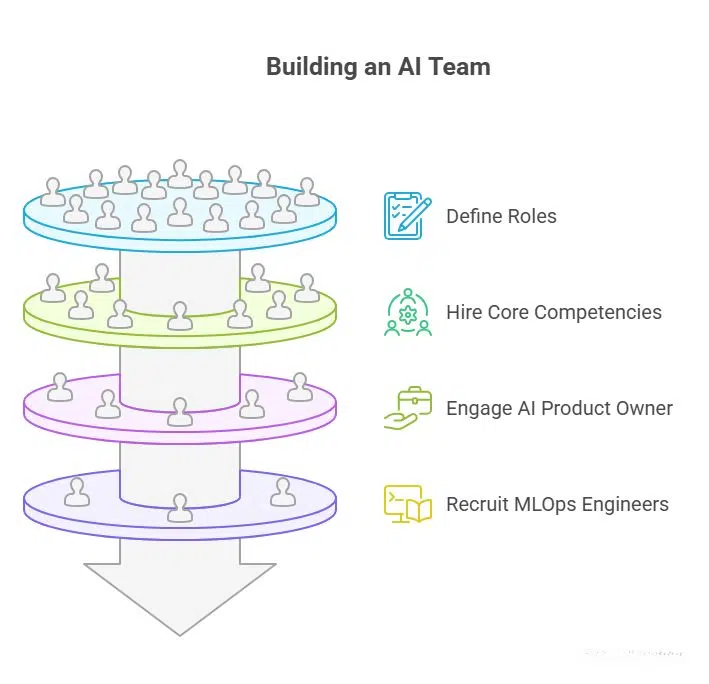
1. Define Roles

Hiring is the process of onboarding an individual or a team to work on your internal AI project on your behalf. In our case, you need to focus on a team that’s familiar with the lead generation. The central roles that you will hire or engage for your company’s success will be individuals who are capable of solving problems yet familiar with setting AI initiatives aligned with your organizational goals. This is where you will define their specific roles. Partnering with an AI Software Development Company gives you access to experts in AI consulting, AI strategy, AI development services, and custom AI solution design—ensuring your lead generation and qualification system is built with the right architecture, automation capabilities, and long-term scalability in mind.

2. Hire Core Competencies

As far as hiring goes, you would want to hire core competencies. You want people who are ideal at solving problems, yet they have a sound understanding of working on AI & ML.

3. Engage AI Product Owner

For example, if you’re planning to design an agentic AI capable of working with lead generation funnels & processes, then you want to hire an AI Product Owner to govern it. This product owner will be responsible to understand the business problem, prioritize features and implement compliance with governance following specific industry AI standards. Since this role is very crucial for your AI solution’s success, where you will be handling over the control of your AI’s regulatory defense, it’s better to hire someone who is eligible.

4. Recruit MLOps Engineer

You will also need people to design the machine learning lifecycle of your AI product. For example, you will require MLOps engineers especially when you will move beyond pilots. These engineers will continuously deploy, monitor, and eventually retrain models (under the governance of the AI Product Owner). Without having an internal team governing the project, you will be dealing with a fragile system which can easily succumb to failure and distortions.

When It’s Suitable to Partner Up?
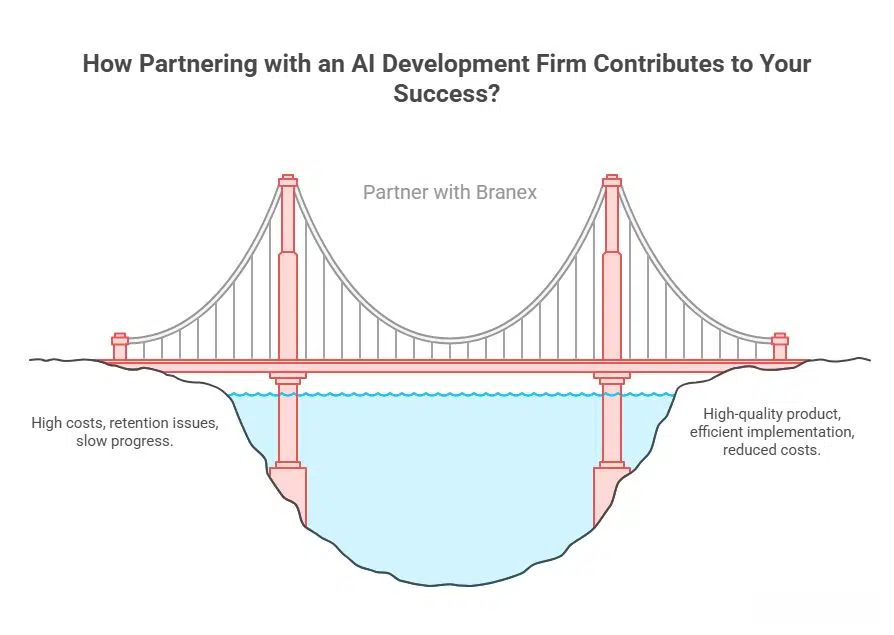
Partnering up refers to bringing a core software team to set up your infrastructure without having to bear the cost of in-house hiring. You find a suitable third-party agency who can work on your Agentic AI system on your behalf. This way, you own the product, but a third-party agency designs, develops & maintains it. Branex is an AI development company where we are fully capable of designing & developing your next Agentic AI software solution. With in-house hiring, you’re often struggling with retaining headcounts; but a more strategic value comes from working with a team that has already gained momentum with AI guardrails. And with an AI development company such as Branex, you don’t have to worry about this. You can have our LLM developers or data engineering experts without worrying about their pay scales and human resource management. The best part? You get a high-quality end-product that’s ready to implement & scale.

Branex - Our Internal Case Study

How Branex Built an Agentic AI Lead Routing System for a B2B Client

To put our AI methodology into practice, here’s a look at how Branex designed and deployed an Agentic AI Lead Qualification and Routing System for the internal B2B sales department struggling with slow, inconsistent lead handling.

The Problem

Our sales pipeline was clogged with unfiltered, low-intent inquiries. The sales team spent hours manually checking, sorting, and assigning leads, which led to delayed responses, missed opportunities, and a declining conversion rate. The core challenges we faced: 
  • No centralized mechanism to categorize leads
  • Delayed assignment to the right sales personnel
  • High volume of unqualified leads draining team bandwidth
  • No visibility into which leads truly mattered
The business needed an AI-driven system that could screen, categorize, and route leads instantly — without depending on manual touchpoints.

Our Approach

Branex followed the same structured framework explained above:

1. Assessing Requirements

We started by auditing their CRM data, conversion history, and sales workflows to understand where the lead triage was breaking.

2. Defining the Use Case

The exact problem was mapped: “Reduce lead qualification and routing time from hours to minutes, while lifting conversion performance.” This clarity guided the team structure.

3. Assembling the AI Team

We brought together:
  • AI Product Owner to define success criteria and business rules
  • Data Scientist to build a classification model that scored and categorized leads
  • Data Engineer to create real-time pipelines from forms and CRM
  • ML Engineer for deployment, monitoring, and retraining cycles
  • Integration Specialist to connect outputs into the client’s CRM workflow
  • Sales SME from the client’s team for validation and continuous feedback
Each role aligned directly with the business and technical needs.

The AI Solution We Built

Based on the resource gathered, Branex developed an Agentic AI system capable of:
  • Reading incoming lead messages in real time
  • Classifying them by intent, urgency, and relevance
  • Scoring confidence levels per category
  • Automatically routing qualified leads to relevant team members
  • Flagging unqualified inquiries without human involvement
  • Logging performance metrics and feedback loops for improvement.
The model was powered by NLP and classification algorithms trained on historical lead data the client provided.

The Results We Achieved

Within 60 days of deployment, the impact was measurable and immediate:
  • 72% reduction in lead qualification and routing time
  • 22% increase in qualified lead conversions
  • Zero manual sorting required for low-intent inquiries
  • Faster sales responses, often within minutes
  • Higher sales team efficiency, with reps focusing only on high-value opportunities

Conclusion

Building an AI team isn’t just about hiring top talent, it’s more about aligning people, processes, and technology toward a shared goal. We did our requirement analysis, defined clear use cases, assembled the best team and found out potential risks improving upon them iteratively. It helped us unlock the maximum potential of AI within our organization. And we successfully integrated it with our lead funnel’s cycle! Do you want to set up your own AI team to design your AI Lead Qualification and Routing System?  Bring Branex in and get yourself an AI team to design your perfect roadmap …and for its successful execution.

FAQs 

1. What does an AI services company do? An AI services company helps businesses design, develop, and deploy AI solutions that automate workflows, improve efficiency, and drive measurable outcomes. 2. Why should a business hire an AI consulting firm? An AI consulting firm provides expert guidance to identify the right use cases, assess data readiness, and create a roadmap for successful AI adoption. 3. How do AI consulting services help define the right use case? AI consultants analyze your business challenges, data, and workflows to pinpoint where AI can deliver the highest impact with the lowest risk. 4. What makes an AI development company important for businesses? An AI development company brings technical talent like data engineers, ML engineers, and LLM developers to build custom AI systems aligned with your goals. 5. What is Agentic AI and why do companies need it? Agentic AI refers to AI systems that take autonomous actions such as routing leads, automating workflows, or triggering tasks without human involvement. 6. How can an AI services company improve lead qualification? By using NLP, classification models, and workflow automation to score leads, detect intent, and route them instantly to the right team. 7. Does partnering with an AI consulting company reduce costs? Yes. Instead of hiring full-time AI teams, partnering with an AI consulting company gives you access to expert talent at a fraction of the cost. 8. How fast can an AI development company deliver a working solution? Most AI systems like lead scoring, routing, or automation—can be deployed within 45–60 days, depending on data and integration needs.
Generative AI in Digital Transformation
Artificial Intelligence Digital Transformation

How Generative AI is Driving Digital Transformation in Businesses?

branex-logo Team Branex
Imagine, a company that once struggled with innovation now creating personalized customer experiences at scale, or a manufacturing plant boosting production by 30% with generative AI-driven designs. This isn’t the future—it’s happening right now. In fact, according to a recent study, 72% of business leaders say AI will be the most significant driver of change in their industries in the next five years. With generative AI capabilities rapidly expanding, a McKinsey report revealed that AI could add $13 trillion to global GDP by 2030. But there’s more: Businesses leveraging generative AI report up to a 40% increase in efficiency. Just a few years ago, the concept of machines creating new content, ideas, or solutions seemed like something right out of science fiction. Fast forward to now, and companies across industries are harnessing this technology to reinvent how they work, connect with customers, and unlock new opportunities. From personalized marketing campaigns to groundbreaking product designs, Generative AI is not just enhancing business operations. It’s reshaping the very fabric of how companies approach digital transformation “But how is this shift happening, and what does it mean for the future of business?”  Let’s read on to learn how generated AI is not just a trend—but the engine driving the next wave of digital transformation.

What is Generative AI? 

Generative AI Generative AI is a type of artificial intelligence that can create new content, ideas, or solutions on its own, rather than just analyzing or processing existing data.  Think of it like a creative partner instead of simply following instructions. It can generate text, images, music, or even code based on patterns  The best part is that I learned all that and more from large amounts of information. For example, if you ask a generative AI to write a blog post, it won’t just summarize existing content. It will create an entirely new article, often with a unique perspective or style.  Similarly, AI tools can design logos, craft personalized recommendations, and even simulate complex business scenarios. What makes generative AI powerful is that it learns from the data it’s fed and becomes better over time, continuously improving its ability to produce new, valuable outputs.  This makes Generative AI the real deal for businesses, helping them automate tasks, innovate faster, and offer more personalized experiences to customers.

The Technology Behind Generative AI 

The technological foundation behind Generative AI is built upon advanced methods like machine learning, deep learning, and neural networks. These technologies let AI systems learn from vast amounts of data and generate new content ideas, or solutions based on patterns they identify.  Let’s understand them individually: 

1. Machine Learning (ML):

Machine Learning At its core, machine learning allows AI to learn from data and improve over time without being explicitly programmed. It involves training algorithms on large datasets to recognize patterns and make predictions. In generative AI, machine learning enables the system to understand the structure of data (like language, images, or sounds) and use that knowledge to create new outputs. A key component of Machine Learning is Natural Language Processing (NLP) which ensures AI comprehends, generates, and interacts using human language. NLP as a subset of generative AI technology, drives advancements in creating human-like text and enabling chatbots, virtual assistants (VAs), and content creation.

2. Deep Learning:

AI Deep Learning A subset of machine learning, deep learning uses algorithms called artificial neural networks to process data through multiple layers. This enables the AI to understand more complex patterns and relationships within data. Deep learning models are especially powerful in generative AI, as they can handle vast amounts of data and extract intricate details—whether it’s generating lifelike images or writing human-like text.

3. Neural Networks:

Neural Networks with Human Brain Neural networks are inspired by the human brain, with interconnected nodes ("neurons") that process information in layers. In generative AI, these networks are used to understand and replicate patterns in data. The more layers (or "depth") in the network, the more complex the learning process becomes. Generative Adversarial Networks (GANs) are a specific type of neural network where two networks (a generator and a discriminator) work together: one creates content (like images), and the other evaluates if it’s realistic enough, pushing the system to improve constantly.

Key Areas of Digital Transformation Powered by Generative AI

1. Content Creation and Personalization

Content Creation with Generative AI Generative AI is revolutionizing content creation by enabling businesses to produce unique, high-quality content for marketing, product descriptions, blogs, and more. By leveraging vast datasets, AI can generate text that closely mimics human language, style, and tone. This allows businesses to automate content production at scale while maintaining consistency and relevance.

Benefits:

  • Increased Personalization: AI can tailor content to different audiences by analyzing user behavior, preferences, and interactions. This ensures that the right message reaches the right person at the right time.
  • Higher Engagement: With AI-driven content, businesses can create more engaging and relevant materials, which leads to higher click-through rates and stronger customer loyalty.
  • Efficient Production: AI tools can generate content in a fraction of the time it would take a human writer, freeing up resources for more strategic tasks.

2. Automation and Efficiency

Automation with Generative AI Generative AI is streamlining complex processes by automating everything from data analysis to coding and customer service. AI-powered systems can process vast amounts of data, identify trends, and generate reports without the need for constant human oversight. Additionally, AI can automate customer service through advanced chatbots that provide real-time support, reducing the burden on human agents.

Impact:

  • Operational Efficiency: Automation through AI speeds up routine tasks, enabling businesses to focus on more high-value activities, while minimizing time spent on manual processes.
  • Reduced Human Error: AI systems can perform repetitive tasks with precision, reducing the risk of human mistakes and improving overall accuracy.
  • Cost Savings: By cutting down on the need for extensive human labor, AI helps businesses save costs, whether it’s through reducing the need for customer service agents or speeding up production cycles.

3. Product and Service Innovation

Innovation with Generative AI Generative AI is transforming the way businesses develop new products, services, and business models. By analyzing existing data and using creative algorithms. AI is helping companies in industries like healthcare, fashion, and manufacturing to push the boundaries of innovation.

Examples:

  • Healthcare: In drug discovery, AI can analyze vast amounts of medical data to suggest new compounds, speeding up the research and development process. Generative AI helps design molecules that might never have been considered by humans.
  • Fashion: AI-driven tools assist designers by generating unique clothing styles based on trends, customer feedback, and historical data, leading to more innovative and on-demand collections.
  • Manufacturing: AI can design prototypes and optimize production processes, allowing manufacturers to develop products faster and more efficiently, while also reducing waste and costs.

4. Customer Experience Enhancement

Customer Experience with Generative AI Generative AI is taking customer experience to the next level by enabling businesses to provide hyper-personalized interactions and dynamic customer support.  Companies can anticipate customer needs and deliver solutions in real-time through tools like chatbots and AI-driven recommendation engines.

How it Works:

  • Dynamic Customer Support: AI chatbots can handle customer queries 24/7, providing instant responses and resolving issues without human intervention. All learning and improving from every interaction.
  • Hyper-Personalized Experiences: AI uses customer data to predict preferences and recommend products or services tailored to the individual, creating a more engaging and seamless experience.
  • Anticipating Needs: By analyzing past behavior, AI can predict what customers are likely to want next, offering tailored solutions before customers even realize they need them, which boosts customer satisfaction and loyalty.

Generative AI in Healthcare and Medical

Healthcare revolutionizing drug development, personalized medicine, and medical imaging Generative AI in Healthcare Generative AI is poised to transform healthcare by accelerating drug discovery, enhancing personalized treatments, and improving medical imaging. AI systems can analyze vast datasets—such as genetic information, clinical trial data, and patient histories—to identify patterns and predict effective treatments.

Key Applications:

  • Drug Development: AI can simulate how different compounds interact with biological systems, helping researchers identify promising drug candidates much faster than traditional methods.
  • Personalized Medicine: By analyzing individual patient data, AI can recommend tailored treatments that are more effective, reducing trial and error in prescribing medications.
  • Medical Imaging: Generative AI can enhance the accuracy of medical imaging by generating high-quality images from lower-resolution scans, helping radiologists detect diseases such as cancer or cardiovascular conditions at earlier, more treatable stages.

Generative AI in E-commerce and Retail 

E-commerce and retail personalized product recommendations, targeted marketing, and virtual shopping assistants Generative AI in Ecommerce and Retail How AI is changing the e-commerce industry is a prime example of this shift, with AI enabling personalized shopping experiences, improving inventory management, and refining marketing strategies. Generative AI is revolutionizing the e-commerce and retail industries by providing customers with personalized shopping experiences, improving inventory management, and enhancing marketing strategies. With AI’s ability to process vast amounts of consumer data, retailers can craft highly individualized experiences.

Key Applications:

  • Personalized Product Recommendations: AI analyzes consumer behavior, preferences, and past purchases to suggest products that are most likely to appeal to each shopper, increasing conversion rates and sales.
  • Targeted Marketing: Generative AI helps create highly targeted advertising campaigns that resonate with specific customer segments, optimizing return on investment.
  • Virtual Shopping Assistants: AI-powered chatbots and virtual assistants guide customers through their shopping journey, answering questions, providing recommendations, and improving customer satisfaction without the need for human intervention.

Generative AI in Finance and Automation

Finance automating trading, fraud detection, and risk management Generative AI in Finance In the finance industry, generative AI is driving automation and improving decision-making by predicting market trends, detecting fraudulent activity, and managing risk. AI can process large volumes of financial data to uncover patterns and make faster, more accurate predictions.

Key Applications:

  • Automated Trading: AI algorithms can analyze market trends and execute trades at optimal times, minimizing human error and maximizing profits in real-time.
  • Fraud Detection: Generative AI models can detect anomalies in transactions that may indicate fraudulent activity, allowing financial institutions to react immediately and prevent losses.
  • Risk Management: AI helps financial institutions assess and manage risk by simulating various market conditions, helping companies make more informed investment decisions.

Generative AI in Entertainment and Media

Media and entertainment AI-generated content for movies, games, and music production Generative AI in Entertainment and Media Generative AI is reshaping the entertainment and media industries by streamlining content creation processes, reducing costs, and enabling new forms of creativity. From movies and games to music production, AI is helping artists and creators push the boundaries of what’s possible.

Key Applications:

  • Movies and TV Shows: AI can generate scripts, assist in video editing, and even create realistic CGI characters, speeding up production timelines and lowering costs.
  • Video Games: AI can generate dynamic, interactive environments, creating unique game experiences that evolve based on player actions, making each session different from the last.
  • Music Production: AI tools can compose original music, generate sound effects, or assist musicians by suggesting melodies or rhythms that complement their creative vision.

Generative AI in Manufacturing and Supply Chain 

Manufacturing used AI in design automation, predictive maintenance, and optimized supply chains Generative AI in Manufacturing and Supply Chain Generative AI is having a significant impact on manufacturing and supply chain management by improving efficiency, reducing waste, and enhancing product design. Through AI-powered tools, manufacturers can automate complex tasks, predict equipment failures, and optimize logistics operations.

Key Applications:

  • Design Automation: AI helps create product designs faster by generating new designs based on input parameters, and optimizing functionality, cost, and performance.
  • Predictive Maintenance: AI can analyze sensor data from machines and equipment to predict potential failures before they happen, reducing downtime and extending the lifespan of costly machinery.
  • Optimized Supply Chains: Generative AI helps businesses forecast demand, optimize inventory levels, and streamline logistics operations, leading to reduced costs and improved delivery times.

Benefits of Generative AI in Digital Transformation

Benefits of Generative AI in Digital Transformation Generative AI is at the forefront of digital transformation, driving significant improvements across industries. Its ability to generate new content, automate processes, and support innovation is reshaping how businesses operate. Let’s explore some of the key benefits:

Increased Speed and Efficiency

Generative AI is dramatically accelerating project timelines. By automating content creation, data analysis, and even decision-making processes, businesses can complete tasks much faster than relying on traditional methods. This boost in speed reduces time-to-market for new solutions, enabling companies to stay competitive in rapidly changing industries.

Key Benefits:

  • AI tools can quickly generate text, designs, or reports, which would typically take humans much longer.
  • Reducing bottlenecks and improving workflow efficiency allows for faster project delivery.

Cost Savings

One of the most compelling benefits of Generative AI is its potential for cost reduction. By automating routine tasks like content creation, customer service, and data processing, businesses can significantly cut down on labor costs. Additionally, AI helps minimize errors, reducing the need for costly corrections and rework.

Key Benefits:

  • Automation of repetitive tasks reduces the need for manual intervention, lowering labor costs.
  • Fewer errors lead to reduced operational inefficiencies and costly mistakes.
  • With fewer resources spent on routine tasks, companies can focus on high-value, strategic activities.

Scalability

Generative AI enables businesses to scale effortlessly without compromising on quality. Whether it’s generating personalized content at scale or managing large amounts of data, AI can handle growing demands efficiently. As businesses expand, AI-driven systems can adapt and continue to perform at a high level, making them more agile in responding to new challenges.

Key Benefits:

  • AI systems can manage an increasing volume of tasks or customers, enabling companies to grow without hiring exponentially.
  • AI-driven automation ensures consistent quality and performance, even as operations scale.

Innovation

Generative AI opens up new avenues for innovation by enabling businesses to experiment with new ideas, designs, and strategies quickly. With AI’s ability to generate and evaluate multiple variations of a concept, businesses can test ideas rapidly, iterate on them, and bring fresh, innovative products and services to market more efficiently.

Key Benefits:

  • AI accelerates the R&D process by generating new ideas and concepts that can be tested and refined.
  • Companies can experiment with creative possibilities—whether it’s in product design, marketing strategies, or customer experiences—without the fear of significant risk.
  • Generative AI empowers businesses to push the boundaries of what’s possible, leading to groundbreaking innovations.

The Future of Generative AI and Digital Transformation

Future of Generative AI and Digital Transformation The future of generative AI in digital transformation is poised for exciting developments, with capabilities expected to evolve from narrow. AI—specialized in specific tasks to more generalized forms capable of performing a broader range of functions with higher autonomy.  As AI continues to improve, we can anticipate its wider adoption across industries, including sectors that have been slower to embrace AI, such as healthcare, legal services, and education. In addition, the rise of collaborative AI will redefine the workplace, as generative AI tools are increasingly used to augment human creativity and decision-making. Rather than replacing human workers, AI will serve as a powerful partner, assisting with everything from creative ideation to data-driven decision-making, helping organizations unlock new levels of innovation and efficiency.

Key Takeaways:

  • Revolutionizing industries such as healthcare, e-commerce, and manufacturing through automation, personalization, and innovation.
  • AI accelerates timelines, reduces time-to-market, and enhances productivity by automating complex tasks.
  • Automates repetitive tasks and minimizes human error, leading to significant cost savings for businesses.
  • AI-driven systems scale seamlessly to meet growing demands without compromising quality.
  • Generative AI enables businesses to experiment and iterate quickly, fostering the creation of new ideas, products, and services.
  • As AI evolves, its use will expand into industries that have been slow to adopt, including healthcare, education, and legal services.
  • The future lies in AI augmenting human creativity and decision-making, enhancing innovation without replacing human workers.

Concluding Thoughts 

In conclusion, generative AI is a driving force behind digital transformation, reshaping industries by automating tasks, enhancing personalization, and fostering innovation.  As AI evolves and is adopted more widely across sectors, businesses will increasingly rely on it to stay competitive.  The future of artificial intelligence lies in collaboration, where human creativity and AI capabilities work together to unlock new possibilities.  Organizations that embrace generative AI will be well-positioned to thrive in a rapidly changing digital landscape. Unlock the Future of Innovation with Branex. Contact us today to transform your ideas into intelligent solutions!
Generative Engine Optimization vs Search Engine Optimization
Artificial Intelligence SEO

Generative Engine Optimization (GEO) vs Search Engine Optimization (SEO)

branex-logo Team Branex
Not long ago, I was searching the Internet and came across the term "Generative Engine Optimization." It got me thinking: Is that even possible? Then I realized how the advent of generative AI has transformed almost everything. Today, we are more inclined to optimize businesses for greater visibility, and that too with AI assistance.  Fast-forward to today, we are now seeing AI implemented in almost everything. Whether it be Google SGE (Search Generative Experience), BingChat, or ChatGPT, Google's AI search engine has become the cornerstone. So with so much happening in the artificial intelligence era, we often wonder if the concept is actually true, especially when it comes to optimizing search engines. Does it have any practical implementations in the field? This led me to explore and scour the Internet, and hence, I found Generative Search Engine Optimization (GEO). It’s a new discipline but covers the basics of our classic Search Engine Optimization (SEO). GEO aims to increase site visibility by optimizing and displaying contextually sound content. By incorporating generative AI in content creation, we enhance this approach, producing engaging, tailored content that aligns seamlessly with user intent. But before diving deep into their meanings and functionality, let’s differentiate between them.

What is Search Engine Optimization (SEO)?

Search Engine Optimization SEO is a well-known search marketing strategy that merely focuses on optimizing websites by adding keywords to rank higher traditionally in SERPs. It usually involves searching for targeted keywords, producing top-quality content, building backlinks, and performing a series of other tactics.  SEO focuses on understanding how crawlers and indexers work. We are all aware of how Google works with algorithms. Every time a website goes live, Google sends web crawlers to explore the site content and see if it meets SEO guidelines. If it does, Google crawlers index the site for ranking.

What is Generative Engine Optimization (GEO)?

Generative Engine Optimization GEO is a much newer concept. It is the same as Answer Engine Optimization (AEO). It has recently emerged, leading to the rise of AI-driven search engines, which are also known as generative engines.  Unlike Google, GEO does not list websites; it creates comprehensive answers by taking information from multiple sources across the Internet. According to one of the recent pieces of research that I came across, GEO utilizes a mix of methods such as citations, quotations from relevant sources, & statistics to boost a website’s visibility through AI.

How Do SEO and GEO Differ From Each Other?

SEO vs GEO While SEO is a practice that optimizes websites to improve visibility ranking in search engine results pages (SERPs) based on relevant keywords & search queries, GEO is a more nuanced approach where optimization happens based on the responses from chatbots or other AI-driven tools. SEO uses a mix of strategies, as discussed earlier, including keyword research, content creation, on-page and off-page optimization, technical SEO implementations, and effective link building. Whereas GEO emphasizes other unique requirements such as context understanding, prompt engineering, and structuring data for better interaction.  While SEO requires accessing the site’s backend to include optimizing metadata, improving site speed, creating optimized content, building backlinks, and a series of other practices, GEO simply focuses on one thing alone: quality content—one that aligns with user expectations.

How is Success Measured in SEO and GEO?

How to Measure SEO Results Another important aspect is measuring the success of both practices based on implementations. In SEO, metrics such as click-through rate, bounce rate, and time spent on a page are commonly utilized. Instead, GEO proposes a set of impression metrics that measure the visibility of citations and relevance based on user queries. In fact, it is worth noting that SEO strategies can be applied universally across different types of content, while GEO strategies may vary depending on the domain in which you’re working! For example, if you’re discussing historical content, authoritative language may work best. Adding citations and laws will increase the chance of your work appearing in Generative Searches more effectively. However, even then, the crux of the entire GEO implementation is based upon contextual correction.

1. Perform Keyword Integration While Maintaining Contextual Depth

While GEO demands contextual depth, SEO requires the accurate integration of primary keywords within the text. This ensures that your content's primary keywords are strategically placed in titles, headers, and throughout the text. Regarding GEO, it’s best to consider keywords that can be naturally introduced within the content. There are plenty of opportunities to add secondary keywords, such as relevant statistics, expert quotations, or effective case studies. This not only helps with traditional SEO practices but also complements how AI engines generate adequate responses.

2. Optimizing for Authority and Relevance

SEO has always favored authority. As with GEO, your main focus should be to optimize the content for both authority and relevance. For example, if your content needs to be recognized by AI-driven engines, it’s important to include contextually sound information that is well-cited from industry-leading blogs and backed by academic papers. This way, AI engines can pull in more relevant information to generate contextually and technically sound answers.

3. Structured for Skimmability

Traditional SEO favors content that is easy to skim. This means your content should feature clear headings, proper bullet points, and concise paragraphs. In contrast, GEO depends on the depth of context. Content written specifically to entice human readers can often overlook small details and contextual depth. These depths are commonly found when you search for queries with GEO.

4. Focus on User Experience or User Intent

Both practices focus on satisfying the user intent. As far as SEO goes, user experience is all about searching queries which offers better customer satisfaction. At the same time, it’s focused on reducing bounce rates and improving the reader’s dwell time. However, GEO focuses mostly on creating content that answers broader questions. It eventually breaks down content into digestible parts for AI engines to use as answers. 

5. User Engagement Score

Beyond bounce rate and time on page, user engagement score can give you a nuanced look at how users interact with content. This metric combines various factors—like time spent, scroll depth, and engagement with interactive elements (think infographics or embedded videos). For SEO, high engagement often signals relevance and authority, while for GEO, it indicates that the content resonates well with users, fulfilling AI-driven engines’ need for rich, engaging responses.

6. AI Readability Index

While traditional SEO considers readability (aiming for concise, skimmable content), GEO measures AI readability index. This is an emerging metric that evaluates how effectively AI can parse your content for relevance, tone, and factual depth. When optimized for this index, content becomes more accessible for AI engines, enhancing its chances of being featured in generative responses. In short, balancing SEO readability with AI readability ensures that your content is not only human-friendly but AI-friendly as well, offering comprehensive AI overviews for search.

7. Content Alignment with User Intent

One evolving metric for both SEO and GEO is content alignment with user intent. In SEO, this means that content precisely addresses what users are searching for. GEO, however, goes deeper into the "why" behind queries, especially as AI models attempt to satisfy broader, sometimes complex user questions. If users consistently find answers to their intent within your content, both SEO and GEO algorithms take note, rewarding content alignment with higher visibility and better positioning.

8. Structured Data Implementation Rate

Another crucial metric is the structured data implementation rate, especially significant in GEO. SEO benefits from structured data to enhance search features like rich snippets, but GEO takes this a step further by focusing on contextual organization. For instance, using schema markup for citations, content types, and source credibility indicators improves GEO performance, making it easier for AI engines to pull contextually rich snippets and authoritative insights.

9. Contextual Relevance Score

In SEO, contextual relevance has traditionally been tied to keyword optimization. GEO, however, gauges a contextual relevance score that considers the entirety of a topic's depth and accuracy, as AI engines prioritize well-contextualized data. This score, derived from how accurately content reflects topic nuances and authoritative knowledge, signals to AI models that your work is both informative and reliable, potentially increasing its visibility in generative responses.

Concluding Thoughts 

In today’s digital world, Generative Engine Optimization (GEO) and Search Engine Optimization (SEO) each play vital roles in connecting with audiences. SEO is essential for helping people find your website through traditional search engines, while GEO brings the power of AI to deliver more personalized, on-demand content. Choosing between GEO and SEO, or combining both, depends on your goals and audience. SEO keeps you visible in search results, while GEO helps you meet modern expectations for tailored, immediate content. By blending these strategies, you’re setting up your brand for success in a digital world that values both accessibility and personalization. We believe in creating remarkably impactful digital experiences. As a generative AI development company, our agenda is also to ensure that your website ranks at the top of search results. To achieve this, we use a variety of tactics, including but not limited to SEO and GEO strategies. If you’re looking to invest in the right digital marketing practices, Branex is only a consultation away.
AI Assistants Transform Daily Lives
Artificial Intelligence Technology

9 Ways AI Assistants Will Transform Our Daily Lives in 2025

branex-logo Team Branex
As artificial intelligence continues to advance at an unprecedented pace, AI assistants are poised to revolutionize our daily lives. From streamlining content creation to providing personalized recommendations, these intelligent companions are rapidly becoming indispensable tools. In this expert roundup, we delve into the importance of generative AI and explore 9 ways generative AI can enhance our routines, transforming how we work, learn, and interact with the world around us. Join us as we discuss the best generative AI tools available. Discover how generative AI in content creation is reshaping the way we communicate and consume information.

1. Minimizing Risk in UI/UX Designing

Minimize Risk in UI UX Design Artificial Intelligence plays a key role in enhancing and automating tasks most effectively. And improving the user experience by delivering more picture-perfect digital products. It remarkably fulfills the need for human creativity and brings more robust AI-driven insights to the table, which increase user satisfaction and contribute to overall engagement while speeding up innovation. And it does all that by minimizing risk to a considerable extent. In my company, Branex, we have achieved this amazing feat by introducing Generative AI-based solutions within in-house teams. So they feel more geared up to bring more robust solutions that cause minimal disruption. Our staff is exceptional in designing amazing UI/UX designs and setting the development bar high for a number of different industry verticals. It’s no secret how AI is transforming our very lives, and introducing it within our everyday technology is just something we are running shy of. Raheel Najmi, CEO – Branex

2. Seamless AI Integration Across Devices

AI Assistants Integrate Devices There is a good chance that all new smartphones will be equipped with integrated AI assistants in the near future. We already have voice assistants, and the next iPhone is going to have Apple Intelligence, which will significantly expand the capabilities of Siri. But, likely, it will eventually be taken a step further where smartphones automatically have AI assistants. And those assistants will probably also be integrated with our other connected personal devices like our laptops and smartwatches. Edward Tian, CEO – GPTZero

3. Revolutionizing Personalized Learning

Personalized Learning with AI Assistants As the founder of StudyX, I think it's obvious that I believe AI assistants will become an essential part of education, especially for self-study and homework in our daily lives. It can be found that there are already a lot of AI tools designed to help students study from preschool to higher education. The biggest advantage of AI assistants is that they can provide personalized assistance to students anytime, anywhere. It can offer targeted learning content and suggestions based on students' learning progress and interests, helping students comprehend knowledge more efficiently. This is also one of the reasons why we created StudyX. Many students now cannot receive timely learning advice and assistance due to factors such as personality, teacher-student relationships, and learning environment. Simply using search engines or looking up books may waste plenty of time and make it difficult for them to understand. But an AI learning assistant, taking our StudyX as an example, can provide step-by-step answers to students' questions during homework or learning processes. And generate personalized exercises based on students' weak areas to help them consolidate their knowledge. At the same time, AI's chat ability can help students engage in deep learning, enabling them to fully utilize fragmented learning time and improve learning efficiency. In addition, parents can also use AI assistants to better follow their children's learning progress even though they do not have professional knowledge. However, AI assistants in education may also bring some hidden troubles. For example, if students rely on AI too much, they will lack the ability to think independently and critically. In addition, as AI gradually replaces some of the functions of teachers, interpersonal interactions in learning may decrease. Therefore, the application of AI in education needs to be carefully balanced to ensure that it becomes an assistant tool for students' learning, rather than a dominant force. Alex Muz, Founder - StudyX

4. Personal Research Analysts

Research Analyst As the founder of Merlin AI, an online productivity and research tool, I believe one way AI assistants will become an essential part of our daily lives is by transforming the way we interact with information and enhancing efficiency. In the future, AI assistants will not only manage our schedules and respond to voice commands but will also act as personal research analysts, curating and synthesizing data tailored to our specific goals. Imagine waking up each morning to a briefing prepared by your AI assistant, summarizing the latest developments in your field, and offering actionable insights on how to apply them to your work projects. The integration of AI assistants into daily life will significantly impact how we approach work, education, and personal development, by providing real-time data analysis and recommendations that are aligned with individual preferences and aspirations. By seamlessly integrating with digital platforms, these assistants can automate mundane tasks, allowing us to focus on more creative and strategic activities. Furthermore, AI assistants can facilitate a more balanced lifestyle by suggesting optimal times for work, rest, and leisure, personalized to our unique rhythms and requirements. Advanced AI assistants will be capable of helping us make more informed decisions, whether it's managing personal finances or understanding global events. They will become trusted companions in navigating the complexities of everyday life, with the capability to adapt to changing priorities and unforeseen challenges. By fostering a more intuitive and interactive relationship with information, AI assistants will empower us to achieve more while enhancing our quality of life, proving to be indispensable partners in our daily routines. Pratyush Rai, CEO – Merlin AI

5. Personalized Experiences in Self-Driving Cars

Self-Driving Car AI assistants are becoming important in various aspects of our lives, and one area where I see this happening is in the area of self-driving cars. We’re already witnessing self-driving taxis navigating the streets of San Francisco, controlled entirely by AI. As these technologies advance, our interactions with them will increasingly be driven by AI assistants. Imagine getting into a self-driving car and being greeted by an AI that asks about your preferred temperature, music choices, or even the type of experience you want during your ride. These personalized interactions that are driven by AI, will soon become a routine part of our daily lives, improving convenience and comfort in ways we’re only beginning to explore. George Burgess, Founder & CEO – Modern Day Talent

6. Personalized Health Monitoring for Well-Being

AI Assistant Health Monitoring One way AI assistants will become an essential part of our daily lives is through their ability to act as personalized health monitors. We often think of AI as just a tool for setting reminders or managing our schedules. However, its potential in health management is enormous and largely untapped by most people. Imagine an AI assistant that analyzes your daily habits—what you eat, how much you exercise, and your sleep patterns—and then provides real-time feedback and suggestions for improvement. It could remind you to take a break if you’ve been sitting too long, suggest meal plans based on your dietary needs, or even detect anomalies in your speech patterns or typing speed that might indicate stress or the onset of illness. What’s even more impressive is the ability of these AI systems to learn and adapt over time. They could offer increasingly accurate health insights tailored specifically to your body and lifestyle. This kind of proactive health management can prevent small issues from turning into bigger problems and promote overall well-being. Lissa Poirot, Head of Content – Joy Wallet

7. Manage Relationships with AI Reminders

Manage Relationships with AI Imagine having an assistant that not only remembers your anniversary but also suggests the perfect gift and even drafts a heartfelt message. AI will soon make this a reality by analyzing our communication patterns. This means it can keep track of how often you connect with friends or family and notify you when it's been a while since you checked in with someone important. To make the most of this technology, consider integrating an AI-based app with your calendar and contacts. This will allow the AI to set reminders for birthdays, anniversaries, and other key events. It can also suggest personalized gestures, like sending a favorite book to a friend who enjoys reading or planning a video call with your grandmother who loves to chat. This practical approach ensures your relationships stay strong, even in a busy world. Casey Meraz, CEO, Juris Digital

8. Revolutionize Travel Planning and Experiences

Travel Planning with AI Assistants AI assistants are on the verge of reshaping our travel planning and trip experiences. They will not only handle routine tasks like booking flights but also create customized itineraries tailored to our preferences and budgets. These assistants will seamlessly adjust plans in response to unexpected changes, such as weather conditions or flight delays while suggesting unique destinations and recommending dining and activities based on real-time data. Leveraging such technology can transform travel from a stressful task into a smooth adventure. Matt Gehring, Chief Marketing Officer, Dutch

9. Reduce Cyber Security Costs

AI in Cyber Security AI assistants will play a crucial role in our daily lives by delivering significant cost savings, particularly in cyber security. Since 2023, more organizations have deployed AI in their security operations and are seeing substantial reductions in breach-related expenses. Companies that extensively use AI for prevention tasks—such as attack surface management, red teaming, and posture management—reported saving an average of $2.2 million compared to those without AI in their prevention workflows. This reflects the growing importance of AI in enhancing security and reducing the financial burden of cyber-attacks. As businesses continue to embrace AI in these workflows, both in terms of improved prevention and cost-efficiency. AI assistants will likely become integral to managing risks and protecting assets in everyday operations. Mia Naumoska, CMO, Internxt

The Bottom-line

Artificial Intelligence is set on its path to create digital solutions, especially the ones geared to offer us well-rounded and satisfying experiences. It’s an impending reality that promises to revolutionize how we interact with technology and navigate our routines. From enhancing personalized learning and revolutionizing travel experiences to managing our health and fostering deeper relationships. AI assistants are set to become indispensable companions in our lives. The journey towards a new era of intelligent assistance is rapidly taking charge.
Artificial Intelligence in eCommerce Industry
Artificial Intelligence eCommerce

How Artificial Intelligence is Reshaping the eCommerce Industry?

branex-logo Team Branex
It’s no secret how the eCommerce market keeps evolving.  From personalized approaches in showcasing products digitally to customized feedback received from customers, the eCommerce industry is set on a trajectory to achieve maximum growth.  Recent data indicates that global eCommerce growth is projected to reach 10.7%, with sales expected to hit around $6.5 trillion worldwide. In the United States, online shopping is anticipated to increase from $910 billion in 2022 to approximately $1.45 trillion by 2025. Today, artificial intelligence has permeated into our lives. From automating workflows to creating content faster, from implementing faster ways of marketing to offering more rich & unique user experiences to consumers, AI now takes center stage in almost every digital activity we perform.  In fact, research shows that half of the eCommerce organizations are now employing AI to offer their users a much more smooth and interactive user experience online.  If you want to learn more, keep reading as we will cover the different details on the role of artificial intelligence in the eCommerce industry, how AI is changing the future of eCommerce, and ways to how you can use augmented reality in eCommerce to gain success in the coming years.  So without further ado, let’s begin. 

The Role of Artificial Intelligence in the eCommerce Industry 

AI in Ecommerce Industry Artificial Intelligence (AI) is truly transforming the way we see the world. In the world of eCommerce, it’s significantly contributing to improving not just the customer’s experience but also the overall operational efficiency. There are many AI technologies such as machine learning, natural language processing & computer vision that help businesses to automate customer service, create personalized recommendations on products, and in fact, even optimize the overall supply chain management.  Today, there are AI-powered chatbots and virtual assistants as well which offer 24/7 customer support allowing customers to put up their queries and address concerns.  With AI-driven analytics, it becomes relatively easier for a web development company & other business owners to gain valuable insights into customer behavior, understand their buying patterns & address preferences. Such practices optimize the shopper’s online experience using a particular website or mobile app and improve the user experience ultimately increasing the chance of conversion.  There are other AI-powered implementations as well which are more useful in detecting and preventing fraudulent activities such as identity theft and even trace credit card scams and so on.  That’s not all because the use of AI in eCommerce goes beyond just tracking fraudulent activities; it also helps with automating routine tasks, managing inventories, performing order fulfillment, and freeing up resources so you can focus more on strategic and creative tasks.  A few benefits of AI implementation in eCommerce include the following: 
  • Personalized customer experiences
  • Improved operational efficiency
  • Enhanced security and integrity of transactions
  • Increased conversions and sales
  • Better customer insights and data-driven decision-making
  • Automation of routine tasks

How AI is Changing the Face of eCommerce? 

Different AI subfields have almost something valuable to offer; specifically in the changing world of eCommerce. AI technologies such as natural language processing, sentiment analysis, and predictive analytics are shaping the way online individuals shop, transforming the overall eCommerce industry.  Here are some of the AI technologies that are definitely changing the way eCommerce works: 

1. Machine Learning

Machine Learning in eCommerce Machine learning (ML) is capable of automating decision-making as well as performing product recommendations in real-time. It is a widely accepted concept in the artificial intelligence realm as one where complex algorithms are trained to learn from pre-existing data models and improve on the existing ones so they can generate better and more accurate results. Today, eCommerce businesses are employing machine learning to gain valuable customer insight and bring more conversions. 

2. Natural Language Processing (NLP) 

Natural Language Processing in eCommerce NLP, termed natural language processing, is one of the components which utilize voice search & speech recognition. With NLP, it becomes easier for complex search algorithms working behind the scenes to understand the concepts more effectively. At the same time, it helps computers to understand written & spoken words more effectively. Certain applications of NLP and how it helps businesses achieve better results are through spam detection and by leveraging the power of chatbots. 

3. Sentiment Analysis 

Sentiment Analysis in eCommerce Sentiment analysis is mostly used to monitor customer feedback and gain a better understanding of the audience’s needs and wants. In terms of business, it helps with making appropriate decisions and performing actions that do not leave the customers disgruntled. With sentiment analysis, marketers are more well-equipped to understand and respond to customers more effectively. It helps them to tailor their respective offerings to better suit their customer requirements. 

4. Predictive Analytics 

Predictive Analytics in eCommerce By leveraging big data and statistics to identify customer requirements, predictive analytics determine the best channels to understand the average shopper’s behavior. At the same time, predictive analytics also spot purchasing trends and optimize a shopper’s online purchasing experience. In this way, marketers better equip themselves to identify behavior and churn out results that prevent data loss. Predictive analytics determine what their average customer needs and when their interest piques while shopping. 

5. Deep Learning 

Deep Learning in eCommerce Deep learning leverages the use of large datasets and helps businesses make predictions to better understand trends, perform effective user actions, and understand user behavior at a deeper level compared to machine learning. These algorithms are very powerful in tracing a person’s buyer’s journey; they utilize this information to predict what type of purchases online shoppers will most likely make. Deep learning helps e-commerce businesses make more relevant recommendations & design personalized content that not only improves customer retention but also increases e-commerce conversions

How Do Businesses Use AI in eCommerce?

AI in eCommerce Business Artificial intelligence is not only about automating repetitive tasks. Its applications in eCommerce go a long way, and its benefits far outweigh the costs. Here’s how AI in eCommerce allows you to take your business to new heights. Check out these benefits of using AI in eCommerce and gaining success:

1. Increased Cybersecurity

Cybersecurity in eCommerce Using AI models enhances your business’s safety and security. For example, AI in eCommerce can automate the detection of inappropriate content using the right AI model and develop new rules that prevent fraudulent transactions. It can also help detect threats and prevent unwanted bots from creating problems on your website. With AI integrated into your eCommerce solutions, you don’t have to worry about external influences stealing credentials or creating fake profiles, ultimately resulting in the protection of customer data.

2. Better Customer Service

Better Customer Service Ask anyone who utilizes AI applications within their business operations, and they will tell you that the two most commonly used applications are chatbots and virtual assistants. They are not only accessible but also provide customers with well-rounded support by keeping them up-to-date regarding complex queries, helping them answer frequently asked questions, or directing them to relevant answers. Furthermore, with the continuous development of ML and NLP, chatbots are evolving tremendously, which helps them learn from previous conversations and better understand customer intent.

3. Fully Targeted Advertising

eCommerce Advertising Artificial intelligence uses data to enable intelligent product recommendations, which help better target potential customers, guide them through the buyer’s journey, and help them find the best products in their respective stores. AI helps customers base their decisions on multiple data points such as purchase history, browsing habits, and searched products. Besides product recommendations, you can also use AI to create content for different audience types. Altogether, this assists businesses in making much more accurate recommendations, reducing buying time, increasing conversion rates, and ultimately enhancing customer satisfaction.

4. Streamlined Business Processes

Business Process Since AI possesses the capability to work with large data sets and collect data from various sources, it is quite useful in streamlining business operations. A great application of AI in eCommerce is its capability to automate repetitive tasks and optimize workflow. As a result, AI allows eCommerce business owners to automate marketing processes, such as PPC advertising, SEO marketing, social media marketing, and content development. This not only increases employee efficiency but also considerably reduces the risk of human error.

5. Creating More Personalized Experiences

Great Personalized Experience Among the many benefits of AI, this technology can drive customer insights which can then be used to create unique, relevant, and personalized experiences for customers using multiple devices. Artificial intelligence is not only limited to offering you useful recommendations by intelligently understanding what you want from your past purchase decisions, but it also leverages AI to deliver better search results and understand you by including your sentiments, your needs, your interests & ultimately understanding your overall behavior. 

What Needs to Be Done Before Implementing AI into Your eCommerce Practices?

AI eCommerce Practices Introducing AI into your eCommerce business is a significant step that can enhance your strategy. Here are some actionable tips to guide you through this process:
  1. Identify AI’s Role in Your Business - First, determine what you want AI to achieve for your eCommerce platform. Are you aiming to enhance your offerings or gain deeper insights into your audience? Gather your team—marketers, business planners, designers, developers, and other stakeholders—to discuss their needs and identify how AI can meet these requirements.
  2. Engage Your Entire Team - When planning to implement AI, it's important to involve everyone in the organization. Keep the process simple to help your team select relevant solutions, customize them to fit their needs, and scale as necessary. If you decide to go for a comprehensive AI solution, consider forming a dedicated AI team to manage the implementation.
  3. Evaluate AI’s Effectiveness - Regularly review data to assess AI’s impact. Is it working? If so, review the complete data and find use cases supported by AI. Start by identifying revenue-generating opportunities and see how you can use the available data.

Use Cases with Real-Life Examples of AI Implementations in eCommerce

1. Personalized Product Recommendations

Product Recommendations Imagine walking into a store where every item on display seems tailor-made just for you. That's what AI can do for eCommerce. By analyzing a customer's past purchases, browsing habits, and preferences, AI crafts personalized product recommendations that feel like they were handpicked. This personalized touch not only boosts sales but also leaves customers feeling understood and satisfied. Take Amazon, for instance. Their "You May Also Like" section leverages machine learning to offer suggestions based on what you've previously bought or browsed. It's like having a personal shopper who knows your tastes perfectly.

2. Intelligent Search Functionality

Search Functionality Have you ever struggled to find the right words to describe what you're looking for online? AI-powered search engines come to the rescue by understanding natural language queries, even when they're incomplete or slightly off. This means you can search with an image, your voice, or just a casual description. eBay is a great example, with its AI-driven search that lets users find products effortlessly using images or voice commands. It's all about making the search process smoother and more intuitive, helping you find exactly what you need with minimal hassle.

3. Chatbots and Customer Support

Chatbot and Customer Support Nobody likes waiting on hold for customer service, and AI chatbots are here to change that. These intelligent assistants provide instant support, answer common questions, and enhance the overall shopping experience. Take Sephora's chatbot, Sephora Assistant, for example. It not only helps customers find the right products but also offers personalized recommendations and real-time assistance throughout the shopping journey. With AI chatbots, customer support becomes quick, efficient, and available 24/7, turning a potential pain point into a seamless experience.

4. Predictive Analytics and Forecasting

Forecasting Report What if you could predict future trends and make decisions today that set you up for success tomorrow? That's exactly what AI does with predictive analytics. By analyzing historical data, AI forecasts demand and optimizes inventory management. Walmart utilizes this technology to ensure that its shelves are stocked just right, reducing the risk of running out of popular items while avoiding excess inventory. It’s like having a crystal ball for your business, allowing you to be proactive rather than reactive.

5. Price Optimization

Price Optimization Finding the perfect price for a product can be tricky, but AI takes the guesswork out of the equation. By analyzing market data, customer behavior, and competitors' pricing, AI suggests optimal price points that maximize sales and profitability. Dynamic Yield, for instance, helped IKEA fine-tune its pricing strategy based on real-time customer behavior and market trends. This smart pricing approach not only boosts sales but also keeps customers happy by offering competitive prices that match their expectations.

6. Fraud Detection

Fraud Detection In the world of online transactions, security is paramount. AI plays a crucial role in detecting patterns and anomalies that indicate fraudulent activities, ensuring safe and secure shopping experiences for everyone. PayPal, for example, uses machine learning algorithms to identify and prevent fraud in real-time, protecting both buyers and sellers. With AI, eCommerce platforms can stay one step ahead of fraudsters, building trust and reliability with every transaction.

7. Visual Search

Visual Search Sometimes words fail to describe what you're looking for, and that's where AI-powered visual search steps in. By allowing users to search for products by uploading an image, AI makes it easier than ever to find similar items. ASOS, for example, uses this technology to let customers upload a picture of a product they love, and the system will find similar options available on their platform. It's like having a magic wand that turns a picture into a shopping list.

8. Automated Email Marketing

Automated Email Marketing AI revolutionizes email marketing by making it more personalized and efficient. Instead of generic blasts, AI crafts campaigns based on customer behavior and preferences, ensuring each message resonates with its recipient. Netflix, for instance, sends personalized email recommendations to its subscribers based on their viewing history and preferences, enticing them to explore new shows or continue watching their favorites. It’s about creating connections and encouraging engagement in a way that feels natural and relevant.

9. Smart Content Creation

Smart Content Creation Creating compelling product descriptions and marketing content can be time-consuming, but AI makes it a breeze. By generating personalized content, AI saves time and resources while maintaining a high level of quality and engagement. Alibaba, for instance, uses AI to craft unique product descriptions for its vast catalog, ensuring each item stands out with tailored content. It’s like having a team of creative writers working around the clock to bring your products to life.

10. AI-Powered Product Design

AI Product Design AI is even transforming product design by analyzing trends, customer feedback, and market data to inspire innovation. Nike, for instance, uses AI to design cutting-edge footwear that aligns with customer preferences and performance metrics. By combining data with creativity, AI helps brands like Nike stay ahead of the curve, delivering products that are not only functional but also highly desirable. It’s like having a design partner who never sleeps, constantly seeking the next big thing.

Concluding Thoughts

Artificial Intelligence (AI) is changing the way we shop online by making it smarter and more fun.  With AI, online stores can suggest products you might like, keep your information safe, and make shopping faster and easier. Businesses using AI can understand what customers want and give them a better experience. As AI keeps getting better, it will help online shopping become even more exciting.  To stay ahead, stores need to use AI wisely to keep growing and making customers happy. At Branex, we believe in building the best eCommerce solutions for our customers.  Whether you’re looking for an eCommerce platform with the latest AI features or you simply want to revamp your existing eCommerce presence, let Branex, a digital product development agency help you build the perfect eCommerce website solution powered by artificial intelligence. 

Contact us today and schedule a free consultation.

How to Use Generative AI to Build Your Website
Artificial Intelligence Guide Web Design & Development

How To Use Generative AI To Build Your Next-Gen Website?

branex-logo Team Branex
Every time you’re tempted to visit CHAT GPT for answers to some basic questions, there’s a high chance that the thought of having your website built may have crossed your mind. Often, you may have wondered how you can use Generative AI to create a shiny new website for your brand. If you’ve been there, this article is written specifically for you. While every other Tom, Dick, and Harry believes they can use tools like ChatGPT or Gemini to come up with potential ideas, they often fail to realize that things can get clunky pretty fast.  The Internet is full of half-baked digital solutions.  Many of these digital assets fail to gain enough traction and some don’t even see the light of day. In fact, more than 75% of users judge a website’s credibility based on the site’s overall design.  To establish that, today, more businesses are turning towards Generative AI services & AI-powered solutions.  They all aim to deliver a remarkable online experience At Branex, we have invested a lot of our precious time exploring a myriad of tools across the Internet, but our eyes have set upon one.  Wix ADI, a full-blown AI website builder. 

WIX ADI - A Complete AI-Powered Website Builder for All Businesses 

WIX AI Website Builder Wix ADI is a website builder that offers a one-of-a-kind experience. It’s not just for website designers and developers, but also for individuals visiting such digital presences. To create a pitch-perfect digital presence, all a person needs is to start a conversation with the Generative AI and share the vision behind the website. Within minutes, the tool will begin designing a website. It won’t just be appealing; it will also be so perfectly designed that it connects with the target audience most effectively. Wix ADI brings one of the best generative AI tools, a custom app solution to build your dream website. 

How to Use Wix ADI? 

How to Use Wix ADI There are two ways to access a Wix ADI-powered website builder. You can directly use the Wix ADI from the official website The simplest way to use Wix ADI is to access the tool from the official website. Wix offers a robust AI website builder. Creating a website is as easy as entering a prompt and hitting the “Create with AI” button. Before you know it, your breath-taking and shiny new website will be ready to hit Google. Are you new to Wix? If you haven’t logged into your account yet, you’ll land on the Wix login page. Simply follow the instructions to create a free Wix account. Once your account is set, you’ll be invited to start a chat with the AI tool.  All you have to do is be expressive. Share your idea with the Wix ADI, and get a website in minutes.

How Wix ADI-Powered Website Builder Works? 

ADI Website Builder The Wix ADI website builder is a user-friendly solution. It’s not like you require a how-to guide to create digital solutions, you can simply follow a series of easy steps to understand how Wix ADI works. 

1. Create a Vision for Your Website

For a website to be a success, it’s important that the Generative AI tool which you’re leveraging to create a digital presence must have a clear understanding of what you’re looking for. To begin with, you have to explain to Wix ADI what your business is all about and what you wish to achieve with the new website. And here’s the big question, if you can’t decide what you want to achieve, you don’t have to worry about it. Wix ADI is set to ask you a series of questions where the AI will use pre-fed information to personalize your dashboard. You can double-check if everything meets your requirement and click, “Generate Site”.  Here’s what the backend of your Wix dashboard will appear like: 

2. Change Your Website Design As Per Preference 

As soon as you hit the “Generate Site” button, the AI will get to work and create a new website experience pre-built with high-quality images, valuable text, and videos that reflect the true essence of your brand. If there’s something that’s not up to your standards, you can always ask the AI to regenerate the website or make a few elements a little bit different. To perform tweaks on certain elements, just highlight areas of the website that you wish to change and ask the AI to regenerate.  You can change different aspects of your website. For example: 
  • Site profile - You can change the basic details of your website such as logo, site type, and site name. 
  • Site structure - You can change the sections which you want to include on your homepage or other pages. 
  • Site description - You can change the description of your business or what you wish to achieve from your site. 
  • Theme - You can play around with the different color palettes, change the mood, and set the typography of your website. 
  • Layout - You can set the overall style (such as “clean” or “modern”) or you can change the existing arrangement (such as, “mosaic” or “grid-like”) to have better-suited elements. 

3. You Can Make Adjustments Within the Wix Editor 

Do you find the current appearance of your website good enough? Or is there anything in particular that you wish to change about your website? Well, you can always make the relevant changes after you connect the domain name. As soon as you’re done with generating your website using Generative AI, the next step is to connect a domain if you haven’t already connected one.  Once you have connected the domain, the Wix ADI will prompt you with “Continue to the Editor.” The Editor will allow you to freely customize your website as per choice.  The Editor will allow you to change several things on your website such as images, page elements, and widgets. In the Editor, you can gain access to several other Generative AI tools, tools for creating text, building images, and taking care of many other areas of your website. Within the Editor, you will see there’s a star icon on certain options which indicates AI capabilities.  There’s also an option to customize the mobile version of your website. All you have to do is click on the phone icon appearing at the top of the Editor using which you can tweak or hide elements. 

What Are the Benefits of Using Wix ADI? 

Benefits of using Wix ADI For now, you might be wondering what the advantages of using Wix ADI are and why it should be considered a favorable option well here are a few benefits of using the platform: 
  • Time-saving - Wix ADI making a unique website design only takes a few minutes.
  • No technical skills - Wix ADI users do not need any coding or previous design experience.
  • Personalized design - You can create a fully customized website design that reflects the user’s brand. 
  • Easy customization -  You can easily customize the design, layout, and content as per choice. 

What Elements of Your Website Can You Customize with Wix ADI? 

Customize Website

1. You Can Change Sections & Pages 

Wix allows you to add, remove, or reorganize different website sections and pages.  As a user, you can choose from a variety of pre-built sections, including headers, service pages, about us section, galleries & even adjust contact forms. 

2. You Can Change Design & Layout Customization

Wix also offers a range of other customizable options.  You can modify the design as per your requirements. You can change the overall layout of the website too. In fact, users can adjust the background, set the spacing, set the alignment of elements as well as add, delete, or rechange content blocks. Wix platform doesn’t just stop there, you also have options for images, icons, and shapes which altogether improve the visual appearance of the website. 

3. You Can Choose Your Desired Typography & Color Schemes 

Just as much as other design features play a role, so do the different typography and color schemes.  Wix ADI provides you access to a large collection of fonts and different color palettes to choose from. You can use them to create a design that’s not just attractive but also sets the perfect tone for your web.  Assuming that your preferred choice of fonts is not available, you can always upload custom fonts to Wix or create your color scheme. You can do all that and much more to match your brand aesthetic. 

4. You Can Add Different Multimedia Integrations 

To make your website more dynamic and engaging, it’s important to integrate and introduce different multimedia elements. The elements can be anything, ranging from images, videos & audio files.  With Wix ADI, you can have your media or choose from an extensive library of free stock images & videos. In fact, users can embed media from external sources such as YouTube, Vimeo, SoundCloud, and other specific areas to make your website content up to par and on-point. 

5. You Can Add Third-Party Apps And Other Types of Integrations  

ADI offers several third-party apps and other interesting integrations such as the ones for e-commerce platforms, booking systems, social media feeds, and even email marketing.  When you integrate all these apps, you can create a truly immersive and interactive user experience. 

What Kind of Websites Can You Build with Wix ADI? 

Websites You Build with Wix ADI

1. You Can Build Small Business Websites

Many small businesses have successfully used Wix ADI to create professional websites. These businesses are eager to showcase their products or services. They want to increase their leads and sales. The only way they can achieve this is by investing in an AI-powered solution. Wix ADI allows them to quickly generate a website design that includes all necessary third-party integrations. These can range from booking systems to eCommerce.

2. You Can Create Personal Portfolios & Personal Blogs

We all have work that we prefer not to put on public platforms. Instead, we want to showcase our work or share our thoughts through personal portfolios and blogs. Wix ADI makes it easy to achieve this. It gives users the chance to create visually stunning personal portfolios. These portfolios speak volumes to customers. Wix ADI offers a user-friendly interface with diverse design options. It helps create a unique online presence that reflects your personality and style.

3. You Can Create eCommerce Websites

Wix ADI offers easy integration for eCommerce. You can create a functional online store with ease. Wix allows users to set up perfect product pages, manage inventories, process payments, and handle other eCommerce tasks through a single dashboard. With Wix, you can sell your desired products effortlessly using a single entity. This ensures your eCommerce sales targets are met.

Wix ADI - Frequently Asked Questions 

1. How does Wix ADI Compare to Other AI-driven Website Builders? 

Although the market is full of different AI-driven website builders, Wix ADI stands a class apart because of its intuitive interface, and plenty of customization options.  The app has earned a decent reputation as a leading website builder. Compared to many other website builders out there, Wix ADI is just an upgrade that offers plenty of room for developers. 

2. Can I Switch Between Wix ADI and Wix Editor?

Yes, you can switch between Wix ADI and Wix Editor to create a truly amazing website.  However, we believe it’s best to educate our audience that transitioning between Wix ADI to Wix Editor is a one-way ticket. It means, that once you shift to Wix Editor, you can’t revert back to Wix ADI.  It’s best to make sure you have completed the initial website design & you’re completely satisfied with the initial product. Because, once you hit the next button, you won’t have the chance to go back. 

3. Is Wix ADI Suitable for Large-Scale Websites? 

We can’t say for sure. Wix ADI has seen thriving success, especially for small and medium-sized websites. If a business profile is small, and you want to create a personal portfolio or relevant blogs for it, then Wix ADI is a good option. For relatively larger websites, you need a more appropriate solution where customizability shouldn’t be a problem.  

4. How Secure is a Website Developed by Wix ADI? 

For Wix, website security is serious. They offer a multitude of options such as SSL certificates. One can use standard security technology that ensures data gets transmitted between a user’s browser & website’s server is encrypted and kept well secure. Always check for updates & ensure the platform is well protected against all such potential security threats and vulnerabilities. 

Wix ADI - Resources & Support 

1. Wix Help Center

If you’re a Wix user, another great feature is the large knowledge database the platform provides. It offers detailed, comprehensive guides on many of the basics of Wix ADI and Wix Editor. There are plenty of tutorials and articles on various website design and development topics. The platform is a valuable resource for users seeking to learn more about Wix.

2. Wix Community Forums 

If you can’t find an answer on the Wix Help Center, there are always the Community Forums. Members are constantly communicating. These forums are a great place for users to connect with other Wix users. You’ll find plenty of web designers, web developers, and Wix experts who can help resolve queries. The forums provide answers to advanced questions and include interesting tips and tricks.

3. Wix Webinars & Workshops

Wix often holds workshops and hosts webinars for users. These events help users educate themselves on different features and functionalities, including Wix ADI. The workshops and webinars are designed to make the platform easier to use for both new and experienced users. Attendees learn best practices and discover new ways to optimize their sites.

4. Wix Design Services 

For website owners seeking professional assistance, Wix also offers standalone design services. Wix provides a wide range of services, including website design, e-commerce setup, branding, and more. These services, offered by experienced design experts, help create unique and engaging websites that meet specific business needs.

The Future of Website Creation with Wix ADI 

Website Build with Wix ADI With the technology constantly evolving, we are now seeing an AI-driven era of website builders. Solutions such as Wix ADI are among the few that are playing an increasingly important role in the field of web design. It has seamlessly simplified the website development process, offers deeper personalization with AI-based solutions, and revolutionizes how individuals and businesses build online presence. The introduction of artificial intelligence and machine learning in websites is exciting and holds significant potential to reshape the industry.  With AI-driven tools such as Wix ADI, website development has become sophisticated giving users an intuitive edge, deeper personalization, and efficient website creation.   Branex is a professional website development company in the USA where we design and develop websites that are bound to give your digital presence the exposure it deserves.  Have a plan to design and implement the perfect website? Get a free consultation. 
Google AI Overviews for Search
Artificial Intelligence SEO

How To Use Google’s AI Overviews For Search

branex-logo Team Branex
This past month, I have been using Google a lot for my daily searches.  Although I am more of a fan of DuckDuckGo since it offers better accuracy in results, Google still takes center stage because it’s just one of those fads that are never going to fade.  What really intrigued me this time was the AI Overview feature and it really got me thinking.  Is Google really putting in the effort to make the search experience better for its users?   So I took the time and sat down with some of our SEO experts at Branex. We had a nice chat over a cup of coffee and they told me the ins and outs of the AI Overview for Search.  But they had their own fears, and here’s what they had to say about it,  One of them said; 
“Google AI Overview poses a high risk for traffic loss, particularly with websites that focus purely on information.” 
Another one voiced a different concern, 
“If an AI Overview already displays all the relevant information in the search results, then users may no longer have a reason to visit individual websites.” 
 So I took the liberty upon myself to clear these fears out. I did my research and wrote this article on how SEO doesn't need to worry about AI Overview for Search. 

The Power of AI in Search - A Google Revolution

Google AI Overviews For a long time, AI-powered search was exclusive to a select few - tech elites, coders, and early adopters.  The exclusive club held the power of AI using it to revolutionize the way we find information. Then, in May 2024, Google, the search engine giant, brought AI to the masses. With the introduction of AI Overviews, the familiar Google search page took on a new dimension. Nearly 70% of all search queries were instantly transformed, with AI-generated responses appearing at the top of the results page. This meant that over 14 million searches now included AI-powered answers, a significant shift that impacted how we interact with information. As of June 2024, while the percentage of searches triggering AI Overviews has settled to around 10%, the impact is still immense. With over 1.5 million daily searches in the U.S. alone benefiting from this new feature, it's a defining moment for users and businesses alike. Hema Budaraju, Google’s Senior Director of Product for AI Overviews, sheds light on when you're most likely to encounter this new feature:
"AI Overviews is designed to assist with specific and complex queries. For example, if you're wondering 'What prerequisites are needed for a particular course?' or 'How do I optimize my website for voice search?', that's when you're likely to see it in action."
(A little birdie tells me that if you want to test this out for yourself, try searching for "AI-powered tools," “Google AI model,” "voice search optimization," or "advanced calculus techniques." You might just be surprised!) With Google's AI Overviews, the power of AI in search has never been more accessible.  It's an exciting time for users and a turning point for businesses, as we navigate this new world of information retrieval. 

How is Google’s AI Overview Enhancing the Power of Search? 

Google Use AI to Power Search

1. For the Casual User

Imagine you're a casual internet user, just browsing the web for everyday information. You might be wondering how AI Overviews change your Google Search experience. Well, for starters, it makes finding simple information even easier! Let's say you're looking for a nearby restaurant. While AI Overviews is designed for more complex queries, it still provides a seamless search experience for your casual queries too. You'll quickly get the information you need, like directions, operating hours, and contact details, all at a glance. But where AI Overviews shine is when you want to explore a topic in more depth. Let's take a common interest like "space exploration." With AI Overviews, you might see a summary of the latest space missions, upcoming events, and even suggested related topics, like the history of space travel or the future of private space companies. It's like having your guide to the vast universe of information.

2. For the Student or Researcher

As a student or researcher, AI Overviews becomes your trusty sidekick. Let's say you're working on a project about the potential impact of climate change on coastal communities. With AI Overviews, you can ask complex questions and get instant, comprehensive responses. It might provide you with an overview of the latest research, and relevant statistics, and even suggest related topics, like adaptation strategies or policy changes. For instance, a student curious about "the impact of social media on youth" might not only get an overview of the topic but also suggestions for further exploration, such as the psychological effects, the influence of influencer culture, or the potential benefits of online communities. A survey by the Pew Research Center found that over 70% of students and researchers believe that search engines have a 'mostly positive' impact on their work, and with AI Overviews, this impact is set to increase. So, the next time you're working on a project or paper, remember that AI Overviews can be a powerful tool to enhance your understanding and provide new directions for your research.

3. For the Business Professional

In the business world, time is money, and AI Overviews understands that.  Whether you’re a marketing professional, social media enthusiast or someone interested in the latest trends of SMM, AI Overviews can offer you a quick overview of the topic which includes all the recent developments, successful campaign strategies, and even future predictions.  AI Overviews also offer valuable industry-specific information.  For example, a financial advisor might search for "investment trends in a high-inflation environment." It gives him an insightful summary of expert opinions, historical data, and potential risks and opportunities.  You can think of it as a personal business advisor helping you make informed decisions.  With AI Overview, businesses can also gain insight into customer’s behaviors and preferences. For example, a retailer might search for “online shopping trends during the holiday season.”  For example, a retailer might search for something like, “online shopping trends during the holiday season” and with AI Overview get results like statistics on consumer spending, popular product categories, and even suggestions for strategies to optimize customer experience.  The benefits of AI are undeniably vast! But let's circle back to our main concern - how will AI impact the SEO market, and how can SEO specialists leverage it to their advantage?

Google AI Overview - A Few Search Tips for Digital Marketers 

Google AI Overview Tips for Digital Marketers You know what they say if you can’t beat the hare, then you become the hare.  With AI-driven search engines such as Google’s SGE, it becomes more prevalent to adapt to SEO strategies which include concepts such as the Generative Engine Optimization (GEO).  To make things easier for you, we have some tips that can definitely help you get started: 

1. Focus on Writing High-Quality Content 

According to a study by HubSpot, articles with updated content are 74% more likely to perform better in search rankings, and those with engaging headlines can increase click-through rates by up to 30%. If there’s one key factor that will make your content stand out and rank highly in Google's AI-driven era, it's how well-researched and informative your content is. As long as your content is engaging and of high quality, it is more likely to be cited in AI-generated responses. When writing, ensure that your message is clear and concise. Avoid unnecessary fluff and get straight to the point. Regularly updating your content with the latest trends and information holds significance. Always invest in writing engaging headlines designed to capture attention. Prioritize user feedback, as it offers valuable insights into how you can continually improve your content. 

2. Use Structured Data Approach 

You want Google to understand the context of your content, and this can only be achieved if you speak the language that Google speaks.  If you want to improve your chance of getting featured in AI Overviews, here are a few steps that you need to perform to get featured: 
  • Add schema markup using schema.org to your HTML. 
  • You can use JSON-LD format for easy integration with search engines. 
  • Introduce key elements such as articles, reviews & events. 
  • Validate structured data using Google’s Structured Data Testing Tool to check errors. 
  • Monitor performance to track how structured data impacts search visibility. 

3. Don’t Forget to Include Citations & References 

To create authority, your content must include citations and references from authoritative sources. By adding authoritative links to your website, you can boost your content’s credibility and increase its overall visibility. Whether you’re using AI-generated or traditional responses, add citations & references. 
  • Always add important references to well-known and credible resources. 
  • Another strategy is to use inline citations to place references within the text to support your point. 
  • Create a reference section to list all sources at the end of your purposeful content. 
  • Add links to original research creating useful links to studies and make mentions. 
  • Don’t forget to mention important links and ensure all references are current & relevant. 

4. Make Use of Multimedia 

According to research by SEMrush, websites that use structured data have a 36% higher click-through rate and a 20% increase in traffic compared to those that don’t.  Incorporating multimedia can further increase engagement, with studies showing that articles with images receive 94% more views than those without. It’s always best to add images, make more videos, and design infographics to make your content a whole lot more engaging and easier to understand.  When you implement these practices, it allows Google’s AI to analyze and present the data in effective limelight & increase the content credibility manifolds. 
  • Start with adding high-quality images which are relevant and high-resolution. 
  • Create videos which are informative and complement your overall written content. 
  • Optimize media for best SEO implementations by using alt text, captions, and descriptions. 
  • Design infographics to visually represent data and add newer concepts. 
  • Embed multimedia in content, integrated images, and added videos & text within the infographic. 

5. Optimize Content for Voice Search 

We are living in an era where voice search takes center stage.  Today, AI-driven search engines have become increasingly popular, utilizing a mix of written content and voice search. As a result, it's essential to optimize content for natural language, ensuring it aligns with conversational tones. When creating content, it's important to write in a way that mimics natural speech, making the language more engaging and accessible. A good example is to cover content by including FAQs that address the typical user queries. Many marketers today focus on covering long-tail keywords, one that people are most likely to speak about rather than type out. It’s always best to address those queries by writing content that’s well-optimized for voice search. Also, never forget about covering how-to guides to answer UGC. All of these efforts would sequentially contribute towards content optimization for AI Overviews. 

Artificial Intelligence - You Don’t Have to Be Afraid 

AI in SEO You might have heard a lot about AI lately, and it's easy to feel a bit unsure about this new technology.  But we're here to tell you that there's no need to be afraid!  AI is your friend, and it's here to make your life easier and more fun. AI is not here to replace SEO but to enhance it. Here's why SEO doesn't need to be afraid:

1. AI Enhances Search Precision

AI-driven overviews are designed to provide more accurate and relevant search results. This means that well-optimized content has a higher chance of being featured, especially when it’s structured to answer specific user queries. AI helps in surfacing the best content, so SEO efforts focused on quality and relevance will continue to thrive.

2. Focus on User Intent

AI overviews prioritize understanding user intent, which is something that good SEO already aims to do. By aligning SEO strategies with AI’s focus on intent, content creators can ensure their work remains valuable and visible. This alignment reinforces the importance of understanding and predicting what users are really searching for.

3. New Opportunities for Featured Content

As AI overviews become more common, there's an increased opportunity to be featured in these snippets. Well-structured content that clearly addresses common queries or offers unique insights will be more likely to appear in these prime positions. This could mean more visibility for those who adapt their SEO strategies accordingly.

4. AI and Human Input are Complementary

While AI can process large amounts of data quickly, it lacks the human touch that understands nuances, emotions, and cultural contexts. SEO experts can leverage this by creating content that resonates emotionally or culturally with audiences, something AI alone can't fully replicate.

5. SEO's Role in Feeding AI

The AI overview relies heavily on the content it crawls and indexes. High-quality SEO-optimized content feeds this AI, making SEO professionals more critical than ever in shaping what information is presented. The better the content, the better the AI results.

6. Adaptation Over Fear

SEO has always evolved with technological advancements. The introduction of AI in SERP is just another step in that evolution. Instead of fearing it, SEO experts can adapt by focusing on the new rules of engagement—like optimizing for natural language queries and understanding AI’s ranking factors. Think of AI as a really smart assistant that can help you with all sorts of things. It can answer your questions, give you helpful information, and even make suggestions.  The best part? It's always learning and improving, so it gets better the more you use it. Some people might find AI a little intimidating at first. Maybe they've seen movies or read books that make it seem scary or complicated. But here's the thing - You don't need to be an expert to use AI.  According to Ziff Davis
“We analyzed thousands of queries across our key domains that generate the lion’s share of our organic search referrals and the percentage of times that an AI Overview appeared. It fell to 8%, meaning 92% of the time the search engine results page did not include an AI Overview for the queries that matter to us most. Analysis by other industry experts indicates a similar percentage of overall searches resulting in AI Overviews. At this point, we don’t see it as a significant change to the search experience.”
 

Conclusion

So there’s nothing to worry about. Just start with something simple.  The key is to remember that AI is built to work for you. It's there to make your life better and simplify complex tasks. So, the next time you want to learn something new or need a helping hand, give AI a try.  It's a brave new world, but one that you can explore at your own pace. So, don't be afraid to embrace AI and all that it offers. It's an exciting journey, and you're in the driver's seat. Ask, explore, and discover—that's the beauty of AI. No content is good enough unless you don’t have the best teams working on it. At Branex, we offer remarkably curated and responsible Generative AI services for our customers worldwide. 

Let’s make your website appear in Google’s AI Overview for Search. 

7 Generative AI Tools and Applications
Artificial Intelligence Guide

Top 7 Useful Generative AI Tools and Applications in 2024

branex-logo Team Branex
Ask a digital transformation company and they will tell you the true value of Generative AI.  We are living in a day and age where Artificial Intelligence is gradually taking center stage. Fast forward to the next era, it’s bound to change the world, the one in which we live.  The technology in itself is well-equipped to provide solutions and overcome mundane activities that many companies often experience. Whether it’s generating content for websites, social media, and blogs, creating graphics or even developing a website code, generative AI offers a solution for everything.  Its use in workplaces goes far beyond what one can imagine.  When it comes to AI, there’s no shortage of tools available in the market that can help overcome problems. All thanks to Generative AI, businesses now have a pocket assistant which holds the power to create remarkable content, unimaginable artwork, sophisticated code, and much more. Today, the market is full of such tools that allow business owners and managers to level up their businesses.  In this article, we are going to explore some of the best Generative AI tools and applications available in the market that are helping businesses grow. So buckle up, and let’s learn about them in detail. 

Wondering which AI tool is right for you? 

Have a quick look. Here’s a visual chart guide comparing top AI players and finding your perfect match!
Tool Company Best For Use Case(s) Starting Price
ChatGPT OpenAI Open-ended conversation, creative text formats Brainstorming, generating creative text formats (poems, code, scripts), casual chat ~$0.06 per 1000 words (estimated)
Microsoft Bing AI Microsoft Web search, factual language tasks Research, summarizing factual topics, question answering Freemium (limited usage, paid plans available)
Gemini Google AI Informative conversation, factual language tasks Research, summarizing factual topics, question answering, integration with Google Apps Freemium (limited usage, paid plans available)
GitHub Co-Pilot Microsoft Programming assistance Code completion, suggesting alternative code structures, generating unit tests Individual: $10 per month, or $100 per year Business: $19 per user, billed monthly
Cohere Cohere Tailored chatbots, specific NLP tasks Customer service chatbots, sentiment analysis, text summarization Playground: Free, limited access for non-production use cases Input: Starting at $0.30 per 1 million tokens
Dall-e 3 OpenAI Image generation Generating creative images from text descriptions App embed: Starting at $0.04 per image Via ChatGPT Plus: $20 per month
Midjourney Midjourney Image generation Generating creative images from text descriptions $8 per month, billed annually, or $10 billed monthly
Jasper Jasper Content creation Writing marketing copy, blog posts, social media content, etc. $39 per seat per month, billed annually, or $49 per seat, billed monthly

The Most Useful Generative AI Tools & Applications to Consider in 2024 

1. GPT-4 (ChatGPT) 

Chat GPT-4 GPT 4 is one of the latest iterations of the Large Language Model (LLM) powered by OpenAI.  Because of its enormous success and widespread adoption, the tool’s latest version surpassed the computational capabilities of its previous two versions, GPT-3 and GPT-3.5. The current version is equipped to generate more creative and accurate results from a more stable foundation.  Without a doubt, the OpenAI ecosystem is one of the most mature, well-researched, and well-funded platforms available within the digital realm. To this date, ChatGPT of Open AI is the most renowned & popular generative AI tool available on the market. You can use the previous two versions for free.  The paid version of the GPT-4 technology will require you to purchase tokens. At an estimate, it costs approximately $0.06 per 1000 words which you can pay at the billing in the platform's dashboard.  Here’s the detailed breakdown of how much different versions of the GPT cost. 

GPT-4:

  • GPT-4 Turbo: $0.01 per 1,000 input tokens; $0.03 per 1,000 output tokens.
  • GPT-4 (GPT-4): $0.03 per 1,000 input tokens; $0.06 per 1,000 output tokens.
  • GPT-4 (GPT-4-32k): $0.06 per 1,000 input tokens; $0.12 per 1,000 output tokens.

ChatGPT:

  • Free: $0 for limited features for individual users.
  • Plus: $20 per user, billed monthly; primarily designed for individual users.
  • Team: $25 per user per month, billed annually, or $30 per user, billed monthly.
  • Enterprise: Pricing information is available upon request.

2. Microsoft Bing AI 

Microsoft Bing AI Microsoft Bing AI appears in the realm of artificial intelligence as one of the successful AI models, particularly in search and natural language processing capabilities.  This AI-powered search engine uses sophisticated algorithms to deliver more accurate, relevant, and context-aware search results, making it a formidable competitor in the digital search market. Thanks to its integration with Microsoft's vast ecosystem, Bing AI benefits from extensive resources and continuous improvements. The AI working behind the scenes for Bing AI understands and processes complex queries effectively to deliver the best user experience to its users. It finds the most precise & accurate information quickly & efficiently.  What makes Bing AI better? It’s how it focuses on following ethical AI practices, yet at the same time, offering a secure platform for users.  One of the standout features of Microsoft Bing AI is its conversational AI that attunes to the search engines' more natural and intuitive backend. It allows users to have a more interactive experience, opening doors to carrying out much better conversations in the fields of education, healthcare & more. 

Pricing Overview:

Bing AI is available in different pricing models depending on the needs and wants of the customers. For individual users, there are basic free features, while enterprise solutions come with specific pricing plans.

Bing AI Search:

  • Free Tier: This allows for 1,000 transactions per month for all markets. It includes basic search capabilities such as web, image, news, video, visual, entity, and auto-suggest searches.
  • Paid Tiers: For higher usage, there are paid tiers with varying transaction limits and additional features. Pricing follows a pay-as-you-go model, meaning you only pay for what you use.

Bing AI Writing Assistant:

  • Free Access: Bing AI’s writing assistant is accessible for free but with some limitations, such as usage only within the Microsoft Edge browser and a daily conversation limit.

Bing Chat Enterprise:

  • Included in Microsoft 365 Plans: Bing Chat Enterprise is included at no additional cost in Microsoft 365 E3, E5, Business Standard, and Business Premium plans.
  • Standalone Service: This service is also available as a standalone offering for $5 per user per month. It is designed to enhance productivity and creativity with features like commercial data protection and visual answers.

3. Gemini

Gemini for Generative AI Gemini AI is definitely one of the revolutionary artificial intelligence platforms, taking the Internet by storm. Powered by Google, this LLM has capabilities that go far beyond the basic LLMs in the market. With its advanced natural language processing capabilities, Gemini AI understands and interprets human language with remarkable accuracy.  The platform is developed by a team of expert linguists and computer scientists. Gemini AI offers a stable foundation for generative AI with remarkable capabilities that bring precise results to the table. The platform's strength lies in its capacity to process intricate requests and generate context-aware outcomes, setting it apart in the competitive AI market.  What makes Gemini more accurate is how it follows all ethical practices while making sure that everything the large language model creates is done observing a greater level of privacy.  The platform is well-equipped to carry out meaningful conversations. Whether you’re young or old, anyone & everyone can benefit from Gemini’s remarkable AI model Here’s a closer look at the pricing structure of Gemini. 

Gemini 1.0 Pro:

  • Input Tokens: $0.0005 per 1000 tokens
  • Output Tokens: $0.0015 per 1000 tokens

Gemini 1.5 Pro:

  • For prompts up to 128K tokens:
    • Input Tokens: $0.0035 per 1000 tokens
    • Output Tokens: $0.0105 per 1000 tokens
  • For prompts over 128K tokens:
    • Input Tokens: $0.007 per 1000 tokens
    • Output Tokens: $0.021 per 1000 tokens

Gemini 1.5 Flash:

  • For prompts up to 128K tokens:
    • Input Tokens: $0.00035 per 1000 tokens
    • Output Tokens: $0.00105 per 1000 tokens
  • For prompts over 128K tokens:
    • Input Tokens: $0.0007 per 1000 tokens
    • Output Tokens: $0.00210 per 1000 tokens

Subscription Plans

Gemini Advanced: $20 per month for personal use and $30 per month for business use. It also offers a 2-month free trial period. 

4. GitHub CoPilot 

GitHub Copilot GitHub Copilot is another AI-powered code completion tool powered by GitHub in collaboration with OpenAI. This generative AI tool works with Visual Studio Code (VS Code) assisting developers by offering them help in a multitude of ways such as suggesting code snippets, auto-completing code, & more.  You may consider GitHub Copilot as an intelligent sidekick programmer working with you.  The GitHub copilot is capable of predicting what code you’re likely to write next and suggesting relevant options. It understands the context of the code, & at the same time, provides accurate suggestions. Copilot also generates entire functions, classes, or methods based on natural language descriptions. Just describe what you are looking for and the tool will create the code exactly the way you want.  Not only does it write code, but it also works like a critic offering comments on documentation improving the code’s overall readability and maintainability. Co-pilot comes with multiple programming language support, including names like Python, JavaScript, Go, Java, and many others. One of the best things about GitHub Copilot is, that the more you use Copilot, the better it becomes in understanding your coding style and preferences. So think of it as a virtual programmer, one that catches errors while you code and suggests suitable solutions. 
  • Copilot Individual: $100 per year if billed annually, $10 per month if billed monthly. Students, teachers, and open-source practitioners may be eligible for free access. A free trial is available to all users.
  • Copilot Business: $19 per user per month.
  • Copilot Enterprise: $39 per user per month. Requires a subscription to GitHub Enterprise Cloud.

5. Cohere 

Cohere AI Platform Cohere is another AI platform that works marvelously well in the ever-evolving market of generative AI models. The platform is known for its advanced retrieval models for enterprise applications making it a favored choice among organizations. Think of Cohere as a powerful toolkit, one that enables developers, marketers, and business owners to create intelligent solutions while keeping in mind human needs and context.  Cohere offers automatic content creation; whether it’s article writing, creating social media posts, or generating high-quality texts based on prompts, Cohere can effectively handle all such tasks allowing people to save time and effort in content creation. Its advanced retrieval model allows efficient searching & quick matching of documents. They work interestingly well for creating personalized content delivery, designing recommendation systems, and optimizing content effectively for search engines.  As a developer, you can use Cohere to fine-tune your pre-trained models on specific tasks and domains. You can eventually create codes that are better in performance overall.  Here’s the updated pricing structure for Cohere:

Command R+

  • Input: $3.00 per 1M tokens
  • Output: $15.00 per 1M tokens

Command R

  • Input: $0.50 per 1M tokens
  • Output: $1.50 per 1M tokens

Fine-tuned Model

  • Input: $2.00 per 1M tokens
  • Output: $4.00 per 1M tokens
  • Training: $8.00 per 1M tokens

Retrieval Models

  • Rerank 3: $2.00 per 1K searches (1 search unit = query with up to 100 documents)
  • Embed 3: $0.10 per 1M tokens

6. DALL-E 3 

DALL-E DALL-E 3 is an artificial intelligence system which depends on text prompts as input and creates new images as output.  DALL-E 3 is a generative model which creates images based on textual descriptions. A user who is using DALL-E 3 simply needs to add a textual prompt and the model will automatically generate a corresponding image. Based on the predecessor, DALL-E 3 offers enhanced image quality, a better understanding of complex prompts, and more creative & accurate rendering.  DALL-E 3 is quite popularly known for its high-quality and well-detailed yet aesthetically pleasing images. What makes DALL-E 3 stand out from the competition is how it adds fidelity and creativity to every image making it surpass all its previous versions and other competing models.  Today many educators and researchers are using DALL-E 3 to illustrate concepts, create educational materials, and increase AI’s creative potential.  DALL-3 has very simple pricing.  $15 buys 115 credits, which you can use to enter 115 image prompts. Each prompt returns four pictures as a result, so it's about 3 cents per image you generate. This simple formula makes it easy to use.

7. Midjourney 

Midjourney Midjourney is an advanced generative AI tool specializing in creating visually stunning digital art and images. It caters to artists, designers, marketers, and digital content creators who seek to bring their visual ideas to life. If you’re struggling to visualize your brand’s essence, Midjourney brings your concepts into breathtaking imagery that talks volumes with your audience.  Today, many creative professionals appreciate Midjourney for its ability to create unique and high-quality images from simple prompts. The platform allows you to produce and refine digital art, enhance social media visuals, and create captivating website graphics as well.  Midjourney also offers complete technical support necessary for creating well-optimized visual content that leaves a lasting impact. Here’s the complete breakdown of the pricing structure for Midjourney.  Basic Plan: Priced at $30 per month if billed annually. This plan is perfect for individual artists and small-scale projects. It includes unlimited image generation, access to a library of pre-designed templates, and basic image editing tools. Pro Plan: Costs $90 per month (or $75 per month if billed annually). This plan is designed for professional designers and small teams (up to five users). It includes all features of the Basic Plan plus advanced functionalities like custom templates, high-resolution image exports, and collaboration tools. Enterprise Plan: Custom pricing tailored to large organizations and creative agencies. This plan offers unlimited image generation, dedicated design consultations, multiple-user access, and premium support with a dedicated account manager and custom integrations for seamless workflow enhancement.

8. Jasper 

Jasper AI Jasper is a generative AI content generation tool, it helps business owners, marketers, and digital content creators to create content for a variety of uses such as website landing pages, social media posts, e-books, essays, newsletters, blogs, guest posts, and more. If you’re struggling to give your brand a voice, Jasper can create wonders by creating AI-generated content that mimics unique buyer personas.  Many marketers enjoy using Jasper because of its versatility in content creation; especially when you just have to add a few prompts and templates and make a creative solution out of it.  The tool is remarkable for creating and updating both text and images.  Whether you want to launch a marketing campaign, start a blog, or create social media posts, Jasper offers all the technical marketing support you need for SEO and performance analytics.  It gives users an accurate solution, one that’s powered by AI-generated recommendations & tangible improvements.  Creator Plan: Priced at $39 per month if billed annually. This plan is ideal for individuals who create short content such as headlines, bios, and descriptions. It includes unlimited word generation, access to over 50 templates, grammar and plagiarism checks, and Jasper Chat.  Team Plan: Costs $125 per month (or $99 per month if billed annually). This plan is designed for small teams (up to three users). It includes all features of the Creator Plan plus additional functionalities like Surfer SEO integration, pre-built recipes, and multiple brand voices.  Business Plan: Custom pricing designed for larger teams and organizations. This plan includes unlimited content generation, custom AI templates, multiple users, and advanced features like a dedicated customer success manager, custom workflows, and premium technical support. 

The Bottomline 

There you have it! These are just a few of the many Generative AI tools that are making waves in 2024.  Each tool has its own unique features and strengths, so be sure to choose the one that best suits your needs. Whether you’re in search of an AI tool to create content, write code, or simply want to explore creative possibilities of AI, this article will provide you with a complete arsenal of tools & applications.  So why wait? Check these AI tools and see for yourself, how the power of Generative AI today can take your project to the next level. Read everything you need to know about Generative AI tools!  Are you looking for exceptionally talented individuals skilled in using Generative AI services to produce remarkable results? Branex is a software development firm where we bring some of the best data engineers and AI enthusiasts to build next-gen solutions for your digital business. 

May it be art, content, or code, we can take care of everything. 

Role of Generative AI in Content Creation.
Artificial Intelligence Technology

Role of Generative AI in Content Creation in 2024

branex-logo Team Branex
Generative AI has taken the Internet by storm, with numerous platforms contributing to its explosive growth.   ChatGPT, Midjourney, and Stable Diffusion are just a few examples of the many platforms that have emerged, showcasing the ever-evolving nature of this technology.   Artificial Intelligence has come a long way; it has evolved from the realms of science fiction and theoretical concepts to becoming an integral part of our daily lives.   The accessibility of AI technology is now widespread, available on desktop computers, laptops, and even smartphones.   As technology advances, so does our approach to content creation & consumption.  While Generative Artificial Intelligence (AI) may have once been considered a passing fad. It has rapidly evolved into a groundbreaking tool with vast applications.   From drafting academic papers and social media posts to creating landing page content and newsletters. Generative AI showcases its versatility and potential in content development. 

How Can Generative AI Assist with Content Creation?  

Generative AI for content creation Generative AI, a transformative technology trained on large datasets, relies on patterns and structures within the data to produce new and more relevant outputs. These outputs can range from texts to images and even other media types. Today, almost two out of every three organizations in the Asia Pacific region are researching Generative AI technology. They find it increasingly useful in almost all domains, including content development. Gen AI provides access to a large repository of information, making it an ideal choice for creating highly customized, search-optimized AI-generated marketing content.  The importance of generative AI and its application in content moderation and creation goes beyond traditional boundaries as it assists with: 
  • Brainstorming & Ideation - Generative AI models effectively assist in brainstorming sessions. They offer more creative suggestions and introduce alternative perspectives. ChatGPT, for example, can provide marketers with innovative ideas and concepts, sparking unique content strategies. Maybe there’s a good thing that came to your attention, but you may have skipped it. Tools like ChatGPT can bring them together in one place.  
  • Producing Unique and Personalized Content - Gen AI tools such as OpenAI’s ChatGPT, Anthropic’s Claude, and Microsoft Copilot utilize natural language processing (NLP) and natural language generation (NLG) techniques to learn from existing data and produce more effective content that matches user preferences more effectively. For instance, you can create blog posts that meet readers’ interests or social media captions that closely resonate with different demographics. 
  • Enabling Faster Content Development - Generative AI can easily help overcome mundane tasks such as writing product descriptions, summarizing long documents, and even repurposing content. It frees human content creators' time, allowing them to focus effectively on high-value tasks such as strategy, ideation, and editing. Not only does it improve productivity, but it also speeds up the content generation process for different formats like blog posts, video scripts, or social media snippets. 
  • Multiformat Content Production - Another way Generative AI is extending the traditional boundaries is that it is not only limited to text-based content. Generative AI also helps with creating images, making videos, creating audio, and making simulations that provide marketers with a range of content formats. For example, you create a good piece of blog but now you want to promote it. Our Generative AI services can help you create different content formats to reach the audience. 

AI Content Creation Tools – Which Ones Are Worth the Attention 

Artificial Intelligence is massively adaptive, but it can only become a worthwhile experience when you have the best AI content-creation tools at your expense. Most AI tools are trained in Large Language Models. Most of the tools appear free in the digital world, such as Microsoft Copilot, Open AI’s ChatGPT, or Google's Gemini AI model. It often becomes challenging to find the one that’s exceptionally going to benefit you.   Generative AI Tools However, to name a few:  
  • ChatGPT: Developed by OpenAI, ChatGPT is a conversational AI model that can assist with brainstorming, idea development, and Q&A content. It has a user-friendly interface and is excellent for creating text-based content. 
  • Jasper (formerly Jarvis): Jasper offers a 5-day free trial and a limited free forever plan. It is a versatile AI content generator with features such as pre-set templates, SEO optimization, plagiarism detection, and brand voice adherence. Jasper is particularly useful for generating marketing and SEO content. 
  • Rytr: Rytr is a user-friendly AI writing assistant with a forever-free plan. It offers a range of use cases, including content generation, translation, and rewriting, and supports over 30 languages. Rytr is known for its ease of use and ability to create content for blogs, social media, and advertising. 
  • Copysmith: While primarily a paid service, Copysmith offers a limited free plan. It helps with generating marketing and advertising copy, and it has features like tone adjustment and multilingual support. Copysmith is particularly useful for creating short-form content. 
  • Midjourney: Midjourney is a prominent AI image generation tool that creates high-quality, realistic images. It is particularly useful for creating marketing content, social media posts, and blog thumbnails. Midjourney offers a 7-day free trial, after which users can choose from several paid plans. 
  • Cohere: Cohere provides a large language model like ChatGPT. It offers a range of paid plans tailored to individuals, startups, and enterprises, focusing on generating text-based content and providing API access for custom applications. 
  • Deepmind's DeepDream: This tool allows users to create surreal and psychedelic images by identifying and altering patterns in images. While it may not be directly aimed at content creation, it showcases the creative possibilities of AI-generated images. 
  • Lexica Art: Lexica Art is another powerful AI image generator that creates highly realistic images. It is commonly used to generate marketing content and blog thumbnail images. Lexica Art provides different prompts to ensure that the generated images align with brand guidelines. 

How Can Generative AI Help with Content Strategy?  

Generative AI content strategy Coming up with a content strategy is no easy feat and requires a lot of brainstorming. But in the modern age, finding the right strategy can often be challenging. When there are so many competitors around the world who are doing the same thing, how exactly will you put up something that sets you apart? Well, here’s how generative AI is currently helping brands develop a powerful content strategy, one that assists them effectively.   Automated Content Generation – A good thing about introducing AI in your content marketing is how it helps you with various types of content such as content for social media, web pages, articles ad copy, and more. Not only does automating the content production process save precious time, but it also provides you with enough room to brainstorm new ideas to maintain a consistent online presence. Altogether, such activities help you achieve greater scalability and develop consistency in content generation.   Personalization – Another benefit of having AI as a part of your content strategy is that it allows you to leverage data and utilize AI’s creative abilities to achieve high levels of personalization within content. Such practices not only allow you to establish trust with the target audience but also allow you to achieve brand recognition. Taking a step towards personalization in today’s competitive landscape is essential because most businesses nowadays want their customers to feel special, and personalization offers you just that.   Efficiency – At the same time, Generative AI also speeds up the content creation process. It allows marketers to revise and test different copy variations. Doing so helps them achieve better results in a matter of minutes. Instead of going through pages for hours checking the inefficiency in content flows, generative AI tools can help overcome the gap by multi-checking the pages and assuring that your content is up to par. This quick iteration process usually helps marketers put the most effective content in front of the target audience. Multilingual Support – Today, AI holds the capability to translate content into more than 140 different languages from around the world. In fact, there’s no language on planet Earth where artificially intelligent tools of today is unable to decipher. It can translate content & adapt to different cultural contexts, yet at the same time, eliminate the need for costly translation services. So, if you’re a brand looking to reach a global audience, AI can really make an impact on your business by offering language localization services.   Human AI – With AI working the bulk of your content creation, it creates a remarkable opportunity for marketing enthusiasts. Taking the load off their shoulders of spending hours researching and coming up with relevant information. Marketers effectively work on strategic storytelling, developing compelling narratives, and coming up with a strong & consistent brand voice which they can push across all channels.   Idea Generation – The AI algorithm is capable of more than just performing research; it can easily analyze trends, perform deeper competitor analysis, and come up with relevant content topics as well. In certain situations, it literally works as a catalyst for creativity. Not only does it help you with coming up with an idea, but you can also create an outline & organize key points to ensure your content is well-suited for your valued audience.   Visual Content – AI algorithms can appeal to a wide range of customers by promoting effective visual content. Now, digital marketers don’t have to go through extensive visual content libraries to come up with designs for personalized ads featuring their products in different contexts. Instead, with effective generative AI tools such as Midjourney and others, marketers can easily create appealing visual content that brings a range of customers solutions that meet their respective needs & preferences. 

Data Dependencies – Limitations of Generative AI for Content Creation 

Limitations of Generative AI for Content Creation The statement that AI would eventually surpass human intelligence is largely unfounded. There are just so many factors which contribute to this statement.   One factor that can be brought to attention is the current algorithm’s deep reliance on vast amounts of data to learn and function effectively. This dependence of the algorithm on large datasets becomes a major bottleneck in the scaling of the AI system. Unlike humans, AI systems are dependent on millions of data points to perform even basic tasks.   Another factor that impacts the performance of Generative AI is directly tied to the inconsistencies present within the data sets. Many marketers fail to realize that having access to inadequate, biased, or incomplete data can often lead to unreliable outputs. With AI models, securing high-quality datasets can often become a challenge. It may incur high costs, create roadblocks in AI’s efficiency & reduce the model’s capability.  The third limiting factor is how Generative AI sometimes becomes ineffective in providing factually correct information. For example, if you want AI to provide you with some data-backed information, it often gives incomplete answers. Also, the potential misuse of Generative AI can go a long way as it may create fake news, impersonate individuals, or even generate offensive content which leads to harmful outcomes.   As a result, the idea that AI systems will spontaneously evolve to outsmart humans is highly improbable, given the current limitations and data dependencies of this technology. 

Key Takeaways 

  • Generative AI is revolutionizing content creation, with its ability to assist in brainstorming, producing unique and personalized content, and enabling faster development. 
  • It offers a range of tools that can create text, images, videos, and audio, providing marketers with a versatile content creation kit. 
  • AI helps develop powerful content strategies through automation, personalization, efficiency, multilingual support, and effective idea generation. 
  • Limitations of Generative AI include its deep reliance on vast data sets. The potential for unreliable outputs due to inconsistent or biased data, and challenges in providing factually correct information. 
  • Despite its limitations, Generative AI is an invaluable asset for marketers, offering enhanced creativity, productivity, and scalability in content development. 

Conclusion 

Generative AI is changing the game for content creators and marketers.   It offers a lot of helpful tools and benefits that make creating content easier and more interesting.   Marketers can now develop content that is personalized and engaging, and they can do it quickly & more efficiently.   Technology is also great for brainstorming & coming up with unique ideas.   Branex is a digital product development agency where we have invested a great deal of our time in creating the perfect digital strategy for businesses. Our team of skilled professionals has mastered the art of utilizing Generative AI to revolutionize content development.  Take the next step in transforming your digital presence by hiring our expert Generative AI engineers today. Learn how Branex is digitally savvy & can take a brand to new heights.  
Gemini vs ChatGPT
Artificial Intelligence Technology

Google Gemini Advanced vs OpenAI ChatGPT Plus – Which AI Chatbot Wins in 2024?

branex-logo Team Branex
The world of artificial intelligence is buzzing with excitement, and at the forefront of this revolution are Large Language Models, or LLMs as they're known in the industry.  Today, we're shining the spotlight on two standout players in this field - Google's Gemini Advanced and OpenAI's ChatGPT Plus. Think of these cutting-edge technologies as your dynamic duo, ready to transform the way we interact with language and information. The impact of these LLMs is undeniable. They have the power to revolutionize how we communicate, create, and innovate. From crafting persuasive text to understanding complex coding languages, these tools are here to enhance our productivity and creativity.  And the best part? They continue to evolve, adapting to the dynamic nature of language and our ever-changing needs. In this comparison, we aim to uncover the unique strengths and nuances of these leading LLMs. By pitting Gemini Advanced against ChatGPT Plus, we'll explore their text generation capabilities, coding assistance, image creation, and more. It's a friendly competition to determine which LLM excels in specific areas, providing valuable insights for individuals and businesses alike. Gemini Advanced, backed by Google's expertise, offers seamless integration and a comprehensive feature set. On the other hand, ChatGPT Plus brings creativity and versatility to the table.  But which one will reign supreme in this battle of the bots? Which LLM will best serve your unique requirements, whether it's crafting compelling emails or developing cutting-edge applications? Let’s find out. 

Large Language Models - What Are They & What Are Their Core Functionalities?

large language model with Gemini Large Language Models, or LLMs, are advanced artificial intelligence systems designed to understand and generate human language. These models are like super-powered tools that can assist us with several language-related tasks and may abundantly help in promoting the future of Artificial Intelligence.

Core Functionalities

LLMs have several tricks up their sleeves:
  1. Text Generation: They can create human-like text, from writing emails to crafting creative stories.
  2. Translation: LLMs can translate between languages, helping us communicate with people worldwide.
  3. Code Completion: These models assist programmers by suggesting code, making development faster and easier.
  4. Summarization: LLMs can condense lengthy texts into concise summaries, saving us time and effort.
  5. Question Answering: They can answer questions, acting like a smart assistant that always has the right facts at hand.

How do LLMs Work?

LLM work LLMs are like sponges, soaking up vast amounts of text from the internet, books, and other sources. This process is called training, and it teaches them patterns in language. They use something called transformers, a special type of neural network, to understand and generate language.  By analyzing massive datasets, LLMs learn to predict the next word in a sentence based on the context, enabling them to generate coherent and relevant responses.

Benefits and Drawbacks

Benefits:

Efficiency: LLMs can automate tasks, saving time and increasing productivity. Creativity: These models can inspire us with fresh ideas and unique perspectives. Assistance: They can aid professionals, from writers to programmers, making complex tasks simpler.

Potential Drawbacks:

Bias: LLMs may reflect biases present in their training data, leading to unfair or discriminatory outputs. Factual Accuracy: While they aim for accuracy, LLMs can sometimes provide incorrect information. Creativity Trade-off: As LLMs generate text based on patterns, their outputs may lack true creativity and originality. LLMs are powerful tools that can assist us in numerous language-related tasks, but it's important to be aware of their limitations and potential pitfalls to ensure their responsible use.

What is Google’s Gemini Advanced? 

Google Gemini Advanced Google Gemini Advanced is a paid tier of the larger Google Gemini project, which focuses on advanced Large Language Models (LLMs).  Compared to the free version, Gemini Advanced packs multiple interesting features.  Here are the core embedded capabilities of Google’s Gemini Advanced which makes it stand apart. 

Embedded Capabilities: 

  • Advanced Text Generation: It excels in various writing styles, offering improved creativity, factual accuracy, and the ability to answer open-ended questions.
  • Coding Assistance: Gemini Advanced provides stronger support for code generation, debugging, and task completion in various programming languages.
  • Data Analysis (Future Update): It's expected to gain data analysis capabilities, allowing users to create visualizations and charts from uploaded data.

Gemini is a More Powerful AI Model of the Gemini Series

[embed]https://www.youtube.com/watch?v=MzHCWZB5ZpE[/embed] It’s one of Google’s most capable LLM and is currently called Gemini 1.5 Pro. The all-new Gemini 1.5 Pro offers better performance and carries out longer conversations. Google explains how the Gemini 1.5 Pro will be capable of adapting to users’ speech patterns and creating more effective conversational responses contrary to what it currently generates. This feature will offer 10 voice options and will have the capability to use smartphone cameras yet, see & interpret real-time videos. The context window for the new Gemini 1.5 Pro model can work with 1 million tokens allowing Gemini Advanced to remember & reference a larger conversational history. It produces more coherent and insightful responses.  In recent events, it was announced that Google’s Gemini AI assistant is getting the new voice chat capabilities for Gemini Advanced subscribers this year. The feature is known as Gemini Live, it will enable two-way conversation between the chatbot and the user, allowing the assistant to better utilize its assistant capabilities & vision features - similar to what OpenAI is working on ChatGPT. Another amazing thing about Gemini Advanced is that you can easily configure it with various apps in the Google Workspace apps such as Gmail, Docs, Sheets, Slides, and Drive. This deeper Google Workspace integration offers much better and more insightful features to perform mundane tasks effectively.  Here are a few ways how Google’s Gemini AI Model Advanced can assist users; 

1. Smart Email Assistant in Gmail

Gemini Advanced offers a range of features to streamline your email communication. For instance, when replying to a lengthy email thread, its contextual summarization feature can provide a concise summary of the key points discussed, saving you time and keeping the conversation focused.  After a Google Meet call, Gemini Advanced can scan your meeting notes and automatically suggest personalized follow-up emails with action items for attendees, ensuring nothing slips through the cracks. The Automated Email Drafts feature takes it a step further by drafting personalized greetings and introductions for new meetings, making your email composition effortless.

2. Enhanced Document Creation in Docs and Slides

The intelligent research assistant feature within Docs is a game-changer. As you research, it scans relevant web pages and highlights key points or statistics directly within your document, making the process of gathering and organizing information a breeze. When working with data in Sheets, Gemini Advanced simplifies chart creation by automatically generating charts and graphs based on your information.  It also suggests optimal visualizations for presenting your data effectively in Slides. Beyond basic grammar checks, the AI can analyze the tone and style of your document to ensure it aligns with your intended message and target audience, elevating the quality of your writing. 

3. Streamlined Workflow Management

Gemini Advanced helps you stay on top of tasks and meetings. It analyzes your calendar and emails to identify upcoming deadlines and creates a prioritized task list in Google Tasks, keeping you organized and efficient. Before meetings, it suggests relevant agenda items based on previous communication and then takes smart notes during the meeting, highlighting key decisions and action items. For recurring data entry tasks in Google Forms, Gemini Advanced simplifies the process by pre-populating fields based on user information or previous submissions, saving you valuable time and effort.

What’s Open AI ChatGPT Plus?  

ChatGPT Plus ChatGPT Plus is a paid subscription plan for OpenAI’s ChatGPT tool. While the free version is good enough with its GPT-3.5 model, the paid subscription of ChatGPT integrates the GPT-4 model. GPT-4 is capable of providing better outputs and understanding your input more effectively, parsing the information across millions of tokens. One of the best features of OpenAI's ChatGPT Plus subscription is how it offers faster response times & also provides priority access to new features. Moreover, it supports features such as DALL-E, which functions as an effective AI image generator. In comparison to ChatGPT 3.5, the ChatGPT Plus version also gives better access to coders so they can code projects more efficiently. It enables them to quickly create, analyze, and upload code more efficiently. In fact, ChatGPT Plus offers additional capabilities that allow users to easily build custom ChatGPT versions for themselves as well.  Recently, Open AI has introduced the GPT-4o technology where (“o” stands for “Omni”). The all-new GPT-4o technology is capable of accepting input in any combination of text, audio, image, and video and generates results similarly. It is also capable of responding to audio inputs and requires a fraction of time approximately 232 milliseconds, the same as an average human would take to respond back during a conversation.  The 4o not only matches the GPT-4 turbo performance in text & code writing capabilities but performs better overall at vision & audio understanding to existing models. 

Strength 1 - Text Generation & Communication

1. Gemini Advanced:

Gemini Advanced excels at generating text in various styles, from informative to creative and conversational. It can adapt its writing style to suit the context and audience. When it comes to answering open-ended questions, Gemini Advanced provides thoughtful and relatively accurate responses, although it may occasionally struggle with complex or abstract topics. Summarization is another strong suit, effectively condensing lengthy texts while capturing key points. In terms of factual accuracy, Gemini Advanced performs well, but like any LLM, it may occasionally perpetuate biases or inaccuracies present in its training data.

2. ChatGPT Plus:

ChatGPT Plus is known for its impressive text-generation capabilities and conversational tone. It can create engaging narratives and adapt its style to various genres. ChatGPT Plus provides thorough responses to open-ended questions and excels at creative writing tasks. However, it may sometimes provide factually inaccurate information, and its responses can be influenced by the training data biases. In terms of summarization, ChatGPT Plus performs adequately but may include non-essential details, requiring some editing.

Verdict:

Both LLMs are powerful text generators, but ChatGPT Plus edges out with its highly creative and conversational responses, making it a preferred choice for narrative writing.  Gemini Advanced takes the lead in factual accuracy and concise summarization, making it more suitable for critical tasks like news reporting or academic writing.

Strength 2 - Coding Assistance

1. Gemini Advanced:

Coding assistance is one of Gemini Advanced's strong suits. It assists with code generation, offering suggestions, and auto-completing code snippets. Debugging is made easier with step-by-step explanations and error identification. The LLM understands various programming languages, including Python, JavaScript, and Java. However, it may struggle with complex debugging tasks or understanding certain advanced language features.

2. ChatGPT Plus:

ChatGPT Plus is also capable of aiding programmers. It can generate code, debug existing code, and suggest improvements. It understands a wide range of programming languages, including Python, C++, and even custom web development services like HTML and CSS. ChatGPT Plus can provide explanations for its suggested code, making it easier to understand its logic. However, it may have limitations in handling extremely complex code or understanding certain niche programming languages.

Verdict:

Both LLMs offer significant coding assistance benefits. Gemini Advanced shines with its detailed explanations and error identification, making it a strong tool for programmers.  ChatGPT Plus stands out with its versatility in understanding various programming languages, making it a versatile assistant for diverse coding projects.

Strength 3 - Image Generation

1. Gemini Advanced:

At the moment, Gemini Advanced does not offer built-in image generation capabilities, focusing primarily on language processing tasks.

2. ChatGPT Plus:

ChatGPT Plus includes an image generation feature, allowing users to create visual outputs based on text prompts. The generated images are often creative and adhere well to the provided prompts. ChatGPT Plus can produce a variety of image types, including charts, diagrams, and even artistic renderings. However, the image quality can vary, and it may struggle with highly complex or detailed requests.

Verdict:

ChatGPT Plus takes the lead in this category with its image generation capabilities, offering users a versatile and creative tool for visual communication.

Strength 4 - User Experience & Additional Features

1. Gemini Advanced:

Gemini Advanced offers a sleek and intuitive user interface, making it easy for users to access its various features. It integrates seamlessly with Google Workspace, enhancing the user experience with familiar tools. Additional features include data analysis capabilities, spreadsheet formula suggestions, and priority task management, making it a well-rounded productivity suite. However, some users may desire more extensive customization options to tailor the interface to their specific needs.

2. ChatGPT Plus:

ChatGPT Plus provides a user-friendly interface that is straightforward and accessible. It offers a conversational format that feels natural and intuitive. Beyond text generation, ChatGPT Plus provides basic data analysis and can assist with spreadsheet formulas.  The platform also includes a "Surprise Me" feature that offers unexpected and creative responses, adding an element of fun to the user experience. However, ChatGPT Plus may have limitations in terms of advanced data visualization or complex spreadsheet formula generation.

Verdict:

Both platforms offer a smooth and user-friendly experience, but Gemini Advanced takes the lead with its seamless integration with Google Workspace and robust additional features.  ChatGPT Plus stands out with its conversational interface and creative surprises, appealing to users seeking a more playful and interactive experience. This head-to-head comparison highlights the unique strengths and features of each LLM, allowing users to make an informed decision based on their specific needs and preferences.

Conclusion 

In the end, it is our understanding that the comparison between Gemini Advanced & ChatGPT Plus showcases that both Large Language Models have their specific strengths and weaknesses.  Both LLMs are powerful enough to increase productivity and add more creativity in their specific ways. We can’t say for sure who is a clear winner because they are both good in their distinct areas. Gemini Advanced is an incredibly worthwhile tool & offers better integration within the Google ecosystem, making it quite the comprehensive productivity suite available.  Its strength lies in coding, data analysis, and concise summarization.  On the other hand, ChatGPT Plus offers remarkable creativity and brings conversational text generation. It offers versatility in coding language understanding and impressive image generation capability.  As far as making the right choice is concerned, it all comes down to the specific needs and preferences of the user. Ultimately, the "winner" is the LLM that aligns best with your specific requirements and enhances your daily tasks and projects. 

Unlock AI Potential with Branex 

At Branex, we understand the power of AI and how it can transform your world.  Our team of AI experts is here to help you unlock your AI potential and harness these cutting-edge technologies for your benefit. Whether you're a writer seeking creative inspiration, a developer needing coding assistance, or a business owner wanting to streamline operations, we can help you leverage the right LLM for your unique needs.  Hire generative AI engineers to enhance your productivity, ignite your creativity, and make informed decisions. Don't let the complexities of AI overwhelm you.  Let Branex be your guide in this exciting AI landscape. Contact us today!
1 2 3
whatsapp