Do you know almost 80% of new mobile apps are left immediately or after a few handfuls of uses? Statista reports spending on mobile apps alone have increased up to 36 billion dollars.
People want micro app experiences, they want to get things done quickly and they are not interested in having an app that’s bloated with unnecessary features. They want to escape the frustrating load times, and they want quick and fast solutions, one that helps them to scale their businesses efficiently.
Micro apps serve the purpose most efficiently. With micro apps, you don’t have to constantly battle dozens of features in a single app interface. Instead, you break down these features into independent deployable micro interactions or micro apps within the mobile experience of your brand.
In this guide, we will explore what micro apps are and what makes them a better option than traditional and progressive web apps overall. We will also discuss the 2026 app trends for these modular & micro-app architectures in detail. So without further ado, let’s get ready to dive deep into understanding it.
What Are Micro Apps?
Micro apps are small but highly focused yet independent mobile applications.
They are designed to perform a single task and deliver results with maximum efficiency. For example, you can imagine logging into a large enterprise app just to apply for a holiday and you are burdened with going through dashboards and HR documentation work and what not just to apply for a single leave. A micro app for employee leaves management can enable you to apply leaves in just a matter of seconds. It’s the true value of a micro app, its ability to remove superfluous elements and address your current need.
What Are the Characteristics of Micro Apps?
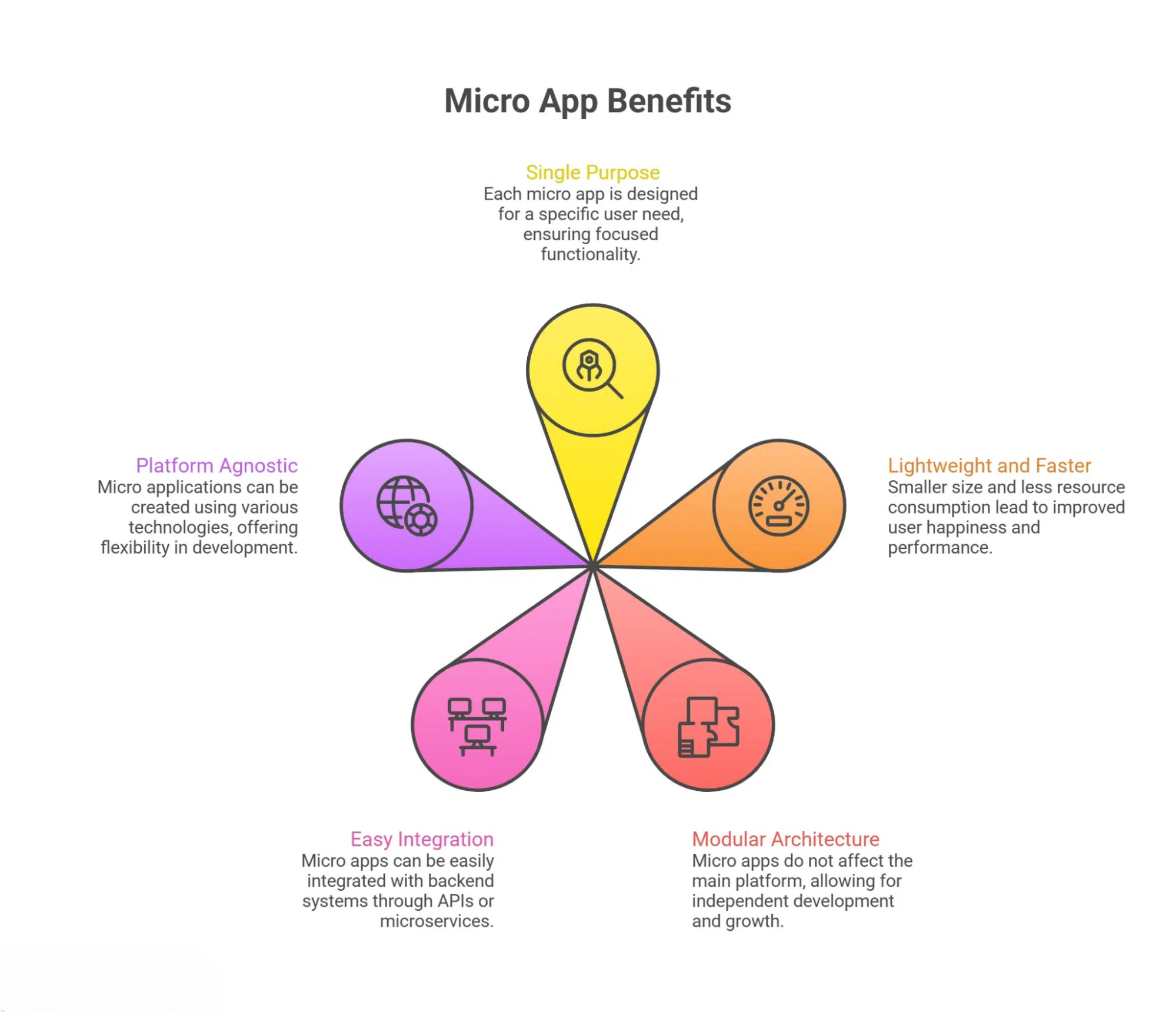
Single Purpose Design – Every micro app designed is for a very specific user need. Whether its checking your bank balance or needing a workflow request, micro apps follow a single purpose design.
Lightweight and Faster – Since they are much smaller and consume less system resources, you do not have to worry about overheads like full scale programs which improves user happiness & performance.
Modular Architecture – They do not impact the functionality of the main platform. Development teams can grow different components of the application ecosystem because of its modularity.
Easy Integration – Micro apps are often a part of a larger container app or digital workspace. They can easily integrate with backend systems through APIs or microservices.
Platform Agnostic – You can use different technologies to create microapplications which range from native mobile frameworks such as Swift to hybrid frameworks like Flutter depending on tech stack.
Technical Architecture Behind Micro Apps
Container (Host) – Micro apps have a container app called the main shell or the host program which users actually install or open. The container app is responsible for loading and displaying what features are present inside the micro app. It holds all the necessary functions such as navigation, layout, theming and shared UI elements. For example, a super app like Grab or WeChat acts as a container where ride-hailing, payments, and food delivery can all run in different UI sections but appears as one experience.
Micro Frontend (UI Module) – Every micro app comes with its own frontend codebase. It’s designed and built independently and often rely on frameworks like React, Vue or Angular. These micro frontends dynamically appear within the container through utilizing technologies such as WebViews, iframes, or JavaScript module federation. For instance, you can launch an e-Commerce super app which might load up “Flash Deals” with a separate micro app for “Order Tracking” without disturbing the system.
Backend to Frontend (BFF) Layer – Almost all micro apps have Backend-for-Frontend service customized to match the specific UI needs of the business for which they are running. It uses multiple backend services to fetch useful data and format it for the frontend. As a result, the micro app functions as a lightweight solution without over-fetching non-usable data or information. The best example is “Travel Booking” micro app with its own BFF feature combining flight data, hotel options & pricing optimized as a single response.
Microservice Backend – In micro app focused systems, business logic is usually distributed into several microservices. Every service has a specific capability like payments, managing user profiles or sending out notifications. Micro apps all only the service required and keep the system loosely coupled. A “Food Delivery” micro app can take orders, show restaurant catalogs and handle delivery without having to access ride-booking services within the same super app. It can only provide services needed.
API Gateways – An API gateway is positioned between the (container + micro app) and backend services working as a single entry point for request. It can manage authentication requirements, rate limiting, handle information routing and sometimes parsing information from the response. For example, a micro app designed for shopping will need product details, whereas the API gateway decides which internal services are needed to call and enforce security protocols before sending data in between.
Authentication & Identity Layers – A central identity system ensures you can access all micro apps without repeating authentication (SSO). It functions through Tokens (like OAuth or JWT) which are issued by a central auth server and trusted across services. For instance, if you are running a super app for banking, a user can open the “Investments” micro app or “Bill Payments” without needing to sign into the app time and again. You can have a single source set for authentication and identity layers altogether.
Shared Data & Storage – Although each microservice has its own specific database, (database-per-service pattern), there’s also shared data environments for setting up user preferences or collecting session info which may appear or live in distributed caches or centralized identity locations. This type of data coupling comes in handy within the database level. For instance, the “Rewards” micro app & the “Payments” micro app both can read basic user profile data from a shared user service. However, both of them own separate transactional databases and run separate logic behind-the-scenes.
CI/CD Pipeline Deployment – Every microapp and microservice has its own specific CI/CD pipeline. It enables independent release without having to worry about redeploying the entire platform. This process is essential in development because it speeds up experimentation and reduces the overall risk. For instance, running the “Promo Campaign” micro app will push a new UI for a holiday sale without risking the super app’s stability or hurting the “Wallet” micro app or “Chat Support” micro app within.
Leading Micro App Trends to Follow in 2026
AI-Powered Micro Apps – Micro apps are getting much smarter with integrated AI, such as chatbots that understand the human context clearly. It provides you with clear insights auto-generated using the generative AI with text/image features, which you can then install right inside the tiny app modules. You can think of it as a travel micro app that recommends hotels based on a specific tone in your messages. Or maybe a finance app that has capabilities to auto-summarize spending trends.
Composable Platforms Everywhere – Microapps will lead the way in 2026 by shifting the monolithic approach to a more composable system. Micro apps are becoming the building blocks that you can arrange, then rearrange and replace as per changing business requirements. You can also update these app types independently, by remixing capabilities such as search, payments, messaging, and other functions across products without rebuilding the entire super app platform & relevant application.
Edge Deployed Micro Apps – The future of micro apps also includes edge-deployed micro apps, which are smaller & much more modular software components that utilize the best computing resources. They contain resources which are physically close, such as data sources, IoT devices & local servers. Instead of using centralized cloud data centers, the edge-deployed micro app architecture reduces latency, improves the overall performance, and provides increased data privacy along with offline functionality.
Contextual Personalization – Contextual personalization is an AI-driven strategy that delivers a tailored experience to users in real time by leveraging specific, situational context. It pulls data from placeholders such as location, device, behavior, or weather, rather than relying on past information. It moves the micro app from a one-size-fits-all segmentation, solving the “multi-armed bandit” problem by instantly delivering a high-converting variant for every individual.
Decentralized Identity & Zero Trust – Today, security models are shifting towards zero trust, which is leading the way in establishing a decentralized identity (DID) for businesses. For micro apps, it means they leverage tokenized credentials, permissioned access, and privacy-first authorization flows. It reduces dependence on adopting a “never trust, always verify” posture. This unique combination helps businesses to identify security challenges head-on before deploying a distributed or cloud-native environment.
What Are the Benefits of Micro-App Architecture?
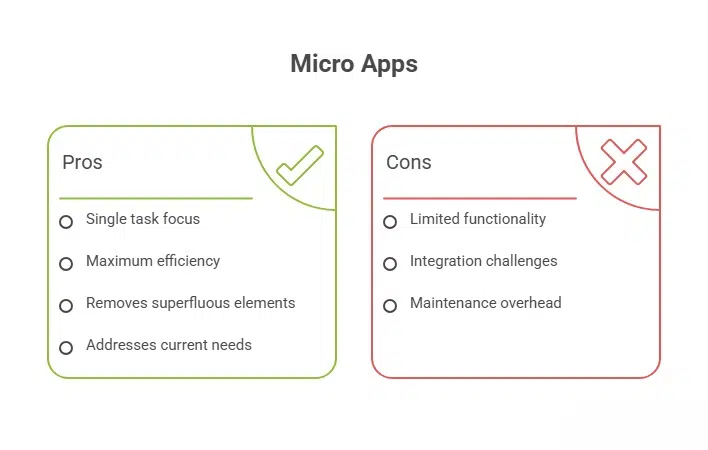
Micro apps come with a range of benefits in order to deliver a clutter-free experience.
The most significant advantage of having a micro-app is that it’s easy to use and update. It’s a reasonable benefit which provides a better overall experience which is faster and much more efficient.
Here are some other noteworthy benefits of micro-app architecture for businesses.
Quick Development & Faster Deployment – Since Micro Apps are single-feature and often focus on a particular aspect of a mobile app, they require less development effort than super apps or traditional app development. You can instantly deploy a micro app within a super app feature without having to worry about how the feature sets will function, whether there will be UI breaks, or whether it will hurt the UX of the ecosystem in which it’s deployed overall. Thanks to the app’s modular design, it creates an easy-to-use interface without requiring a large team of developers to add complex features.
Interested to learn more about Super Apps, we have covered this interesting guide on:
Read More: Why Are Super Apps the Next Big Thing?
Lightweight & Task-Specific Functionality – Micro apps are great because, unlike large-scale or enterprise-grade mobile apps with large backend databases, they are an additional part of the existing super app system, making them a lightweight solution. Users can access and operate the micro app instantly thanks to its lightweight design. Since they offer task-focused functionality, Micro apps deliver an exceptional experience when used as standalone features within a super app environment. Speed and performance are among the reasons all favor them.
A Flawless User Experience – The modular architecture and the simple design of a micro app keep things simple for its users. When someone accesses the complex architecture of a micro app, they create a solution that doesn’t put a customer into an overwhelming experience. The micro app features a relatively cleaner design that users can quickly access when they need and where they need it. Now, you don’t have to sort through irrelevant buttons or links, but can make decisions as soon as possible.
Easy Maintenance & Continuous Updates – Another leading benefit of having a micro app is that you can run it independently on a large system. This is what makes these app types better when it comes to maintenance. Let’s say, if a developer wants to tweak a single aspect of the micro app, for instance, they want to change some elements in the appointment scheduler, they can do it without changing any other aspect of the app within the ecosystem. This capability of maintenance and running continuous updates in a micro app environment is what makes the app’s architecture a dominant one.
Cross Platform Compatibility – One good thing about micro apps is that they are built universally. It means they support different tech types such as HTML, CSS and JavaScript which makes it easier to run them across any platform of choice. So if you want to run a specific micro app in different environments, let us assume you want to run it on phone, computer, tablet or any other platform, you won’t need a separate version. You can simply keep one micro app code and replicate it across platforms for different users & development teams. As a result, you can offer a better & more consistent user experience.
Learn: What is Mobile-First CSS in Mobile App Development?
Real World Use Cases for Micro App Architecture in 2026
Here are some useful, strong real-world use cases of micro app architecture, which you can plug straight into your existing super app systems or existing apps to get the most out of your micro app.
The ideas suggested here are purely hypothetical, and do not have any real-world implementation as of our knowledge. If there’s any similarity to any existing feature set, then we haven’t taken anything from it.
Instant Checkout Micro App – Gone are the days when you had to force users to have a complete shopping experience. They can now cut through the noise by simply using a powerful micro app that handles the essential checkout task at a moment’s notice. The micro app can pull up saved addresses, offer payment methods, and provide shipping options, all via APIs interconnected with the main system at the backend. It lets users complete purchases in a handful of seconds.
Embedded Wallet Micro App – Say goodbye to maintaining a digital wallet with the embedded wallet micro app, an app that acts as your lightweight wallet. Whether it’s booking a ride, sending food out for delivery, or a gaming app experience, you can do all that and much more with a single embedded wallet micro app that is a part of your existing app ecosystem. It gives users a chance to add funds, view balance, make payments, and they can do it all without having to burden themselves with making payments or even opening a separate bank account.
Real-Time Order Tracking Micro App – Are you tired of handling a complete account with an added dashboard? Do you want to open a user account that is compact yet provides you with all the features to perform tracking, show live delivery status, help identify driver location, and provide you with the required ETA along with a support chat? A real-time order tracking micro app can do just that for you. It can connect to logistics, send out push notifications, give users a better focus, and provide a real-time experience.
Event Booking Micro App – The micro app to book your airline tickets, find cinema tickets online, or connect you with the leading event platforms for quick and easy seat selection, ticket upgrade or purchase, or enjoy simple add-ons such as meals, baggage, or VIP access. This micro app will act independently as a core booking engine, but plugs within the same backend services, which allows platforms to upsell. If you’re interested in having an event booked, then this event booking micro app might just be the solution.
Expense Submission Micro App – Are you an enterprise owner, or do you manage administrative tasks for one? Inside every company, there’s an employee portal and a bunch of collaboration tools such as Teams, Slack, Asana, Jira, or other project management solutions. You can integrate the expense submission micro app within these productivity tools to take a quick snapshot of a receipt, auto-extract useful details using OCR, and submit expenses instantly. Now, you don’t need to open a separate module in an ERP system, but can handle everything from a single interface of a micro app.
Appointment Scheduling Micro App – Imagine an app purely dedicated to clinical or hospital platforms where you don’t have to worry about scheduling appointments. The Appointment scheduler micro app can be an add-on for your existing digital experience. Here, you can have a complete dedicated app solely designed for booking, rescheduling, and viewing appointments with the doctors. The micro app is capable of helping you find availability of doctors from the healthcare system, and send reminders to you while maintaining your medical records in a robust and well-organized medical record system.
Quick Assessment Micro App – Think learning platforms that can embed quiz systems or skill check features as micro apps within existing lessons? Yes, that’s how a quick assessment micro app works, offering you a quiz-as-you-go model within your LMS setup. You can fetch useful questions dynamically, grade responses in real-time, and update your learning progress all from a single dashboard without reloading the learning environment time and again.
Customer Support Micro App – Has customer support been giving you a tough time in your existing module? A customer and support micro app can separate the customer support system from your entire ERP setup and handle the essential tasks on your behalf. These features can be chat, ticket tracking, knowledge base search and more without ever having to worry about redeploying an entire product or sifting through tons of data to provide accurate information to customers. Also, a separate entity for support is modular, which means companies can upgrade the support tool at their leisure.
Differences Between Micro Apps vs Progressive Web Apps
People often get confused between Micro apps and PWAs and don’t know which one is which. Let’s start with the core difference between micro apps and PWAs: micro apps are modular building blocks, and they are a part of a very large digital ecosystem. Whereas PWAs are standalone apps or enhanced app versions that behave just like native mobile apps. Here are the rest of the differences between the two:
| Aspect | Micro Apps | Progressive Web Apps (PWAs) |
| Core Concept | • Small, modular applications inside a larger platform • Designed to deliver a single focused function | • Web applications enhanced to behave like native mobile apps • Focused on improving web app performance and usability |
| Primary Goal | • Break large systems into independent, pluggable features • Enable modular product ecosystems | • Make websites feel like installable, offline-capable apps • Improve mobile web experience |
| Architecture Style | • Built on microservices + micro frontend architecture • Independently developed and deployed modules | • Built as a single web app enhanced with service workers and modern browser APIs |
| Deployment Model | • Deployed as separate units within a host (super app, portal, platform) • Can be updated without redeploying the entire system | • Deployed like a regular website • Updates happen when the web app is refreshed |
| Runtime Environment | • Runs inside a container app, super app, or enterprise shell • May use WebViews, iframes, or module federation | • Runs directly in the web browser • Can be launched from home screen after installation |
| Independence Level | • Each micro app can have its own team, codebase, and release cycle • Loosely coupled with other modules | • Typically one unified codebase • Changes affect the whole application |
| Offline Capability | • Depends on host platform and implementation • Not inherently offline-first | • Built for offline or low-network use via service workers and caching |
| Installation Experience | • Usually not installed separately • Accessed within a host platform | • Can be “installed” to device home screen like a native app • Uses web app manifest |
| Use Case Scope | • Best for feature-level experiences (payments, booking, chat, tracking) • Focused and task-specific | • Best for full app experiences delivered via the web (news apps, e-commerce sites, SaaS tools) |
| Scalability Strategy | • Scales by adding more micro apps without bloating the core system • Encourages composable ecosystems | • Scales like traditional web apps • Performance optimizations improve load speed, not modularity |
| Team Structure Fit | • Supports multiple autonomous teams working in parallel • Aligns with domain-driven design | • Usually managed by a centralized frontend team |
| Integration Style | • Deeply integrated with platform services (auth, payments, data APIs) • Communicates via APIs and events | • Integrates like any web app via APIs • Less about internal modular ecosystems |
| Performance Focus | • Performance depends on host + module optimization • Emphasis on lightweight, task-based UX | • Strong focus on fast load, caching, and smooth mobile performance |
| Security Model | • Often relies on platform-wide authentication (SSO, tokens) • Governed by host security policies | • Uses standard web security (HTTPS, browser sandbox, service worker scope) |
| Examples | • WeChat mini programs • Grab in-app services (payments, food, transport modules) • Enterprise portal widgets | • Twitter Lite • Starbucks PWA • Pinterest PWA |
Challenges of Micro App Development
Although micro apps have simple designs, they still have multiple challenges. These can widely range from security issues, balancing performance or scalability in delivering high user satisfaction.
Fragmented User Experience – Micro apps provide simple and easy-to-use solutions for your super app ecosystem. But when you have too many interfaces, it can relatively create confusion for your end-users. You can only make the most out of a micro app environment or ecosystem, when you:
- Use the same typography, fonts and color schemes.
- Keep buttons and menus the same across different apps.
- Connect apps like scheduling and timesheets together.
Integration Challenges – If you’re integrating micro app systems to a legacy system, it can be tricky to deploy because many of the outdated systems don’t know all too well how to communicate with modern apps. There can be many gaps such as the entire system running on old versions or lack of API integration capabilities. A better approach to adding a micro app experience to your existing super app will be to break the integration into smaller chunks. Identify what bottlenecks you’re facing and update sections in ways that do not affect the entire system. You can do it by creating a centralized API to keep all well connected especially when you’re working smoothly on different channels with your micro app.
Security Concerns – The more micro apps you add to your existing super app system, the more vulnerable you will become to open security threats. As a result, you can often end up facing complex issues on multiple connection nodes and the last thing you want is to have your entire digital ecosystem compromised. If you want to maintain the best level of security in a micro app architecture, you can regularly monitor & upgrade APIs to keep things secure. You can also add options like OAuth and two-factor authentication to add security. Last but not the least, keep confidential data encrypted to protect it from cyber breach.
Best Practices for Designing a Micro App Architecture
If you want to make sure your micro app sees the light of day, you need to focus on delivering efficient functionality. Here are some simple but best practices you need to consider when designing a micro app.
Single Use Case Focused – You don’t want to overload the system or have the development team work overtime. Therefore, you need to decide what that one essential task is that your micro app is going to solve for incoming customers. For example, if you’re running a banking app solution, and you’re planning to add a micro app for budgeting, then its sole purpose should be to provide you with budgeting, nothing else. This way, your micro app will be more customer pain-point focused and deliver a much better quality experience without burdening visitors with unnecessary features or an overly complicated user journey.
Maintain Consistent UI/UX – Different microapps offer different benefits, but if there’s one thing you need to address, it’s how well you reinforce your brand identity and build trust among your visitors.
Here are some developmental practices you need to consider to maintain a consistent user experience.
- Use a component library with reusable UI elements to create uniformity across apps.
- Make sure logos, colors, and marketing material all appear consistent across channels.
- Keep layouts, buttons, navigation, menus, and other micro-app items consistent across architecture.
- Continuously, check for design and functionality inconsistencies within the micro app ecosystem.
Focus on Speed & Performance – The only reason for integrating a micro app in a large digital ecosystem is to deliver customers on-the-go use. Therefore, in such digital environments, response time holds significance. To ensure your app works faster, you can use techniques such as lazy loading, which means images or scripts can load only when they are required to be loaded. An alternative to make micro-app architecture workable is to add code splitting, where certain code, like JavaScript, will only run on the backend of a user’s profile when they click it.
Easy Integration with Backend Services – You can integrate APIs in microapps just to make sure they provide real-time data retrieval from the backend. This step is crucial because it helps to reduce duplicated information and improve the overall micro-app architecture’s load time. When it comes to micro apps, designing clear, reliable API documentation is of utmost importance. If you’re investing in one, make sure the documentation is well prepared, so it serves as a guardrail for developers. This way, developers will keep the API version up to date and prevent unexpected app failures.
How Micro Apps are Becoming the Future?
People want solutions, and with the attention span circumference becoming smaller and smaller, they want straightforward interactions especially when they are dealing with a routine task.
Micro apps have become important, now more than ever because there’s a real need for streamlined experiences. A good micro app delivers such interactions on-the-go.
How Micro Apps Are Helping Workforce?
Employees want easy solutions that satisfy their requirements. Today, people are predominantly choosing remote and flexible work environments and micro apps are giving employees the flexibility they expect. Micro apps don’t take you through a complex enterprise system interface to find specific features, but you can access them instantly from a single UI. You can have multiple apps on your screen to manage your routine operations at the workplace. It gives them an edge over employees who are traditionally engaged.
Micro Apps Are Common in Emerging Technologies
In the IoT ecosystem, micro apps are offering customers complete access to control smart devices such as setting the temps on thermostats or managing locks remotely. You can also connect these micro app experiences with technologies like 5G and edge computing. Even if you’re experiencing low connectivity while working in an IoT industrial environment, micro apps are seamlessly designed to deliver services, and help with multiple actions such as track machinery performance, catch system failure & reduce downtime.
Concluding Thoughts
Micro apps are flipping the script on bloated platforms, giving users fast, focused, and friction-free experiences. Brands that embrace modular architecture now will outpace slower competitors tomorrow.
Ready to build smarter, lighter, and future-proof digital products? Branex can help you design your next micro-app ecosystems, a solution that can easily scale up with your ambitions bringing you success.
 Read More Blogs