Most mobile frameworks don’t fail on day one. They fail quietly, month over month.
Believe it or not, only a tiny fraction of mobile apps become financially successful. Research indicates that less than 0.01% of consumer mobile apps achieve sustained commercial viability.
Further reports conclude that 90% of apps fail to survive their first year in the App Store, a mortality rate often rooted in poor architectural choices and performance degradation.
Failure doesn’t show up instantly. It manifests slowly: appearing first in a failed compliance review for a Fintech startup, or as subtle frame rate drops in a mission-critical Enterprise tool.
In 2026, choosing a mobile framework is no longer about following trends or finding a “cross-platform enough” solution. It is about architectural alignment.
Different app categories face radically different constraints; therefore, your mobile framework must be a natural fit for those pressures, not a hurdle to be cleared.
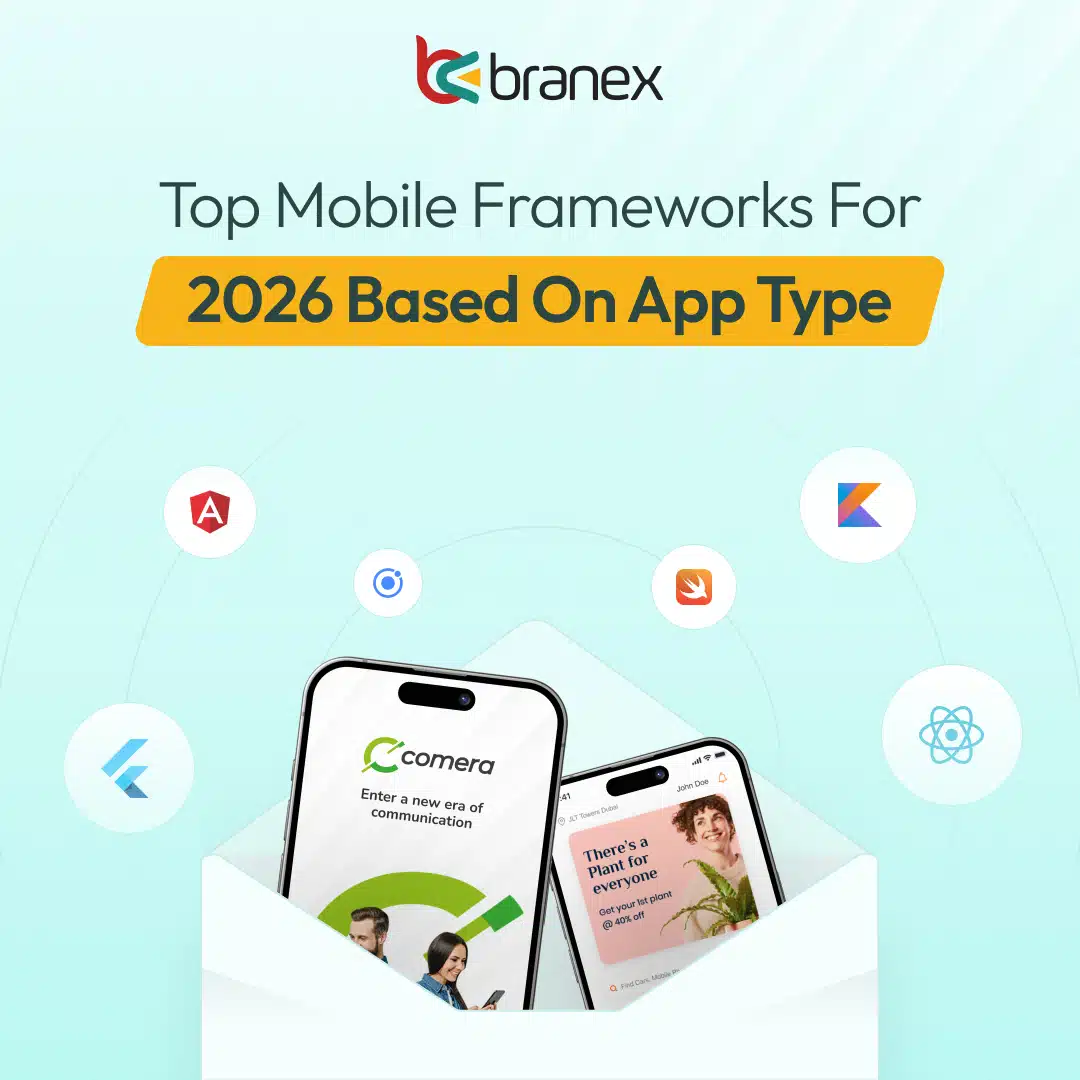
Today, we will dive deep into the leading mobile frameworks of 2026.
What Are Mobile App Development Frameworks?
The reason so many apps fail quietly is often found in their bedrock. Mobile app frameworks create the foundational structures that developers use to build mobile applications. They provide a standard way to deploy applications and simplify the overall development process.
At the core, a mobile app framework is a software library. It’s like a schematic that developers can use to build applications. It establishes the basic flow control and provides specialized functionality for developers, enabling them to design the best applications. Mobile frameworks provide support for applications to handle tasks such as UI design, data management, connectivity, and so on.
It’s what makes them an invaluable tool in the mobile developer’s toolkit.
However, in 2026, the “standard way” is no longer enough; the framework you choose must align with the specific technical rigors of your industry to ensure long-term survival.
Also Read: What Are the Essential Steps to Building a Mobile App?
Top Mobile App Frameworks by App Type
Choosing a framework involves navigating the “Trilemma of Mobile Development”: Performance, Cost, and Time-to-Market.
You aren’t paying for “speed of development”; you are paying for the peace of mind that comes with Hardware-backed Keystores.
If a cross-platform bridge has a vulnerability, your entire user base is exposed. Native eliminates that abstraction layer.
In E-commerce, “Brand is King.” Flutter is the only framework that guarantees your brand’s specific shade of blue and custom button radius will look identical on a $200 Android phone and a $1,200 iPhone.
While Flutter and React Native can “draw” shapes, Unity handles Spatial Math and Physics. For games, the framework isn’t just a UI tool; it’s a world-building engine.
So there’s no one size fits all, each technology stands for its own.
Here is a comprehensive comparison of the top frameworks for 2026, evaluated across the seven most critical metrics for success.
| Framework | Core Language | Performance Tier | Security Architecture | UI Consistency | Dev Speed | Best For |
| Native (Swift/Kotlin) | Swift, Kotlin | Ultra-High | Hardware-Level (Enclaves) | OS-Specific | Moderate | Fintech, Banking, High-Security |
| Flutter | Dart | High | Sandboxed | Pixel-Perfect (Skia/Impeller) | Fast | E-commerce, High-Fidelity UI |
| React Native | JavaScript | High | Bridge-based / JSI | Native Look & Feel | Fast | On-Demand, Social Media |
| Kotlin Multiplatform | Kotlin | High | Shared Logic/Native UI | Native per OS | Moderate | Healthcare, Logic-Heavy Apps |
| .NET MAUI | C# | Moderate | Enterprise-Grade (Azure) | Native Wrappers | Fast | Internal Enterprise, MS Ecosystem |
| Ionic | JS/TS | Standard | Web-Standard | Web-Based | Very Fast | MVPs, Web-to-Mobile Ports |
| Tauri | Rust / Web | High (Smallest Size) | Strict Memory Safety | Web-Based | Moderate | Secure Utilities, Crypto-Wallets |
| Unity | C# | Game-Engine | Proprietary | Canvas-Based | Moderate | 2D/3D Games, AR/VR |
How We Evaluated These Frameworks?
To provide a high-trust evaluation, we didn’t just look at GitHub stars or marketing hype. Our 2026 rankings are the result of a rigorous Multivariate Framework Assessment (MFA).
We analyzed each framework against the actual pressures a production-grade app faces in its second and third years of life long after the “honeymoon phase” of initial development is over.
Our Evaluation Methodology
To earn a spot on this list, a framework had to excel in these five mission-critical categories:
- We prioritized frameworks backed by “Big Tech” (Google, Meta, Microsoft, Apple) or robust open-source foundations. In 2026, a framework is only as good as its patch cycle.
- We looked at the “Fortune 500 Drift,” the rate at which major enterprises are migrating away from or toward specific stacks.
- We explored how well these frameworks handle 2026’s “new normals,” including Edge-AI integration, 5G-native streaming, and Spatial Computing (AR/VR) hooks.
Based on our findings, we have organized the list of frameworks that offer the most resilient foundations for 2026. The following list represents tools that don’t just solve today’s development hurdles but are architected to withstand the silent failures that claim 90% of the market.
Here is how they rank across the industry’s most demanding use cases.
Top Mobile Frameworks for 2026 Based on App Type
1. Fintech & Banking – The “Fort Knox” Approach
Framework: Native (Swift / Kotlin)
In the Fintech world, trust is the only currency that actually matters.
You aren’t just building a pretty interface; you are building a gateway to a user’s life savings.
With the average cost of a financial data breach now soaring past $5.9 million, a single “security glitch” can do more than just crash your app, it can trigger a bank run or land you a massive regulatory fine.
This is why for serious banking, Native is the only logical choice.
Why Native Wins the “Trust War”
Think of a cross-platform framework as a “middleman” standing between your code and the phone’s physical security hardware. Native development deletes that middleman.
By building directly in Swift (Apple) and Kotlin (Android), you get an unmediated, “to-the-metal” line to the device’s most sensitive areas: the Secure Enclave on iPhone and StrongBox on Android.
In the world of high-frequency trading or split-second fraud alerts, Native code executes directly on the processor. There’s no “translation” lag, meaning zero jank when a user wants to move money.
The giants of the “Neo-bank” era didn’t get to the top by cutting corners on their tech stack. Look at Revolut and Monzo, who handle over 40 million global users.
They stick to heavily optimized Native stacks because they prioritize that “Native Feel” – that snappy, instant responsiveness that makes a digital bank feel as solid as a physical vault.
Even Starling Bank uses native apps to ensure their 24/7 real-time accounting features never freeze, no matter how much traffic spikes.
💡 Branex Insider – The Security Audit Reality
“In our 2025-2026 Fintech projects, we’ve seen that compliance with standards like SOC2 or the MAS (Monetary Authority of Singapore) guidelines is much faster with a Native stack. By using Kotlin for Android, we recommend implementing StrongBox Keymaster directly, ensuring that even if the OS is compromised, the user’s private keys remain physically isolated. In banking, ‘Native’ isn’t a performance choice; it’s a legal one.”
2. E-Commerce & Retail – The “Digital Flagship”

Framework: Flutter
In the world of retail, “good enough” is a death sentence. If your app stutters while a user is scrolling through a summer collection, they won’t just close the app, they’ll abandon the brand.
In 2026, retail apps have turned from digital catalogs to high-performance showrooms.
And this is where Flutter has become the go-to for brands that want to look like a million bucks without spending twice the budget on separate iOS and Android teams.
Why is Flutter the Retail King?
The “silent failure” in retail is UI Friction. Most cross-platform frameworks try to “mimic” native buttons and sliders, which often leads to a subtle, uncanny valley lag.
Flutter takes a different path. It uses its own high-speed rendering engine, Impeller, to draw every single pixel directly on the screen at a rock-solid 120Hz.
Whether your customer is on a high-end iPhone 17 or a mid-range Android, your brand looks exactly the same. Flutter doesn’t “wrap” native components; it paints them ensuring your custom “Add to Cart” animations and high-res product carousels are buttery smooth across the board.
In retail, trends move in hours, not just weeks.
Flutter’s speed lets teams experiment with new layout or set up promotional banners. In fact, you can see a code change on your device in under a second, which is why Flutter is best for A/B testing.
💡 Branex Insider – Scaling for High-Traffic Sales
“When building high-fidelity retail apps, our team recommend Flutter’s Impeller engine to eliminate early-frame jank during heavy animations. For one of our e-commerce partners, switching to a Flutter-based custom UI reduced ‘Add to Cart’ abandonment by 15% simply because the experience felt more responsive and tactile on mid-range Android devices, not just flagship iPhones.”
3. Food Delivery & On-Demand – The “Always-On” Marketplace

Framework: React Native
On-demand apps are chaotic. They aren’t just one app; they are three-sided marketplaces where customers, drivers, and restaurant vendors all have to dance in perfect sync.
In 2026, the “silent failure” for delivery apps isn’t just security, it’s staleness. If your menu pricing is wrong or your driver tracking lags by ten seconds, the system breaks.
This is where React Native dominates.
Why React Native Owns the “On-Demand” Space
React Native allows you to build for iOS and Android using a unified JavaScript and React model. But its real “superpower” in 2026 is Agility. While most frameworks require a full App Store submission to change a single line of logic, React Native supports Over-the-Air (OTA) updates, allowing developers to push UI tweaks, new promotions, or set new pricing logic to address thousands of users in an instant.
On-demand platforms live or die by their notifications and live tracking. React Native’s modern architecture (specifically the Hermes engine) ensures that as order statuses flip from “Preparing” to “Out for Delivery,” the data flows across the customer and driver apps without draining the battery.
If you want to see React Native at an Olympic scale, look at the companies that redefined “on-demand.”
- Uber Eats: One of the most famous success stories. Uber used React Native specifically to build their Restaurant Dashboard. They needed a way to give restaurant owners a highly functional, real-time interface that worked perfectly across various tablets and phones. React Native allowed them to ship features to both platforms simultaneously without slowing down.
- Delivery.com: This marketplace giant uses React Native to handle the complex logistics of thousands of local merchants. By sharing over 90% of their codebase, they can scale into new cities and add new verticals (like laundry or groceries) with a lean engineering team.
- Shopify: While primarily e-commerce, Shopify has gone “all-in” on React Native for their mobile apps. They realized that for a marketplace to stay healthy, the merchant-facing tools need to be as fast and flexible as the buyer-facing ones.
4. Healthcare & Medical: The “Scientific Standard”

Framework: Kotlin Multiplatform (KMP)
In healthcare, “consistency” isn’t just a coding preference, it’s a clinical requirement.
If a dosage calculator or a heart-rate monitor behaves differently on an iPhone than it does on an Android, it’s no longer a bug; it’s a medical liability.
It’s where Kotlin Multiplatform has become the surgical tool of choice for 2026 medical apps.
With Kotlin Multiplatform (KMP), you are able to build a “medical brain” while keeping the interface feeling familiar and accessible for every user on the block.
Why KMP is the “Single Source of Truth”
The “silent failure” in medical apps is Logic Divergence. When you write business logic twice (once for iOS and once for Android), you double the chance of a life-critical calculation error.
KMP solves this by letting you share the Core Logic, across both platforms. It means you share data handling, rule validations and medical decision-making.
By sharing the “brain” of the app, you ensure that every patient receives the same data processing and treatment support, regardless of their device. You test the math once, and it’s right everywhere.
From Bluetooth glucose monitors to Apple Health/Google Fit APIs, KMP gives you direct access to the OS. You aren’t fighting a cross-platform “wrapper” when trying to pull data from a life-saving wearable sensor.
The world’s most trusted health tech companies are moving toward KMP to ensure their systems are as precise as their hardware.
- Philips: A global leader in health technology, Philips used KMP to build its connectivity SDK. They needed to ensure that millions of connected medical devices—from baby monitors to heart scanners—communicated identically across all mobile platforms.
- NetVirta: This 3D body-scanning leader used KMP to share 3D math and body-fit algorithms across devices. They saved thousands of development hours by ensuring their complex “fit-scanning” logic only had to be written and audited once.
- Careem (Health Vertical): The “everything app” used KMP to modernize their infrastructure, allowing them to scale health and delivery features across the Middle East with 100% logic consistency between platforms.
💡 Branex Insider – Why Logic Consistency Saves Lives
“At Branex, we recommend KMP for healthcare because it allows us to build a ‘Shared Clinical Brain.’ By writing the dosage algorithms or vital-sign monitoring logic once in Kotlin, we ensure that an Android user and an iOS user receive the exact same medical calculation. This ‘test-once, deploy-everywhere’ logic is our standard for reducing digital health liability.”
5. Enterprise & Internal Business – The “Corporate Workhorse”
Framework: .NET MAUI
Internal business tools don’t need to win design awards; they need to win the “Reliability War.” When a logistics manager is tracking a fleet or a field engineer is auditing a turbine, they need an app that integrates seamlessly with the company’s existing software.
In 2026, .NET MAUI has become the gold standard for organizations that are already “all-in” on the Microsoft ecosystem and need tools that scale without the maintenance headaches.
Why MAUI is the Enterprise “Safety Net”
MAUI isn’t just a framework; it’s a member of the family. It integrates natively with Azure, Microsoft Entra ID (Active Directory), and Power BI. It means implementing role-based access or multi-factor authentication (MFA) isn’t a custom build, it’s a standard configuration.
For internal tools, UI flair is secondary to business logic. MAUI allows teams to share up to 95% of their code across iOS, Android, and Windows. This drastically reduces the cost of supporting field workers who might be switching between a ruggedized Android tablet and a Windows laptop. Unlike trendier frameworks that change every six months, MAUI is backed by Microsoft’s enterprise support lifecycle. For a CTO, this means the app you build today will still be patchable and secure in 2030.
Major industries with “heavy-duty” requirements rely on the .NET backbone to keep their operations moving.
For example, Vestas, the wind energy leader, uses .NET and Azure to run turbine simulators and digital twins. They rely on the framework to ensure their field technicians have identical data on their mobile devices as the engineers have in the office.
NBC Sports Next reimagined their sports management tools using .NET MAUI to deliver faster feature updates across platforms, ensuring their internal teams could manage complex data on the fly.
In fact, many global logistics providers use the NET ecosystem to power their internal scanning and tracking apps. The ability to pull live data from an Azure SQL database directly into a C# mobile app is a massive advantage for real-time supply chain visibility.
💡 Branex Insider – The 2030 Proofing Strategy
“For our enterprise clients, we recommend using .NET MAUI to integrate Azure-backed Edge AI directly into internal logistics tools. This means a field engineer can use their mobile app to run offline predictive maintenance models on a turbine, then sync that data seamlessly back to the corporate Power BI dashboard when they’re back in range.”
6. Web-First & Content Apps: The “Speed-to-Market” Engine

Framework: Ionic
In 2026, not every app needs to reinvent the wheel.
If you are building a content-heavy platform, a social community, or a rapid MVP (Minimum Viable Product), you shouldn’t be fighting the complexities of native code.
You should be leveraging the web.
Ionic is the industry leader for teams that want to turn their web expertise into a high-quality mobile experience without the six-figure price tag of native development.
Why is Ionic the “Shortcut” to Success?
The “silent failure” of many startups is running out of cash before finding market fit.
Ionic prevents this by allowing you to use the languages of the web such as HTML, CSS, and JavaScript to build your app once and deploy it everywhere.
With Ionic, you don’t need to hunt for specialized Swift or Kotlin developers. If your team can build a website, they can build an Ionic app because it’s that easy.
Through its native bridge, Capacitor, Ionic gives you access to essential device features like the camera, GPS, and push notifications through simple, standardized plugins.
It’s “Hybrid” in the best sense of the word: web-fast development with native-like functionality.
Some of the world’s most data-intensive and user-focused brands rely on Ionic.
MarketWatch, the financial news giant, relies on Ionic to provide real-time stock analysis and market updates to millions of users. They have a single codebase, their small dev team was able to double their output and maintain a 4.5-star rating on both the App Store and Google Play.
Similarly, Sworkit who is a leader in the fitness space, Sworkit used Ionic to scale to over 10 million downloads. They famously reported that switching to Ionic cut their development time in half and saved them over $200,000 a year in maintenance costs.
7. Performance Utilities & Lightweight Apps: The “Zero-Weight” Challenger
Framework: Tauri (Mobile)
For years, the trade-off for “build once with web tech” was a massive app size and sluggish startup times.
In 2026, Tauri shattered that narrative.
Originally the “Electron killer” for desktop, its expansion into mobile has given developers a way to build hybrid apps that are impossibly small (sometimes under 10MB) while maintaining a security-first architecture.
Why is Tauri the 2026 “Vibe Shift”?
Tauri is built on Rust, a language famous for memory safety. Unlike other frameworks that give the “web side” of your app full access to the phone, Tauri uses a strict permission system.
You explicitly define what the UI is allowed to touch, making it a favorite for 2026 privacy-focused utilities.
Because it doesn’t bundle a heavy browser engine, Tauri apps launch near-instantly. In a world where users delete an app if it takes more than two seconds to load, Tauri’s sub-second “cold start” is a massive retention tool.
While some hybrid apps can bloat to 100MB+, a basic Tauri mobile app can be as small as 2MB to 5MB. For users in regions with expensive data or limited phone storage, this “lightweight” status is a major selling point.
The CrabNebula team behind many of Tauri’s cloud features uses the framework to build high-security dev tools. They prove that you can have a complex, cloud-synced app that still feels like a tiny, native utility.
In fact, many of the password managers and security firms have been keeping a close eye on Tauri’s Rust-based core. It possesses the ability to handle sensitive encryption logic in a memory-safe language like Rust, while keeping the UI in simple HTML/CSS is the “holy grail” for security-conscious developers.
Also Read: Why is Mobile-First CSS Necessary?
Key Takeaways – Choosing Your 2026 Tech Stack
- 90% of apps fail within their first year, not due to a lack of features, but because of poor architectural alignment. In 2026, a framework that doesn’t fit your industry’s specific pressures (security, speed, or consistency) will eventually lead to “death by a thousand bugs.”
- Using Swift and Kotlin is the only way to eliminate “middleman” vulnerabilities and gain direct, unmediated access to hardware-level security like iOS Secure Enclave.
- Flutter wins in retail because its rendering engine (Impeller) ensures your brand’s UI looks and performs identically across every device at a fluid 120Hz.
- React Native dominates fast-moving markets like food delivery because of its ability to push Over-the-Air (OTA) updates and manage complex, three-sided marketplaces with a unified codebase.
- KMP is the tool of choice for medical apps because it ensures life-critical calculations are written once and run identically on all platforms, reducing medical liability.
- For internal corporate tools, .NET MAUI provides the “Safety Net” of the Microsoft ecosystem, offering seamless integration with Azure and long-term patch support through 2030.
- Ionic remains the fastest bridge from Web-to-Mobile for startups, while Tauri has emerged as the 2026 leader for ultra-lightweight, Rust-powered secure utilities.
Concluding Thoughts
Choosing a framework isn’t a “one-and-done” technical checkbox; it is the foundation of your business’s digital future. In 2026, the gap between a successful app and a failed one often comes down to the expertise behind the code. You need a partner who understands that a Healthcare app requires the clinical precision of Kotlin Multiplatform, while a Retail giant needs the pixel-perfect elegance of Flutter.
At Branex, we don’t believe in “cookie-cutter” development.
We specialize in matching your specific industry constraints with the perfect technology stack. With over a decade of experience and 100+ success stories, our team of IT professionals excels at:
- Building “to-the-metal” security for Fintech and “always-on” logic for Delivery.
- Eliminating “jank” and lag with GPU-accelerated rendering and clean, modular codebases.
- Architecting cloud-native solutions that grow alongside your user base.
Your vision deserves more than just “good enough” tech. It deserves an award-winning team that speaks the language of your industry.
Ready to find the perfect stack for your next big idea? Book Your Free Consultation with Branex Today —
Let’s turn your app concept into a market leader.
FAQs
1. Why do most mobile apps fail within the first year?
Most mobile apps fail not because of missing features, but due to poor architectural decisions. Issues like performance degradation, security gaps, scalability problems, and framework misalignment with the app’s industry requirements often surface gradually and lead to long-term failure.
2. Why is Native development still the best choice for Fintech and Banking apps?
Native development using Swift (iOS) and Kotlin (Android) provides direct access to hardware-level security features like Secure Enclave and StrongBox. This eliminates cross-platform abstraction layers, ensuring stronger security, faster execution, and easier compliance with financial regulations.
3. What makes Flutter the preferred framework for E-commerce and Retail apps?
Flutter uses its own high-performance rendering engine to deliver pixel-perfect UI consistency across all devices. This ensures smooth animations, identical branding, and better user experience, which directly impacts conversion rates and customer retention in retail apps.
4. Why is Kotlin Multiplatform ideal for Healthcare and Medical applications?
Healthcare apps require absolute logic consistency. Kotlin Multiplatform allows developers to write critical medical logic once and reuse it across platforms, reducing the risk of calculation errors, improving reliability, and lowering medical and legal liability.
5. Which framework is best for startups building MVPs or content-based apps?
Frameworks like Ionic and Tauri are ideal for startups and MVPs. Ionic enables rapid web-to-mobile development with minimal cost, while Tauri offers ultra-lightweight, secure apps with fast launch times—perfect for budget-conscious teams and quick market validation.
 Read More Blogs