Imagine spending months building the perfect mobile app.
You launch it, and downloads start pouring in.
But then something unexpected happens.
Your app starts losing users.
Reviews show minor glitches that are ruining the experience.
You check it out…and it’s true.
Surprising as it sounds, you’re not alone.
Data shows that almost 25% of apps get abandoned because of poor user experiences.
We live in a fast-paced digital world full of competition. What’s new at the start of the year can feel outdated by the end. In this environment, users expect apps to just work, flawlessly.
That’s why businesses bring in app maintenance teams. Their job is to keep apps updated and running smoothly. Mobile app maintenance isn’t just about fixing bugs. It’s about keeping users engaged, giving them a great experience, and building a strong brand reputation.
Today, we’re going to talk about how to create a solid app maintenance strategy and explore the different types of app maintenance.
So, buckle up and let’s dive in.
What is Mobile App Maintenance?
Mobile app maintenance is a continuous process. It involves monitoring, updating, and optimizing a mobile application after it has been launched.
This maintenance service is compulsory because it will ensure your mobile app functions correctly and delivers as expected by users.
A maintenance team ensures the app remains stable and up-to-date with the latest technologies and fully compliant with all OS versions.
The process entails fixing bugs, improving performance, updating features, ensuring security compliance, and adapting to new devices and operating system versions.
Mobile app maintenance is a proactive strategy to increase the lifecycle of any mobile app.
The end goal is to protect your business investment.
The Different Types of Mobile App Maintenance
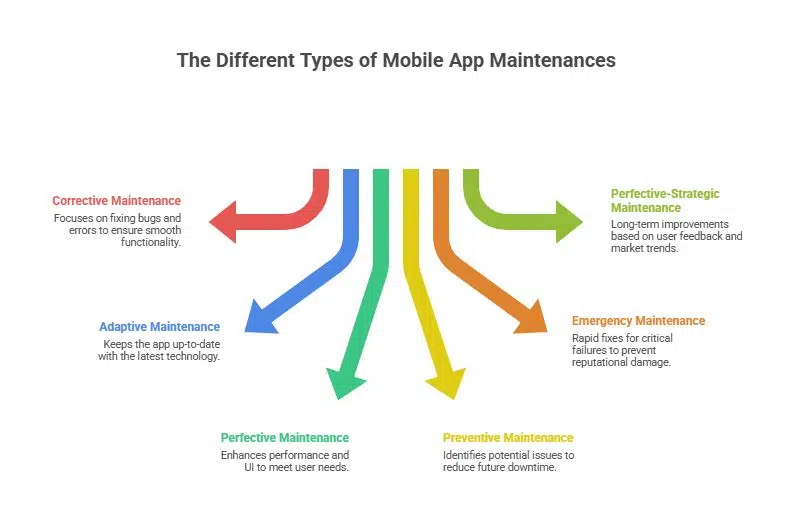
Technically speaking, there are six types of mobile app maintenance available and they are as follows:
Corrective Maintenance – This type of maintenance focuses on fixing bugs, errors, and defects which impact the app’s functionality, directly or indirectly. The purpose of this maintenance is to ensure the app works smoothly and delivers a consistent end-user experience.
Adaptive Maintenance – This maintenance ensures your mobile app remains up-to-date on the latest software and operating system to deliver seamlessly across multiple devices & with third-party integrations. The objective is to keep apps consistent with technology advancement.
Perfective Maintenance – Perfective maintenance enhances mobile app’s performance by adding new features or through improvement in user interface (UI). The goal is to continuously improve the app to meet changing user needs & expectations accordingly.
Preventive Maintenance – This is a proactive maintenance measure where teams identify potential issues before they become a major problem. In this type of app maintenance, the goal is to reduce the future downtime and minimize costly emergency fixes before they take place.
Emergency Maintenance – As the name suggests, these are rapid fixes for critical failures or security breaches which can cause hindrance within app’s overall functionality. The goal is to restore the app’s normal functioning as quickly as possible to prevent reputational damage.
Perfective-Strategic Maintenance (sometimes considered a subset of perfective) – is a maintenance method where long-term improvements are suggested based on user feedback. Data is collected through analytics & from market trends to forecast how to achieve competitive advantage.
Why Mobile App Maintenance is Crucial for Your Mobile Strategy
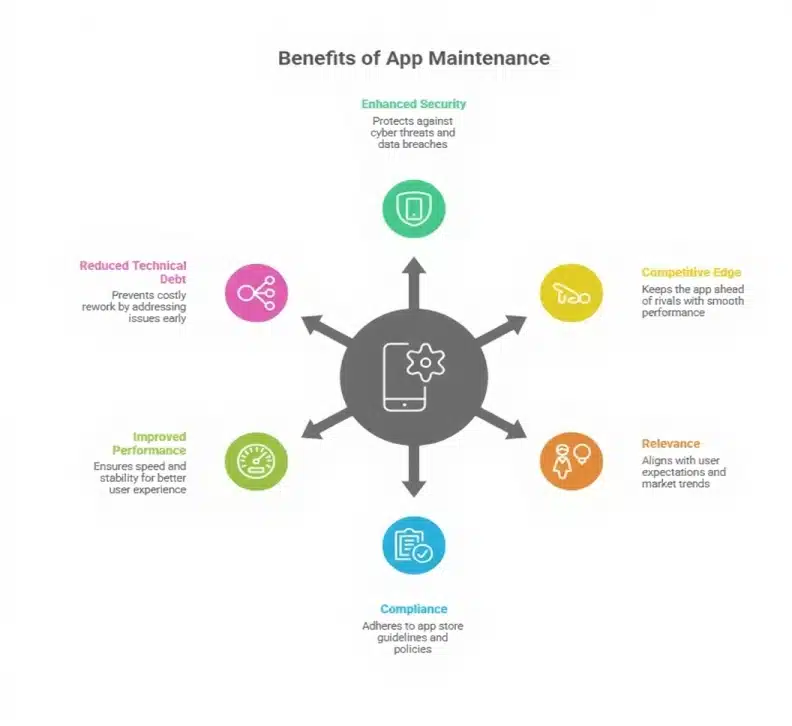
Mobile app maintenance is highly crucial if you want your mobile app to truly turn successful. This is because app maintenance is the backbone of a sustainable mobile strategy, one that keeps your costs under control, your security tight, your users happy, and your app competitive.
You Don’t Want Your App Budget to Bleed Out!
When you own a mobile app, you’re always keeping an eye on where your money goes. An app only has value if it saves you money, not drains it. You see, every time your app goes down, whether it’s a server issue or an application glitch, you lose revenue. Since you’ve already invested heavily in building it, you need a solid team to maintain it.
Having a maintenance team constantly updating, fine-tuning, and applying best practices keeps your app running smoothly with minimal downtime. This proactive approach catches bugs early, prevents users from leaving, and ultimately saves you the money you’d otherwise spend on fixing problems, rebuilding your reputation, or bringing users back.
It Ensures Maximum App Security
Cybercrime is on the rise, and malicious actors are always hunting for entry points. Even when your mobile app follows great security practices, breaches can still occur. That’s why every reliable mobile app development team includes a maintenance unit dedicated to ensuring the app adheres to top-tier security protocols. App maintenance teams implement updated encryption standards, add advanced security features, and ensure every protection measure remains intact. Users are cautious about sharing private information — but with a strong maintenance process behind the scenes, the risk of data leaks becomes minimal.
It Ensures You Remain Competitive
The market is fiercely competitive, and your rivals are always ready to capitalize on any glitch or loophole in your app. To maintain an edge, your app needs preventive and adaptive maintenance routines that keep functionality smooth and performance steady. As new features and technologies continue to enter the market, your responsibility as an app owner is to deliver an app that’s more reliable and error-free than your competitors’. Maintenance helps you achieve exactly that.
It Keeps You Relevant to Your Business
Staying relevant in your audience’s eyes is everything. Customer interests evolve quickly, and users expect their favorite apps to grow with them. This is where consistent maintenance becomes essential. Your maintenance team keeps an eye on emerging trends and ensures your app stays aligned with user expectations and business goals. Regular updates help your app remain fresh, intuitive, and connected to the needs of your consumer base.
It Keeps Your App Compliant with App Store Rules
Apple and Google frequently update their guidelines, regulations, and policies. Falling behind even slightly can put your app at risk. When you have a mobile app maintenance team working behind the scenes, active maintenance will ensure your app meets new requirements before they become a problem. Since both app stores are strict about quality and user experience, staying compliant helps secure long-term success, high performance, and a positive brand reputation.
It Improves App Performance and Speed
If your app is appropriately designed and well-built by a professional mobile app developer, it will degrade over time. However, with the passage of time, device models become more diverse, and there are many third-party API changes that can harm user experience. However, when you opt-in for mobile app maintenance, it helps you with a variety of essential tasks, such as cleaning up old code, optimizing the app for performance, reducing load times, & evenly minimizing crashes. As a result, you get a faster app with higher retention, less user bounce, and an app that barely lags.
It Reduces Technical Debt
Every mobile app experiences technical difficulties. Technical debt can often arise from the use of outdated libraries, deprecated functions, or code that was written in a rush. When you have an app maintenance team in place, it clears up your technical debt piles, which may eventually lead to expensive fixes later on. They also perform time-consuming updates on your mobile app and remove any blocks that may become a hindrance to new feature development & launch.
Regular maintenance, on the other hand, also helps trim the technical debt early, saving your development team from catastrophic rework later.
A Quick Overview of the Essential Maintenance Task
| Maintenance Task | What It Means | Why It Matters |
| Bug Fixes | Identifying and resolving crashes, glitches, and performance issues. | Keeps the app stable and prevents users from dipping. |
| API Updates | Updating third-party APIs, internal APIs, and deprecated endpoints. | Ensures features keep working smoothly as external services evolve. |
| OS Compatibility | Optimizing the app for the latest iOS/Android versions. | Avoids breakage after OS updates and keeps the UX smooth. |
| Security Patching | Applying new security protocols, fixing vulnerabilities, and improving encryption. | Protects user data and shields your app from breaches. |
| UX Improvement | Tweaking navigation, visuals, interactions, and overall usability. | Makes the app feel fresher, faster, and more user-friendly. |
| Database Cleanup | Removing redundant data, optimizing queries, and improving storage efficiency. | Boosts performance and cuts down on loading delays. |
| Third-Party SDK Audits | Checking integrated SDKs for updates, vulnerabilities, or performance issues. | Avoids hidden security risks and keeps third-party features reliable. |
How Often Should You Update Your Mobile App?
Since your app users are expecting the best app experience, you need to make sure the app remains consistently up-to-date. An update is critical right after launching as this will ensure your audience remains content almost all the time while engaging with the mobile app.
Here’s a few ways how mobile apps can be updated:
Regular Updates – If you want to update new features and enhancements, you can schedule a new mobile app maintenance plan.
Bug Fixes & New Features – There’s always certain issues that customers encounter, and it is wise to patch them up as soon as possible.
As Per Requirement – When stakeholders demand a new release and when it has become necessary.
These roll outs often happen around every 2 to 3 weeks. Most of the time, these roll outs happen without the customers experiencing any app setbacks or delays in mobile experience.
Here’s a tabular representation of what type of maintenance is required at what frequencies.
| Task | Primary Focus | Suggested Frequency | Impact on App Performance | Impact on User Experience | Risk if Ignored |
| Bug Fixes | Stability & crash prevention | Weekly / As issues arise | ⭐⭐⭐⭐⭐ | ⭐⭐⭐⭐ | Frequent crashes, user churn |
| API Updates | Smooth functionality with external services | Monthly | ⭐⭐⭐⭐ | ⭐⭐⭐ | Broken features, data issues |
| OS Compatibility | Supporting new iOS/Android versions | Every OS release | ⭐⭐⭐⭐⭐ | ⭐⭐⭐⭐⭐ | Major breakage after OS updates |
| Security Patching | Data protection & vulnerability fixes | Monthly / Critical patches ASAP | ⭐⭐⭐⭐⭐ | ⭐⭐⭐⭐ | Breaches, data leaks, compliance violations |
| UX Improvements | Navigation, design, and overall usability | Quarterly | ⭐⭐⭐ | ⭐⭐⭐⭐⭐ | Poor usability, low retention |
| Database Cleanup | App speed & backend performance | Monthly / Quarterly | ⭐⭐⭐⭐ | ⭐⭐ | Slowdowns, storage bloat, crashes |
| Third-Party SDK Audits | Ensuring SDKs are safe & updated | Monthly / Per SDK update | ⭐⭐⭐ | ⭐⭐⭐ | Security risks, broken integrations |
How Much Does Maintaining an App Usually Cost?
App owners expect to spend around $2,000 to $2,500 every month to make sure the app is running optimally.
The idea is to invest roughly 20% of the total cost which was utilized in the application’s initial development.
For example, if your app costs around $200,000, the cost of app maintenance should be around $40,000 annually.
In case, if the app development supported both Android and iOS, this price can slightly go on the upper end.
However, the overall cost can vary depending on the updates you wish to launch. So once, you create your mobile app and send it out live in the market, you should ensure that it sustains.
Many app maintenance expenses may amount to 40% of the initial development during the first year and can eventually drop anywhere between 15 to 25% within the subsequent years.
The app maintenance cost depends on the service agreement you have with the mobile app development company.
Every company has its own terms for providing after-services.
Therefore, choose the app development partner wisely.
How App Maintenance Prepares You for What’s Next
Winning on mobile isn’t about reading the future.
It’s about making sure your app can pivot the moment the landscape shifts. Regular maintenance keeps your backend fresh, your tech stack agile, and your app ready for whatever drops next.
AI Integration
Regular maintenance keeps your data pipelines, APIs, and backend systems clean and optimized. This is exactly what you need for AI features like recommendations, chatbots, or automation. Without proper upkeep, AI is hard to implement and even harder to scale.
New OS Releases
iOS and Android update every year. Apps that aren’t maintained quickly run into compatibility issues. Regular maintenance ensures your libraries are updated, features stay compliant, and your codebase is clean. This makes adapting to new OS versions smooth instead of chaotic.
Wearables
Smartwatches and other wearables rely on lightweight, optimized apps. Maintenance trims code, updates APIs, and keeps background processes efficient. This makes it easier to extend your app to devices like Apple Watch, Wear OS, and fitness trackers.
Voice and Gesture Controls
Voice commands, gesture navigation, and hands-free interactions only work on apps with modern frameworks and clean UI logic. Maintenance keeps your app ready to support these emerging input methods.
Privacy Regulations
Data laws like GDPR, CCPA, and whatever comes next evolve quickly. Maintenance ensures your app stays compliant by updating permissions, improving data handling, and adding new regulations into your system before they become a risk.
Concluding Thoughts
Keeping a mobile app alive isn’t just about releasing updates. It’s about protecting your investment, staying competitive, and delivering an experience users want to keep coming back to.
A well-maintained app doesn’t just work. It grows with your users, adapts to new devices, and keeps your brand looking sharp.
From catching bugs early to rolling out new features and staying compliant with OS standards, maintenance is what turns an app from “nice to have” into “industry-grade.”
If you’re serious about scaling your mobile strategy, think long-term. Build the app and build the system that keeps it running. Maintenance isn’t an add-on. It is the backbone of everything your app can become. Your app deserves better than “launch it and hope for the best.”
Looking for a mobile app maintenance partner who thinks ahead, not just fixes things when they break? Entrust your app development and maintenance to Branex.
FAQ
Do I really need continuous mobile app maintenance?
Yes. Mobile apps need ongoing updates, bug fixes, and security patches to stay functional, secure, and user-friendly. Without maintenance, apps quickly become slow, outdated, and lose users.
Can I outsource mobile app maintenance instead of hiring a team?
Absolutely. Outsourcing is cost-effective and gives you access to experts who handle updates, security, performance, and OS compatibility — without the overhead of an in-house team.
How much does mobile app maintenance cost?
Costs vary, but most businesses spend 15–25% of the initial development cost annually. On average, that comes to $2,000–$2,500 per month, depending on app complexity and update frequency.
How often should I update my mobile app?
Most apps are updated every 2–3 weeks, or sooner if critical bug fixes, security patches, or OS updates are required. Regular updates keep your app smooth, secure, and competitive.
 Read More Blogs