
In the early days of mobile technology, apps had a single job.
A messaging app was for chatting. A shopping app was for buying. A digital wallet existed purely to pay.
It was simple, focused and unpredictable.
But as we move through 2026, that model feels somewhat outdated.
Today’s users don’t think in terms of apps. They think in terms of moments. People want to order food while chatting. Paying a bill mid-conversation. Booking a ride without switching screens.
Modern digital products are expected to move at the speed of life, and that’s where super apps step in. What started as a regional success has quickly become a global phenomenon.
Super apps are no longer an experiment; they’re a new standard. They are growing at an annual rate of 27.8% and they serve as the primary gateway for daily routine tasks.
Almost, one-third of users worldwide are leveraging super apps.
These apps help them message, shop, and perform transactions through a single ecosystem. It dilutes the friction of app fatigue. More importantly it unlocks personalized experiences.
The benefit? Stronger retention, richer data and longer user engagement.
But building a successful super app isn’t just about stacking features. With development costs ranging from $65,000 to $300,000, the challenge lies in balance and delivering powerful functionality without overwhelming the user.
Today, we will explore the design principles and core components that make super apps work and how to build experiences which feel effortless, human & genuinely useful.
What Are Super Apps?
Super apps are all-in-one mobile platforms which integrate multiple services like messaging, payments, e-Commerce, ride-hailing and food delivery in one single application.
You can create an ecosystem where users don’t have to switch between different apps for daily tasks. They can perform these functions from a single app that’s like a digital mall.
It allows third-party developers to add “mini-apps” in a single ecosystem app.
The idea is to give customers a more personalized experience.
Some of the popular examples of such apps are WeChat and Grab.
What are the Key Characteristics of Super Apps?
Here are some of the core characteristics of a super app.
1. All-in-One Ecosystem
Super apps turn a single application into a digital “Swiss Army Knife.” You can use a single app to perform banking, ride-hailing, and food delivery, all through a single platform. The all-in-one ecosystem removes the friction of users switching in between multiple platforms and managing different accounts. It centralizes and simplifies the user’s digital life by making the app indispensable in daily routine.
2. Integrated Payments
Super apps also come with a built-in payment system or a digital wallet which powers every transaction. As a user, it takes away your worry to re-enter credit card information for different services and ensure you achieve it all through a single tap checkout process. Because the payment layer is native, super apps are very noteworthy and handy for performing peer-to-peer transfers. It also helps with earning loyalty rewards.
3. Mini-Programs/Embedded Apps
Mini-programs are lightweight “sub-apps” which are developed by third-party developers who live inside the main platform. Mini-programs often don’t require a separate installation. Businesses can offer specialized services like booking a movie ticket or setting up a doctor’s appointment directly from the app’s existing user interface. The main app’s file size remains the same while the functionalities can become infinite depending on how much you scale.
4. Data-Driven Personalization
Super apps can observe user behavior across different sectors. They can study customers based on what they buy, where they buy, how they travel, what they treat, etc. Due to its holistic & wholesome view, it takes users deeper into the data pool allowing platforms to serve recommendations. Besides, it understands user behavior, you can set dynamic pricing personalized to individual user habits. As a result, customers get a proactive user experience that often anticipates customer needs before the customer searches up.
5. Unified User Experience (UX)
A super app comes with its own visual language and navigation structure that works seamlessly across different modules. Whether it’s finance or social media, it reduces the learning curve by providing different services function through different buttons, gestures, and menus. A clean unified UX prevents the app from feeling cluttered. Despite its massive range of features, you get a very unified user experience (UX) that makes everything a breeze.
6. Platform for Businesses
Beyond being a tool for consumers, a super app acts as a digital infrastructure where merchants and service providers can set up shop. It provides businesses with instant access to a massive, verified audience and handles the “boring” parts of commerce like security and logistics. Eventually, it creates a powerful network where businesses attract more users and vice versa.
7. Seamless Integration
The true power of a super app lies in the “connective tissue” between its services, allowing a user to move through a logical journey without interruption. For example, after booking a flight, the app might automatically suggest a ride to the airport or offer travel insurance. This flow ensures that separate tasks are linked together into one continuous, logical digital experience.
8. High User Engagement & Retention
Super apps solve a variety of daily problems. They have the capability to become “sticky” which means users return to them almost a dozen times per day. Since the app handles everything from morning coffee to evening utility bills, there’s very little reason for a user to leave the ecosystem. This high frequency of use builds intense brand loyalty and makes the app a permanent fixture on the user’s home screen.
How Does a Super App Work?
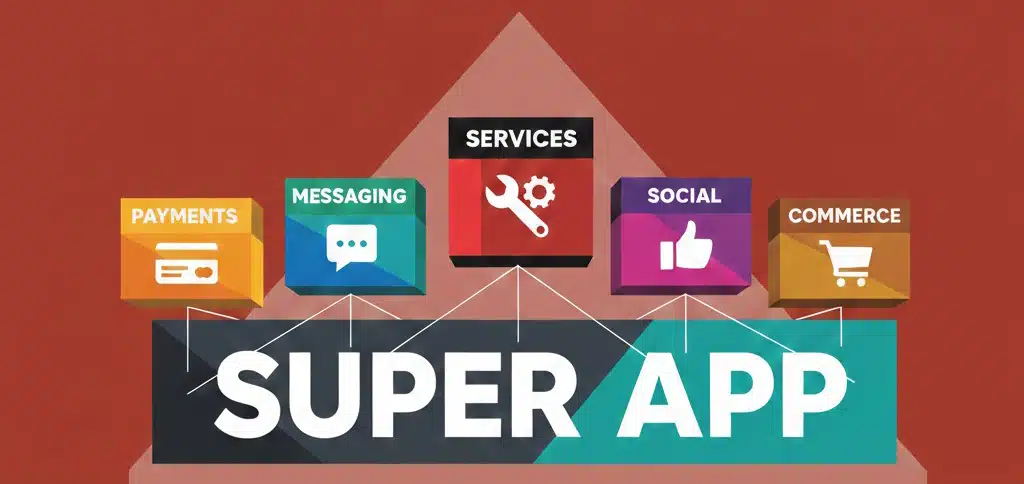
To understand how the Super App works, you will have to look at it as a digital foundation rather than just a single app.
While a normal app is built to do one thing (like order pizza), a super app is built to host an entire city of services.
Technically and operationally, they work through four main layers:
The Modular Architecture
Instead of being one giant, heavy piece of software, a super app uses microservices.
Each feature like payments, chat or ride-hailing works as an independent module.
For example, if the “Food Delivery” section crashes, the “Chat” section keeps working. Everything is powered by a central “Host App” which works as the Hub managing navigation and identity, while these modules plug in and plug out as per requirements.
The “Super” Identity (Single Sign-On)
The “backbone” of the app is a Unified Identity System.
When you log in once, you are authenticated for every service within the app.
Since you use one profile, the app knows your home address for delivery, your work address for a taxi, and your credit card for both without you ever having to re-enter that information.
Mini-Programs (The Open Door)
Super apps often allow third-party companies to build “Mini-Programs” (lightweight apps) that live inside the main interface. Instead of a cinema building their own expensive app and trying to get you to download it, they build a tiny version that sits inside the super app.
You can use these third-party services instantly because the super app provides the payment and location tools they need to function.
The Central Payment Rail
Most super apps started as either a messaging app (like WeChat) or a wallet (like Alipay).
The integrated payment system works as the “glue” that connects every service. It handles the currency exchange, fraud detection, and transaction processing for every module, making the transition from “chatting” to “buying” completely frictionless.
What Are Some Famous Examples of Super Apps?
The “super app” phenomenon is mostly dominant in Asia where different versions have emerged globally. It starts out with one “hero” service (like chat or ride-hailing) before it expands to a complete ecosystem. Here are some of the most famous examples of super apps;
China (The Pioneers)
The Chinese are the pioneers in developing super apps.
WeChat – The world’s first and most successful super app is WeChat powered by Tencent. It started as a messaging tool but now handles everything from utility bills to doctor appointments and beyond. You can even file for a divorce & run millions of “mini-programs.”
Alipay (Ant Group) – Originally the payment arm of Alibaba, Alipay has now evolved into a financial super app. Its functionality goes beyond just transacting payments; it offers insurance, wealth management, and everyday lifestyle services like bike-sharing & food delivery.
Southeast Asia
Grab – Based in Singapore, Grab began as a ride-hailing app (the “Uber of Southeast Asia”). It has since expanded into GrabFood (delivery), GrabMart (groceries), and GrabPay (financial services), serving eight countries across the region.
Gojek – Indonesia’s biggest success story. It started as a call center for motorcycle taxis (ojeks) and grew into a platform offering over 20 services, including GoSend (logistics), GoClean (house cleaning), and even GoMassage (on-demand massages).
India
Paytm – Initially a mobile recharge and wallet app, it became a massive financial ecosystem offering banking, stock trading, flight bookings, and e-commerce.
Tata Neu – A newer entry from the Tata Group that consolidates their vast empire—from groceries (BigBasket) and electronics (Croma) to flights (Air India) and hotels (Taj)—into one loyalty-driven interface.
Latin America & The Middle East
Rappi – Often called the “everything store” for LatAm, this Colombian app delivers food, medicine, and groceries, while also offering banking services through RappiPay.
Careem – Originally a ride-hailing rival to Uber in Dubai, it was acquired by Uber and transformed into a super app that provides bike-sharing, laundry services, and food delivery across the region.
Uber – By integrating Uber Eats, grocery delivery, and public transit tracking, it is attempting to become a “one-stop-shop” for mobility and logistics.
What Are the Benefits of Super Apps?
User Convenience
Super apps combine a lot of things under a single roof which eliminates the need for users to download & switch between multiple apps.
As Statista puts it, almost 80% of smartphone users in Asia are already using super apps daily, citing convenience as the primary reason.
Better Customer Engagement
According to a HootSuite study, super apps engage customers 40% more frequently than single-function apps which ultimately boosts brand visibility and increases customer loyalty.
It indicates that super apps can offer better overall customer engagement.
Data-Driven Personalization
Super apps centralize user behavior across services—payments, browsing, bookings, and communication—creating a unified data ecosystem.
McKinsey reports that companies leveraging advanced personalization see up to 15% higher revenue and 20% increased customer satisfaction, making super apps uniquely positioned to deliver hyper-relevant experiences.
Lower Customer Acquisition Costs
By offering multiple services within one platform, super apps cross-sell internally instead of relying on external acquisition channels.
According to Bain & Company, increasing retention by just 5% can boost profits by 25–95%, highlighting how super apps reduce CAC while maximizing lifetime value.
Seamless Ecosystem Lock-In
Super apps become daily utilities rather than occasional tools, embedding themselves into users’ routines.
A study by Accenture shows that ecosystem-based platforms retain users 2× longer than standalone apps, as switching costs increase with deeper service integration.
Faster Go-To-Market for New Services
Launching new features inside an existing super app eliminates the friction of onboarding users from scratch.
Deloitte notes that platforms with an established user base can introduce new digital services 30–40% faster than greenfield app launches.
Operational Efficiency at Scale
A unified infrastructure for authentication, payments, support, and analytics reduces redundancy and operational overhead.
PwC estimates that platform consolidation can reduce operational costs by 20–30%, enabling businesses to scale more efficiently.
Stronger Brand Authority
Super apps position brands not as service providers, but as indispensable digital partners.
According to Edelman’s Trust Barometer, brands that deliver consistent, high-utility digital experiences are 1.6× more likely to earn long-term consumer trust.
FAQs
What is a super app used for?
A super app is used to access multiple digital services (such as payments, messaging, shopping, ride-hailing, bookings, and financial services) within a single platform. It eradicates the need to download multiple apps by offering a unified, all-in-one user experience.
Which apps are considered super apps?
Well-known super apps include WeChat, Alipay, Grab, Gojek, Paytm, KakaoTalk, and LINE, as they combine multiple services like payments, commerce, communication, and third-party integrations within one ecosystem.
What makes an app a super app?
An app becomes a super app when it integrates multiple standalone services into one platform, supported by a shared login system, payment infrastructure, and consistent user experience. It typically allows third-party services to operate within the app through APIs or mini-programs.
Is a super app safe to use?
A super app is generally safe to use when it follows industry-standard security practices such as end-to-end encryption, secure payment gateways, multi-factor authentication, and compliance with local data protection regulations. Security ultimately depends on the platform’s architecture and governance.
Is WhatsApp a super app?
WhatsApp is not a full super app, as it is primarily a messaging platform with limited integrated services and does not offer a broad ecosystem of third-party functionalities.
How to delete apps super fast on a smartphone?
You can delete apps quickly by long-pressing an app icon and selecting “Uninstall,” or by using bulk app removal options available in your device’s app management settings.
What are the benefits of using a super app?
Super apps offer greater convenience, reduced app clutter, faster access to services, and a more easy to follow digital experience by centralizing multiple everyday functions into a single application.
Concluding Thoughts
Super Apps aren’t just winning because they do more, they are winning because they do less thinking on behalf of the user. We are living in a world where attention is fragmented and time is of the essence. The most successful digital products are the ones that disappear into daily life. Super apps achieve this by shifting mobile UX from task completion to moment orchestration.
As we move deeper into 2026, super apps will continue to redefine user expectations. They won’t be judged by how many services they offer, but by how effortlessly they become a part of our everyday life. The brands that succeeds will be those that understand the simple truth:
“The best user experience isn’t the one users notice – it’s the one they rely on without thinking.”
 Read More Blogs