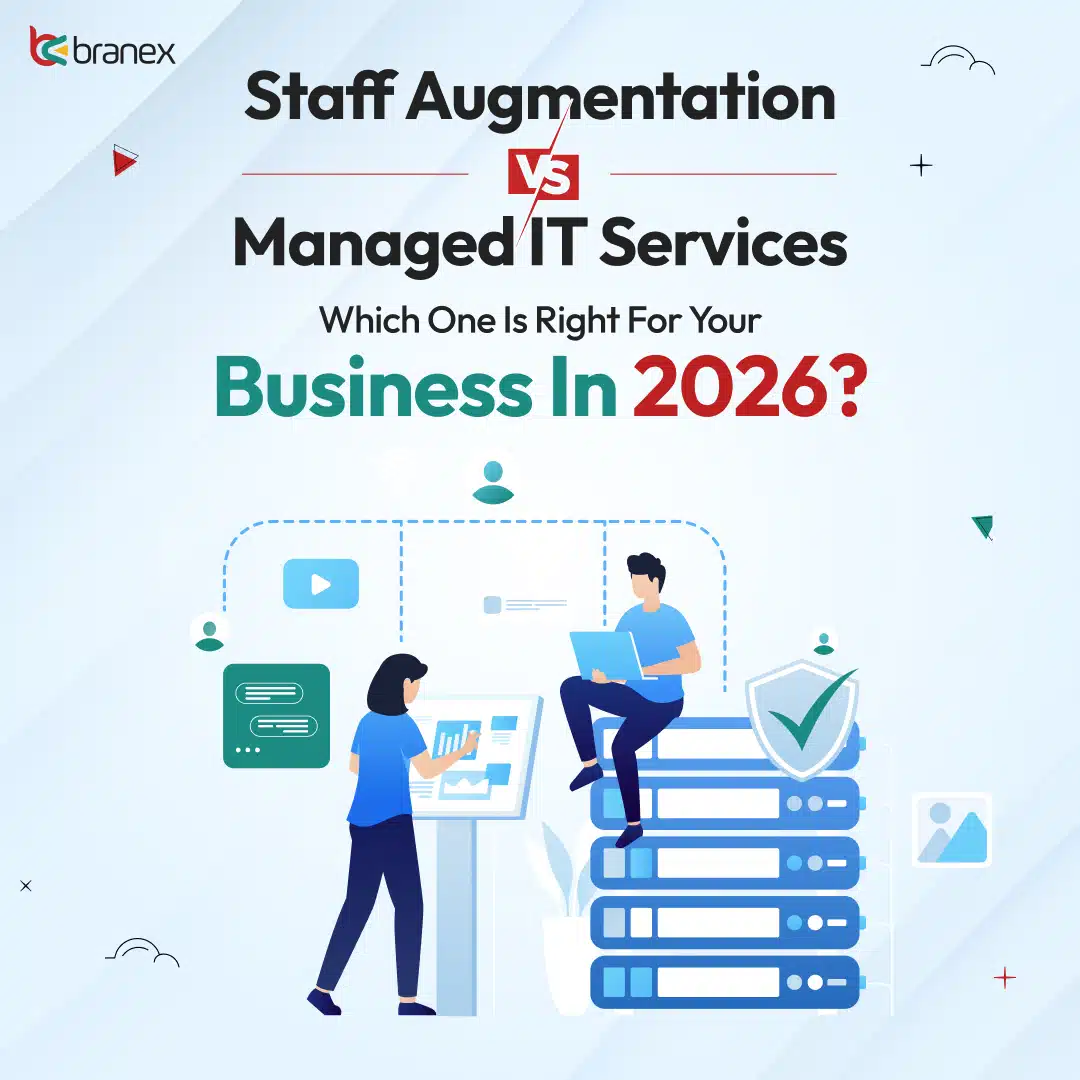
Staff Augmentation vs Managed IT Services – Which One is Right for Your Business in 2026?
Stuck choosing between staff augmentation or managed IT services? Let’s help you understand the differences so you can pick the right model.
The managed IT service is expanding exponentially, redefining how businesses operate. In 2023, the managed service market was valued around $270 billion and it’s set to surge past $878 billion by the end of 2032. These numbers aren’t just representing a growth pattern, but they’re showing an actual paradigm shift.
On the other hand, we have staff augmentation. The global IT staff augmentation market is valued at approximately $300 billion in 2023. And, it is projected to reach a total valuation of $857.2 billion by 2031, a compound annual growth rate (CAGR) of roughly 13.2%.
With such numbers hitting the horizon, it often becomes difficult for businesses to decide which option is the most suitable for their particular business.
In this article, we will discuss staff augmentation vs. managed IT services.
We will explore which option best serves businesses and how an enterprise or an SMB can enjoy long-term benefit choosing the one that serves them effectively.
How to Decide Whether You Need Staff Augmentation or Managed IT Services?
If you’re confused between staff augmentation and managed services, ask: Do you want more hands or a guaranteed result?
The fundamental difference between staff augmentation and managed IT service is who manages the work and who is responsible for the outcome.
Staff Augmentation provides “hands to perform the job”, while managed services provides you “the solution itself.”
Key Differences at a Glance
| Feature | Staff Augmentation | Managed IT Services |
| Who Manages? | The Client (You) | The Provider (MSP) |
| Responsibility | Client is responsible for results | Provider is responsible for results |
| Focus | Specific tasks and skills | Strategic outcomes and SLAs |
| Cost Model | Usually hourly or daily rates | Monthly subscription or fixed fee |
| Knowledge Retention | Stays with the client’s team | Stays with the provider |
| Scope | Flexible and task-oriented | Clearly defined in a contract |
What is Staff Augmentation?
Staff augmentation is a strategy where you (as a company) hire experts from outside to join your internal work culture for a temporary period. They become a part of your in-house existing team and work alongside you as a full-time employee, but they aren’t employed as a part of your company’s internal task force. They work with you to provide services as a third-party service provider for clients associated with your business. Once their contract terms end, and the client’s objective or goal is achieved, the company will remove you.
In the staff augmentation model, you (the company) manage the augmented staff as if they were your own. You assign them tasks and oversee project progress. The real objective in the staff augmentation model is to create focused teams to fulfill a specific skill gap.
For example, your company offers digital marketing services, but they are limited in their scope of providing services for a specific technology. You use a CRM like HubSpot to manage your sales cycle and client retention strategies, and a client walks in demanding expertise in Go-High-Level. As a company, you entertain the client’s request by providing a resource from the external pool (augmented staff) to join the in-house marketing team and deliver the required service. Until the client continues and does not close the contract, the augmented staff will work temporarily.
What is Managed IT Services?
Managed IT services, on the other hand, means a complete handover of an internal responsibility to a third-party agency to handle it on your behalf. For example, you can hire a managed IT service provider to take care of your cloud infrastructure and cloud service management. Or you can onboard them to take care of your cybersecurity setup, or you can have a managed service provider (MSP) handle your help desk support.
In a managed IT service model, the MSP is responsible for managing people, processes, and technology. It means you don’t manage individual workers; instead, the company ensures the third-party agency is held accountable for meeting specific Service Level Agreements (SLAs). In managed IT services, you’re paying for the results, not the hours worked.
MSPs typically focus on long-term business stability. They don’t just offer preventive strategies; they actually delve deep into fixing the problems for your business.
How to Choose the Right Model for Your Business?
Selecting the right model for your business is a strategic decision. It heavily depends on your budget, project delivery, and internal workload. To decide which framework is best for your business, your leadership team needs to follow these six critical steps.
Step # 1 – Assess the Problem
Your first step is to find the problem that you wish to resolve.
If your problem is something that can be resolved by hiring an extra helping hand, then staff augmentation will be sufficient enough to provide you that resource. However, if you think the complexity of the problem goes far deeper and an extra hand will not be sufficient, you will then have to choose a third-party managed IT service to take over.
Here’s a pro tip – if your problem is task-oriented, go with staff augmentation. If it’s result-oriented, choose managed services.
Step # 2 – Check the Bandwidth
Be honest, how much internal team bandwidth can you afford, because staff augmentation will require you to onboard external workers just as you would hire internal employees. Managed services, on the other hand, wouldn’t require you to take care of the management.
If you have in-house managers, the preferred time and infrastructure to oversee daily operations, then staff augmentation will be the best route. However, if your management team already has their hands tied, managed services will be a safer bet.
Step # 3 – Analyze the Timeline
Check with the timeline and consider how long it will take for you to complete the project.
If it’s a temporary surge in your work for which you need an individual to handle and take care of things for a short span like (3-6 months or an year), staff augmentation sounds like a feasible choice.
But if your need is long-term (and you will require ongoing services) then managed services can provide you with continuous operational support. You can have a multi-year partnership and accomplish far more better results.
Step # 4 – Check Budget & Pricing
Both models will have very different financial impacts on your business.
The staff augmentation team often bills you based on the hours they serve. So the best thing about working with an augmented staff is that you only pay for what you hire them to do. These costs can change, especially if a project takes longer or becomes overly complex.
Managed IT services typically follow a fixed monthly subscription model. You already have a ball-park figure knowing that they will charge you a certain price every month which altogether makes it easier for long-term financial planning and budgeting.
Based on what you can afford and for how long, you can hire one of the two to help you with your business duties.
Step # 5 – Check Risk & Accountability
It’s important to assess who you want to hold responsible if things go south.
In the staff augmentation model, you own the project so as management, it will be your decision and responsibility to call the shots. If you feel the augmented staff isn’t performing too well, you can replace them with someone else whenever and however you feel comfortable.
With managed IT services, the service provider is often bound by a contract to meet Service Level Agreements (SLAs). If they don’t meet the service level agreement, they may be subjected to financial penalties or meet the company’s specific request.
Which Model is the Right One to Choose (And When)?
- Choose Staff Augmentation if: You have a strong internal management structure, need to fill a temporary skill gap, or want full control over how a project is executed.
- Choose Managed IT Services if: You want to offload the burden of IT management entirely, need predictable monthly costs, or want a partner who takes full responsibility for system performance and security.
Concluding Thoughts
The choice between staff augmentation and managed IT services isn’t about which model is superior, but one that meets your immediate goals and long-term vision.
In 2026, specialized talent is scarce and technology is moving at breakneck speed — whether you’re figuring out your development roadmap or comparing top industry providers like mobile app development leaders for strategic insights.
Want to overcome a niche skill gap in AI or cloud deployment? Staff augmentation can be your best bet. Need an end-to-end cybersecurity setup deployed by managed IT services?
Whether you’re looking for a staff augmentation team or a full-scale IT managed service partner, Branex is here to power your next move with the talent, tools, and tech leadership.
 Read More Blogs