Mobile apps aren’t just products, they’re the heartbeat of modern life.
We’ve long viewed offshore development as the engine room of the global economy: a way to cut costs, move 40% faster, and fill the talent gaps of Silicon Valley.
And we have always believed the world’s most sophisticated mobile ecosystems are designed in the West only to be exported in the East.
However, this notion has not entirely been preached true.
When U.S. markets were perfecting single-purpose apps, developers in Asia and Latin America were pioneering “Super Apps,” the digital Swiss Army knives that handle everything.
They have spent the last decade solving problems of scale, connectivity and hardware constraints that Western developers are only just beginning to experience.
Offshore is not only limited to finding someone to build your idea, it’s bringing the world’s best minds straight into your team to solve the challenges of the next decade.
They are importing the future of UX and architecture from the very markets that were once considered “secondary.”
The Evolution of Offshore Development
To better understand where mobile innovation is taking us, let’s have a look at where it all started.
Offshore development was one simple cost-saving tactic which many countries considered as a fundamental global product pillar. However, it has now undergone a radical transformation.
1. The Era of Execution (1990s – 2005)
In the early days, offshoring was purely transactional.
Western companies sent rote, repetitive tasks like back-office data entry and simple maintenance to teams in India or Eastern Europe. The goal was arbitrage, it was a dream of doing the same work for 70% less.
In this era, the offshore team was the “hand,” but the “head” stayed firmly in the West.
2. The Era of Integration (2006 – 2020)
As cloud collaboration tools matured, the relationship shifted to Managed Services.
Companies began trusting offshore partners with entire lifecycles.
Whether it was QA testing or cross-platform mobile builds, we saw the rise of the Dedicated Development Center (DDC), where offshore talent became an extension of the local team, working in Agile sprints.
This era proved that offshore teams could deliver quality, not just quantity.
3. The Era of Innovation (2021 – 2025+)
Today, we have entered the age of Strategic Partnerships.
With the global IT outsourcing market projected to hit $151.9 billion in 2025, the focus has changed from “How much can we save?” to “How much can we learn?”
- Domain Leadership: Offshore hubs in Latin America and Southeast Asia are now leading the world in Fintech and Super App architecture. They are solving problems of scale and offline connectivity.
- The AI Surge: In 2025, over 30% of global IT outsourcing is driven by specialized needs in AI & ML, skills that offshore hubs have aggressively refined often outpacing the local market.
Why Mobile Development Thrives Offshore?
The shift towards offshore development isn’t just a trend, it is a structural response to the growing mobile ecosystem.
Here’s why some of the most ambitious apps are now designed across borders:
Niche Mastery at Scale
While local talent pools often see a “war for generalists,” offshore hubs have become centers of excellence for specialized mobile disciplines.
We see hubs in Eastern Europe and India have become the global “R&D labs” for frameworks like Flutter and React Native.
They let businesses target iOS and Android simultaneously without doubling the budget.
And with the introduction of Edge AI (processing data on-device), offshore teams in regions like Vietnam and Poland are integrating lightweight machine learning models into mobile apps to add a layer of personalization.
Here’s a breakdown how some of the primary offshore hubs are utilizing key technologies to create business impact in specialized mobile niche.
| Specialized Mobile Niche | Primary Offshore Hubs | Core Strength | Key Technologies | Business Impact |
| Cross-Platform Engineering | Eastern Europe, India | Framework-first architecture thinking | Flutter, React Native, Kotlin Multiplatform | One codebase, faster launches, lower burn |
| AI-Native Mobile Apps | Vietnam, Poland | On-device intelligence & personalization | Edge AI, TensorFlow Lite, Core ML | Real-time UX without cloud latency |
| Mobile Fintech Security | Ukraine, Estonia | Secure-by-design mobile systems | Biometric auth, encryption, PSD2 APIs | Trust, compliance, reduced fraud |
| Scalable App Architecture | India, Romania | Long-term performance planning | Clean Architecture, MVVM, Microservices | Apps that don’t collapse at scale |
| Super App Development | Southeast Asia (Indonesia, Vietnam) | Multi-service mobile ecosystems | Modular SDKs, in-app wallets | Higher LTV, ecosystem lock-in |
| Mobile Health & Wearables | Poland, Czech Republic | Sensor-driven, regulated builds | Bluetooth LE, HealthKit, FHIR | Data accuracy + compliance |
| AR-Driven Mobile Experiences | Ukraine, Serbia | Real-time rendering optimization | ARKit, ARCore, Unity | Differentiated, immersive UX |
| Mobile DevOps & CI/CD | India, Latvia | Automation-first delivery pipelines | Fastlane, Bitrise, GitHub Actions | Faster releases, fewer rollbacks |
| Performance Optimization | Belarus, Lithuania | Deep system-level tuning | Memory profiling, CPU/GPU tuning | Lower churn, better app ratings |
| AI-Powered QA & Testing | India, Philippines | Predictive testing & coverage | Automated UI tests, ML-based QA | Fewer bugs, shorter test cycles |
The “Sun Never Sets” Development Cycle
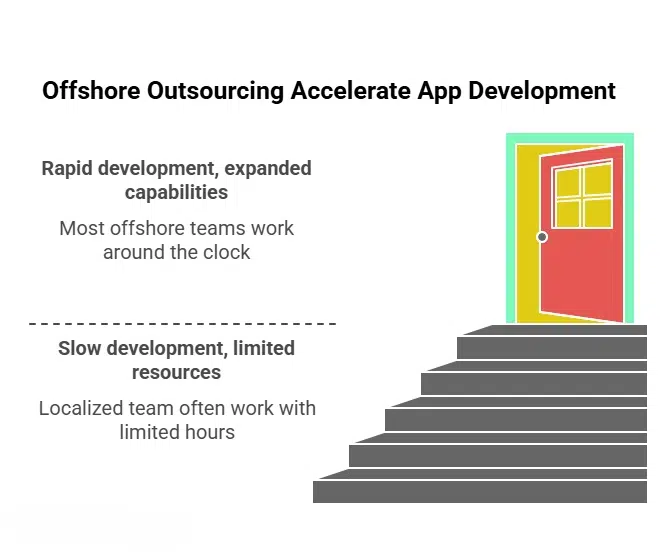
If we are talking about the app economy, the most valuable currency is Time-to-Market.
Offshore development creates a 24-hour production loop which a localized team simply cannot match.
While a New York-based product manager sleeps, a team in Manila or Bangalore is performing QA, fixing bugs discovered during the day, and pushing code. Offshore Outsourcing mainly leverage time-zone offsets, letting companies to effectively compress a six-month roadmap into four months.
It allows them to capture more markets before the competitor can.
The “Quality-Value” Paradox
The old narrative claims you had to choose between, “cheap” and “good.”
If they went cheap, they hired a low-cost dev shop to slap together a basic iOS app. It worked… until users hit crashes during peak hours, maps lagged, and adding features meant rewriting half the codebase.
So technically, you hired a team who was cheap but didn’t deliver as per expectations.
The new reality is that offshore hubs often provide higher quality because of their talent density.
In Silicon Valley, developer tenures are notoriously short. In emerging tech hubs, developers often stay with projects longer, leading to better institutional knowledge and cleaner long-term codebases.
Simultaneously, developers in “mobile-first” economies (like Latin America) have a native understanding of low-bandwidth optimization and intuitive UI, telling apps are high-performing even in sub-optimal conditions.
It tells us the advantage has quietly moved. Quality in mobile development isn’t just limited to individual brilliance anymore; it’s about systems, context, and continuity. It’s banked on distributed centers of excellence quietly outperforming legacy tech capitals.
Case Study: How WhatsApp Scaled to 450M Users with 50 People?
When WhatsApp was acquired by Facebook for $19 billion in 2014, the tech world was stunned by one metric: the company had only 55 employees to support nearly half a billion users.
In its early days, founders Jan Koum and Brian Acton didn’t have the capital to compete for high-priced engineers in Mountain View. Instead, they turned to a team of developers in Russia to build the core functionality of the app. What the founder did was he kept “business” (customer support and operations) in the U.S. and sent the “technical heavy lifting” offshore.
This offshore team was responsible for the app’s legendary reliability. They utilized Erlang, a specialized programming language known for handling massive concurrency, which allowed WhatsApp to scale to millions of messages per second with a skeleton crew.
At the time of acquisition, WhatsApp had a ratio of 1 developer for every 10 million users, an industry record. When competitors were bogged down by massive overhead and local hiring cycles, the offshore-centric model gave the company an edge to dominate the global messaging market before anyone else. They launched a world-class product on a startup budget, and the founders achieved one of the largest tech acquisitions in history.
The WhatsApp story is the “North Star” for modern mobile development because it proves that offshore isn’t just for maintenance. It’s for building the core, high-performance architecture that defines a billion-dollar company.
Case Study: How Expensify Automated Fintech with a Strategic Global Team
Expensify is the #1 expense reporting solution in the U.S., processing billions of dollars for over 60,000 companies. But the core function of the app, the ability to scan a receipt and have it instantly reconciled with a bank account, requires a massive, complex back-end which must work 24/7 across thousands of different global banking institutions. When Expensify needed to scale, they faced a choice: hire a massive, expensive team in San Francisco to maintain the “scrapers” (tools that pull data from bank websites) and “parsers” (tools that read receipt data), and ultimately find a specialized partner for deployment.
They chose a strategic offshore partnership to build and manage their Core Back-End Systems.
Because every bank has a different website architecture. If a bank changes its login page, the Expensify app breaks. It requires a dedicated & specialized team to monitor, update & secure integrations.
Similar to WhatsApp, Expensify kept its core “Vision and Strategy” in-house but moved the high-complexity and high-maintenance technical engineering to an integrated offshore team.
A team of just 14 dedicated offshore developers was able to manage the entire back-end for millions of users, allowing Expensify to remain a lean, high-margin company.
The Major Benefits of Investing in Offshore Outsourcing for Mobile Development
Significant Cost Optimization
Cost remains a major advantage when it comes to outsourcing mobile app development.
When you outsource to regions which have a lower cost of living (such as South Asia, Eastern Europe or Southeast Asia), businesses can often reduce development cost down to 40% and even up to 70%.
It saves you office space, hardware cost, software licenses, and employee benefits. It also saves you health insurance coverage cost and 401K, an employer-sponsored retirement savings plan in the U.S.
Similarly, a senior developer in North America may cost $150/hour while an equally skilled developer in an offshore hub might only cost around $30 to $50/hour.
You can only pay for the hours worked on a project which ultimately saves you cost on “idle time.”
As a result, you don’t have to pay any full-time in-house salary.
Access to a Global Talent Reservoir
When you’re hiring people in-house, it often limits you to a 50-mile radius. Offshoring removes geographic barriers, letting you tap into specialized expertise that might be scarce or too expensive at home.
For example, if you need specific experts in Ai, blockchain or emerging frameworks like Flutter or React Native, offshore hubs often have deep & pre-vetted pools of these incredible specialists.
Many offshore firms are ISO-certified and follow strict global compliance standards such as GDPR or HIPAA, which ensures the quality of the final product meeting international benchmarks.
“Follow-the-Sun” Productivity
One of the most underrated benefits is the 24/7 development cycle created by time zone differences.
While your local team sleeps, the offshore team continuously works round-the-clock. For instance, a U.S. based product team can hand off feature requirements at the end of their workday to an offshore team & by the time they log back on their system the next morning, the offshore team has already implemented the features, fixed bugs, and shared updates accordingly. This way, you can save up an entire day of progress, often reducing the app launch from months to just weeks, with a successful release.
Operational Scalability and Flexibility
Mobile app needs can change over time.
For instance, you need 10 developers to develop the app, only 2 to work on maintenance tasks later on.
With rapid scaling, offshore partners can ramp up a team in days, whereas hiring internally can take up to months. For example, if a startup suddenly needs five mobile developers to meet an investor deadline, an offshore partner can assemble and deploy a ready team within a week, while in-house hiring would require weeks of interviews, negotiations, and onboarding before any real work begins.
Similarly, if you need to switch from a native iOS app to a cross-platform solution mid-project, offshore agencies often have different internal resources to swap team members without hiring crisis. For example, a product team pivoting to React Native after early user feedback can immediately replace iOS-only engineers with cross-platform specialists, keeping development moving instead of pausing.
Focus on Core Business Strategy
When you offload the technical “heavy lifting” to an external partner, your leadership team can stay focused on what actually grows the company.
You can spend your energy on marketing, user acquisition, and investor relations. For example, instead of sitting in daily standups or debugging release issues, founders can run growth experiments, close partnerships and prep investor decks while the offshore team builds, tests and deploys.
Offshore teams let you focus on the “why” and “what” of the app while the offshore team handles the “how.” For instance, product leaders can spend time validating features with users and refining the roadmap, while the external team makes decisions for architecture, code & infrastructure.
Cost Comparison Between In-House and Offshore Team
This table will show the exact cost estimate and the financial advantage offshore team provides;
| Attribute | In-House Team | Offshore Team | Impact / Notes |
| Hourly Rate / Salary | $100–$150/hr (senior dev in US) | $30–$50/hr (experienced offshore dev) | Direct savings of 60–70% per developer. |
| Recruitment Costs | $5,000–$10,000 per hire | Minimal (included in service fee) | Offshore partners maintain ready-to-go talent pools. |
| Onboarding & Training | 2–4 weeks | Immediate (internal knowledge available) | Reduces downtime and accelerates project start. |
| Employee Benefits | Health insurance, 401K, PTO, other perks (~20–30%) | Usually included in service fees | Major savings on overhead costs. |
| Hardware & Software | Laptops, monitors, dev tools, licenses | Provided by offshore provider | No capital expenditure for equipment or software. |
| Office Space | Dedicated workspace, utilities | N/A (remote / provider-managed) | Saves on rent, electricity, and facility costs. |
| Project Management Overhead | PM + Scrum Master salary + internal reporting | Often included by offshore provider | Reduces overhead of managing individual developers. |
| Scalability | Hiring additional staff can take months | Can ramp up in days | Flexible response to sudden workload spikes. |
| Quality & Retention | Shorter tenures, risk of turnover | Higher retention in mature offshore hubs | Ensures long-term institutional knowledge and cleaner codebase. |
| Time-to-Market Impact | Limited to local working hours, slower iterations | 24/7 development cycle via time-zone advantage | Speeds up launch, reducing overall product development lifecycle. |
Challenges You Experience with Offshore Mobile App Development
Communication Gaps
Timezone differences can often delay feedback. For example, a developer in Manila finishes a feature at the end of their day, but the U.S. product manager doesn’t review it until 12 hours later, slowing down feedback cycles. Cultural or language barriers may cause misalignment of requirements or design nuances. For instance, a UI element labeled “Submit” may be misunderstood in translation, or context loss. However, this can actually be fixed with clarification and rework.
Coordination Overhead
When you’re managing multiple teams across geographics, it requires a strong project management team to overview everything. Companies need separate project managers to run daily standups with teams located in California, India, and Poland that require multiple sessions to accommodate time zones. It might make standups, sprint planning and hand-offs a bit heavier than working with a local team. However, a simple fix by the offshore QA team might need extra documentation for onshore developers.
Hidden Costs
There are many hidden costs such as travel allowances, onboarding costs or workshop costs which can all add up. For example, a U.S. company may need to fly to Vietnam for a two-week alignment workshop, costing thousands in flights and accommodations. When you integrate offshore processes with onshore systems you often require extra tools or middleware. Just adding middleware to sync code repositories or project management tools between teams can increase software licensing costs.
Quality Inconsistencies
Not all offshore talent is equal, some may require additional training to meet your global standards. Certain offshore engineers require effective training on your specific tech stack or meeting code standards. Code review cycles, on the other hand, may require stricter standards to maintain consistent quality. Because when you’re working with offshore teams, they can often leave subtle bugs unidentified in payment flows or security features which will require additional cycles by an in-house tester.
Security & IP Concerns
Sensitive data may require extra encryption or legal protections. Therefore, handling healthcare or financial data with offshore teams may require HIPAA or GDPR compliant servers and encryption protocols. This leads to securing effective IP ownership, NDA enforcement, and regulatory compliance. For example, a U.S. startup sharing proprietary algorithms with an offshore partner needs clear NDAs and legal frameworks to prevent ownership disputes.
Concluding Thoughts
Offshore outsourcing is no longer a cost-saving tactic, it has turned into a strategic advantage. Offshore outsourcing leads to global talent acquisition, time-zone efficiency and accessing a specialized team of expertise where companies can scale faster, innovate smarter and focus on what drives growth.
The future of mobile development is borderless, and the smartest teams are building it together.
Don’t let geography limit your ambition.
Tap into global talent with Branex’s offshore and staff augmentation solutions.
Build Your Team Now.
 Read More Blogs